
Table of Contents
Introduction
Drying clothes indoors sounds simple until the rack is actually opened. A structure that looked compact beside the washing machine may suddenly block a doorway, make it difficult to reach a cabinet, or occupy the only clear area in a small apartment. Once wet towels, shirts, trousers, and bedding are added, the problem becomes less about owning a drying rack and more about managing an entire temporary drying zone.
An indoor folding clothes drying rack needs to work differently from equipment that spends most of its time on an open balcony or in a dedicated utility area. Indoors, the rack shares space with people, furniture, ventilation, heating, and everyday movement. The best design therefore does more than fold flat. It needs to create useful drying capacity without making the room uncomfortable while laundry is present.
That makes indoor drying a space-planning problem as much as a laundry problem. Where the rack opens, how air moves around it, what happens to room humidity, and where the structure goes afterward all determine whether the product actually improves daily life.
Indoor Drying Changes the Rules
Outdoor drying can borrow space from a balcony, terrace, or garden. Indoor drying usually cannot.
A rack opened in a living room immediately becomes part of the circulation route. In a bedroom, it competes with wardrobes and beds. In a bathroom, it has to coexist with higher humidity and limited floor area. In a laundry room, it may interfere with appliance doors or storage cabinets.
For that reason, the useful size of an indoor folding clothes drying rack is not simply its maximum width.
The more important question is whether people can continue using the room while the rack is loaded.
A 150 cm-wide structure may work perfectly in one home and feel oversized in another. Furniture position, door swing, walking routes, windows, air vents, and available storage space all change the result.
Indoor rack selection should therefore begin with a room plan rather than a capacity number.
The Room Becomes Part of the Drying System
Once wet laundry moves indoors, the surrounding room affects drying performance.
Air needs to move around garments, and moisture released from fabrics enters the indoor environment. The U.S. Environmental Protection Agency notes that hanging wet laundry can contribute to indoor moisture and that poor ventilation allows humidity to remain elevated. Its indoor-air guidance emphasizes moisture control and adequate ventilation as important parts of maintaining indoor conditions.
This means an indoor drying rack should never be evaluated in isolation.
A rack positioned beside an openable window may behave very differently from the same rack placed in a closed corner. A heated room with reasonable circulation creates different conditions from an unventilated bathroom. Garments packed tightly together may remain damp longer even when the rack itself offers many rails.
For a broader explanation of how moisture behaves in indoor air, the humidity overview on Wikipedia provides useful background on relative humidity and water vapor.
Good indoor drying therefore depends on three things working together: the rack geometry, garment arrangement, and room environment.
A Folding Rack Should Create a Temporary Zone, Not Permanent Clutter
The best folding products change the character of a room only temporarily.
Imagine a small spare bedroom. On laundry day, a folding rack opens near the window and creates enough surface for shirts, trousers, and towels. Several hours later, the laundry is removed, the rack folds flat, and the room returns to its normal use.
That transition is the real benefit of folding.
If the structure remains awkward after collapsing, leans dangerously against a wall, or requires a large cupboard just for storage, much of that advantage disappears.
A useful indoor folding clothes drying rack should therefore be judged in two states:
| Rack State | What Matters Most |
|---|---|
| Open and loaded | Stability, airflow, access, usable drying area |
| Partially loaded | Ability to use only the space required |
| Fully folded | Thickness, balance, carrying convenience |
| Stored | Whether it fits naturally into an existing home space |
This approach is more realistic than judging a rack only from its expanded dimensions.
Where the Rack Opens Matters as Much as How It Folds
Indoor homes contain many spaces that appear empty but are poor drying locations.
Opening a rack directly against a wall may reduce airflow on one side. Positioning it beside a wardrobe can prevent doors from opening. Setting it beside a bed may make movement difficult. Placing it too close to soft furnishings can make the room feel crowded even when there is technically enough floor area.
The best position usually provides three things at once: room for people to move, reasonable air circulation, and enough clearance for garments.
This is why a narrower rack with better positioning can outperform a larger rack placed poorly.
For small apartments, the ability to relocate the rack also matters. A portable folding model can move closer to a window during drying and return to storage afterward. That mobility is one of the strongest reasons floor-standing folding racks remain useful even as ceiling-mounted systems become more advanced.
Bedrooms, Bathrooms and Laundry Rooms Need Different Solutions
“Indoor” is not one environment.
A bedroom usually offers more floor area but may need the rack to disappear completely after use. A bathroom provides convenient access to laundry and water-resistant surfaces but can already have relatively high moisture levels. A laundry room may be the most logical drying location but is often crowded with machines, cabinets, sinks, and household supplies.
The indoor folding clothes drying rack therefore needs to match the room.
In a bedroom or living area, appearance and folded storage dimensions can matter almost as much as drying capacity. A slim structure that fits behind a door may be more useful than a larger multi-tier rack.
In a laundry room, door clearance becomes critical. A rack should not prevent a front-loading washing machine from opening or block access to storage.
Bathrooms require particular attention to ventilation and floor conditions. If the room is small and already humid, simply adding more wet fabrics can make drying less comfortable unless air movement is adequate.
There is no single ideal indoor rack layout because each room imposes different constraints.
Sometimes the Better Folding Solution Moves Up Instead of In
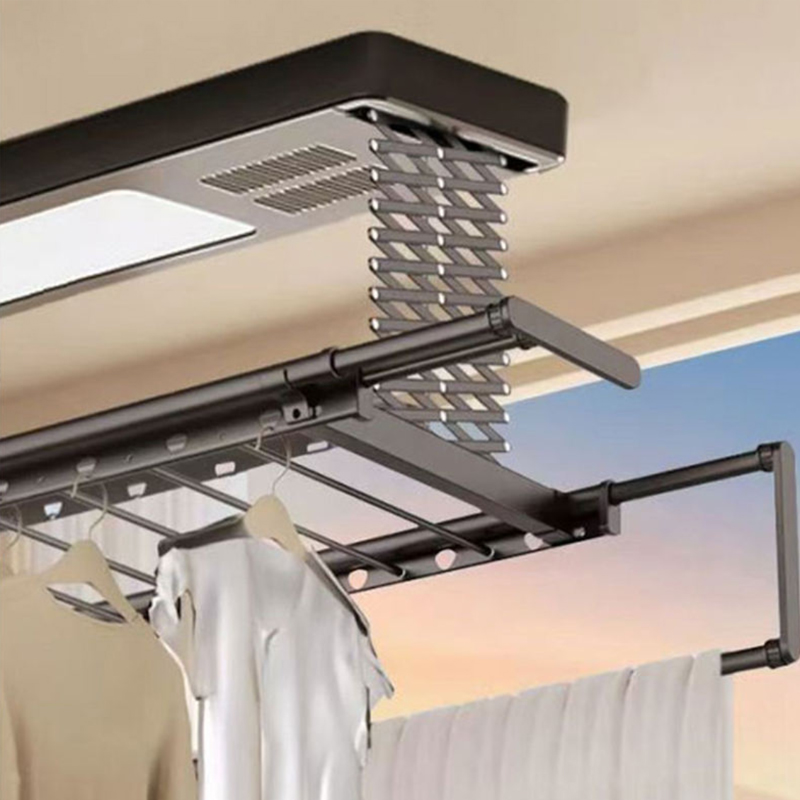
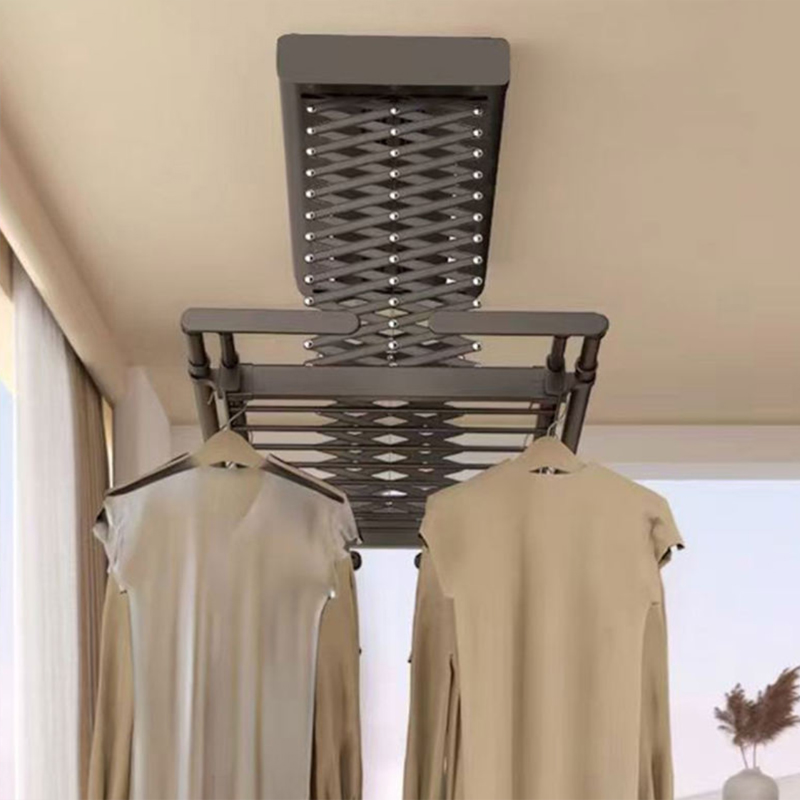
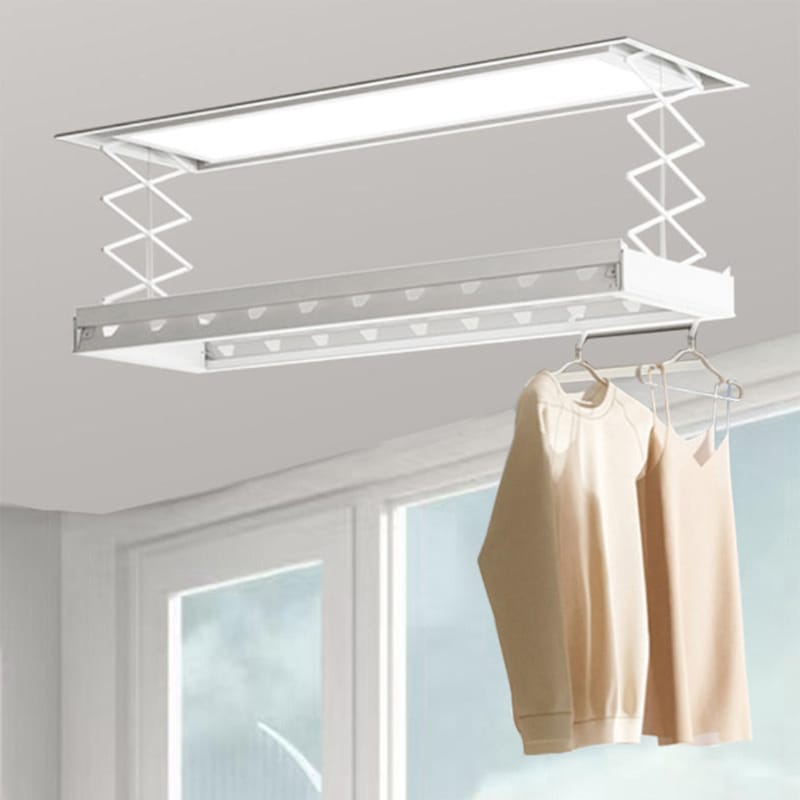
Floor racks solve space problems by folding after use. Ceiling systems solve the same problem differently: they remove the drying zone from the floor.
This distinction becomes important in homes where the rack needs to remain available but floor space is extremely limited.
A ceiling-mounted system can be lowered to a comfortable position for loading and then returned overhead. Instead of carrying and storing a frame elsewhere, the user changes its vertical position.
YIHUI’s Electric Ceiling Drying Rack 8828 demonstrates another variation through retractable poles. The poles can extend when additional drying width is needed and return inward when that capacity is unnecessary. The principle is useful for indoor planning because capacity does not have to remain permanently at its maximum size.
This does not make ceiling systems automatically better than portable folding racks.
It simply shows that “folding” and “space saving” can be approached through different kinds of movement.
Indoor Folding Should Follow the Laundry Load
Many racks are designed around maximum capacity, but households rarely operate at maximum capacity every day.
A small wash might contain several shirts and lightweight garments. Another cycle may include bath towels. Bedding may require long uninterrupted sections. Children’s clothing creates many small items rather than several large ones.
An effective indoor folding rack should adapt to this variation.
If one wing can remain closed during a small load, the rack occupies less floor space. If side sections can open independently, users can create capacity only where necessary. If hanging bars accept clothes hangers, shirts can occupy vertical space instead of requiring multiple horizontal rails.
This adaptability is especially valuable indoors because unused drying capacity still occupies room.
A rack that can match its physical footprint to the laundry load is often more practical than one that forces the user to open the entire structure every time.
More Rails Can Actually Make Indoor Drying Worse
Rail count is easy to measure, so it often becomes a prominent specification. But maximum rail count does not necessarily equal maximum usable capacity.
When too many garments are placed close together, airflow around the fabrics becomes restricted. Thick towels can block air reaching smaller garments behind them. Long clothing may overlap lower tiers. Large pieces folded over narrow rails can create multiple layers of wet fabric.
Indoors, where natural wind is usually weaker than outdoors, spacing becomes particularly important.
Instead of filling every available rail, a better strategy is to arrange laundry according to fabric thickness and garment shape. Heavier items benefit from more exposed surface area. Shirts can often hang efficiently on hangers. Small pieces can use clips or dedicated sections rather than occupying full-length rails.
The rack should make this organization easy.
Useful indoor capacity is therefore not simply how many garments can physically fit. It is how many garments can be positioned reasonably while allowing the room and rack to support drying.
Large Towels Are a Better Test Than T-Shirts
A rack can look stable when holding lightweight shirts and still perform poorly with wet towels.
Wet household textiles introduce both weight and surface area. A large towel concentrates load across a limited section of the structure and can restrict airflow around nearby clothing. Bedding creates an even more difficult combination of width, weight, and overlap.
For this reason, anyone evaluating an indoor folding clothes drying rack should look beyond idealized product photographs filled with lightweight garments.
Consider what the household actually washes.
Can a bath towel hang without touching the floor?
Can trousers be positioned without overlapping lower rails?
Does one heavily loaded wing make the frame lean?
Can a sheet be spread across enough width to avoid excessive layering?
These practical questions reveal much more about rack usability than maximum garment counts.
Floor Contact Deserves More Attention Indoors
Outdoor racks are often evaluated for wind stability. Indoors, the relationship with the floor becomes equally important.
Smooth tile, laminate, vinyl, and wooden flooring can behave differently beneath a loaded rack. If the feet provide insufficient grip, opening a heavy side wing may cause movement. If leg geometry is narrow, uneven loads can make the structure feel unstable.
Floor protection matters as well.
The rack should not scratch sensitive flooring when moved or leave marks where it remains loaded for long periods. Feet and end caps are small components, but indoors they influence the daily experience significantly.
A rack may have excellent drying capacity and still feel poorly suited to a home if moving it repeatedly damages the floor or requires excessive care.
When a Floor Rack Is No Longer the Best Answer
Portable folding racks are highly practical, but there is a point at which repeatedly opening, loading, folding, and storing them becomes less convenient than using a permanent overhead system.
This often happens in households that air-dry clothing almost every day.
If a rack is opened six days a week, the theoretical benefit of folding it away may rarely be realized. It may simply remain standing in the same room because putting it away becomes another task.
That changes the space calculation.
For frequent indoor drying, a ceiling-mounted system can keep the drying function permanently available without permanently consuming the floor. YIHUI’s Electric Hanger 8868 uses motorized height adjustment and is specified for home use, illustrating how indoor drying can shift from portable furniture toward installed laundry equipment.
The decision therefore depends partly on frequency.
Occasional drying favors portability. Daily drying can make permanent vertical solutions more attractive.
A Small-Apartment Example Shows the Trade-Off Clearly
Consider a one-bedroom apartment with no dedicated laundry room.
The washing machine sits in the bathroom. There is no outdoor balcony. The living room has the best ventilation, but the occupants do not want laundry equipment visible throughout the day.
A large tower rack may offer excellent capacity but dominate the living area while open. A small wing rack stores easily but may require several drying cycles for larger laundry loads. A ceiling system keeps the floor free but requires a suitable installation position.
There is no universally correct answer.
The best option depends on how often laundry is washed, where the rack can be stored, which garments are typically dried, and how long the household can tolerate the drying area occupying the room.
This example shows why indoor drying is not simply a product-selection problem.
It is a household workflow problem.
For Indoor Use, Convenience Happens Before and After Drying Too
Much of the attention goes to the period when clothes are hanging on the rack. Yet indoor convenience begins before the first garment is placed and continues after the last one is removed.
How far does the rack need to travel from storage to the drying location?
Can one person carry it comfortably?
Does it unfold without moving furniture?
Does the locking mechanism engage naturally?
After drying, can it be folded without removing detachable components?
Can it stand securely while stored?
These steps occur every laundry cycle. A minor inconvenience repeated several times per week can become more significant than a feature that is rarely used.
For indoor folding products, the entire sequence matters:
storage → opening → loading → drying → unloading → folding → storage.
A good rack makes every stage predictable.
What Distributors Should Test for Indoor Applications
For distributors and product developers, indoor folding racks should be tested in realistic rooms rather than only on an open factory floor.
A large empty testing area can hide problems that become obvious inside an apartment.
Place the rack beside a wall. Test it near a washing machine. Open a nearby door. Load only one wing with wet towels. Move it across smooth flooring. Fold it while standing in a narrow space. Check how thick it becomes when stored vertically.
These simple tests reveal whether the design actually matches indoor use.
The most relevant evaluation points include operational footprint, stability under uneven loads, joint behavior, rail spacing, floor grip, folded thickness, and ease of movement.
A product intended for indoor households should feel designed around rooms rather than simply designed around laundry.
Conclusion
An indoor folding clothes drying rack succeeds when it creates a useful drying area without permanently taking ownership of the room.
That requires more than a frame that collapses. Indoor performance depends on where the rack opens, how people move around it, whether clothes receive reasonable airflow, how the structure behaves under wet loads, and where it disappears once the laundry is finished.
Portable folding racks remain particularly useful for households that need flexible drying locations or cannot install permanent equipment. Ceiling-mounted and retractable systems provide another solution for homes where floor space is limited or drying happens frequently.
The right choice is ultimately shaped by the room itself.
A well-planned indoor drying solution should support the laundry routine while allowing the home to return naturally to everyday life afterward.
FAQ
Where is the best place to use an indoor folding clothes drying rack?
A suitable location should provide enough room around the rack, reasonable ventilation, convenient access, and minimal interference with doors, furniture, or household movement.
Does drying clothes indoors increase room humidity?
Wet laundry releases moisture into indoor air. Adequate ventilation and moisture management are therefore important when clothes are regularly dried inside.
Is a multi-tier rack better for indoor drying?
Not necessarily. Multi-tier racks can provide more hanging positions within a smaller footprint, but garment spacing and airflow should also be considered.
Is a ceiling drying rack better than a folding floor rack indoors?
Each solves a different problem. Floor racks provide portability and require little installation, while ceiling systems preserve floor area and can be more convenient for frequent drying.
What dimensions matter most for an indoor folding rack?
Both open and folded dimensions matter. The open footprint determines whether the room remains usable during drying, while folded thickness and height determine whether the rack can be stored conveniently.
Need Help Choosing the Right Indoor Folding Clothes Drying Rack?
If you’re comparing indoor folding clothes drying rack designs for apartments, laundry rooms, or other compact residential spaces, our team can help you evaluate drying capacity, storage footprint, installation conditions, and everyday usage needs. Contact us today to discuss a drying solution that fits naturally into the way the room is actually used.





