
Table of Contents
Introduction
The washing machine has finished its cycle, but the laundry job is only halfway complete. Wet shirts need somewhere to hang, towels need enough open area to release moisture, and larger items may demand much more width than the household normally uses. In a small apartment, finding that drying space without turning the balcony or utility room into an obstacle course can be surprisingly difficult.
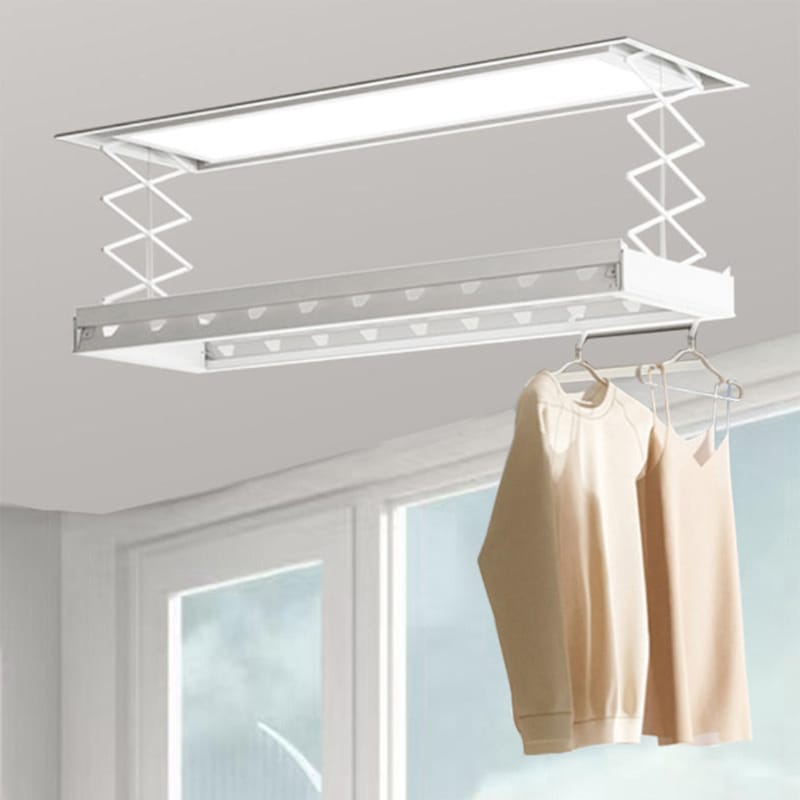
An electric laundry rack changes this part of the routine by moving the drying area instead of forcing people to work around a fixed structure. A ceiling-mounted rack can descend to a practical loading height, hold the laundry above the main activity zone during drying, and return upward when the space below is needed again.
That sounds like a simple improvement, but it affects several parts of daily laundry at once: how far wet clothes must be carried, how comfortably garments can be hung, whether floors remain accessible, how different loads are arranged, and whether the drying equipment dominates the room after the laundry is gone.
For households, designers, and product developers, the more useful question is therefore not simply “Is the rack electric?” It is whether electric movement actually makes the laundry routine easier.
The Most Awkward Part of Laundry Often Starts After Washing
Modern washing machines have automated much of the washing process, yet transferring wet clothing to the drying area remains largely manual.
A basket full of damp laundry can be heavy. If the drying rail is positioned permanently near the ceiling, each garment has to be lifted overhead. If a portable floor rack is used, it first needs to be opened somewhere with enough room. If the balcony is narrow, the rack may immediately reduce the available walking area.
An electric laundry rack addresses this awkward transition by bringing the hanging surface closer to the user.
Instead of repeatedly reaching upward, users can lower the rack, arrange clothing at a comfortable level, and then move the drying area back overhead. The benefit is not simply powered movement; it is the change in how the body interacts with the laundry area.
This becomes particularly meaningful when the household handles laundry frequently. A small inconvenience repeated once may not matter, but repeated reaching, bending, moving furniture, or carrying a rack several times every week can make the design of the drying area far more important.
Height Adjustment Changes More Than Accessibility
A fixed drying rail has only one useful height. An electrically adjustable system can have several.
During loading, the rack can sit lower. During drying, it can move upward to release the floor. When large fabrics need additional clearance, the position can be adjusted differently again.
This creates a drying zone that changes with the task.
Consider trousers or dresses. They need more vertical clearance than children’s clothing. Towels may need more horizontal separation. Bedding requires both width and enough surrounding room to prevent excessive folding over itself.
A variable-height rack gives households more control over these situations than a fixed rail.
The same principle can improve room planning. Instead of designing the balcony around a permanently occupied drying height, the drying system can move between a working position and a storage position.
This makes vertical movement a space-management feature rather than merely an electric convenience.
The Rack Should Give the Floor Back When Laundry Is Hanging
Floor space is one of the biggest differences between an electric ceiling rack and a conventional drying stand.
A floor-standing rack needs a physical footprint during the entire drying period. Even if it folds compactly afterward, the floor remains occupied for several hours whenever laundry is present.
In a dedicated laundry room, this may be acceptable. In a small apartment balcony, the same footprint may block access to a window, cabinet, plant area, or doorway.
An overhead electric laundry rack approaches the problem differently. The laundry still occupies physical volume, but the supporting structure is no longer competing directly with the floor.
This matters because modern balconies increasingly perform several roles. The same space may be used for washing, storage, ventilation, plants, and everyday household activities.
Moving the drying area vertically allows those functions to coexist more easily.
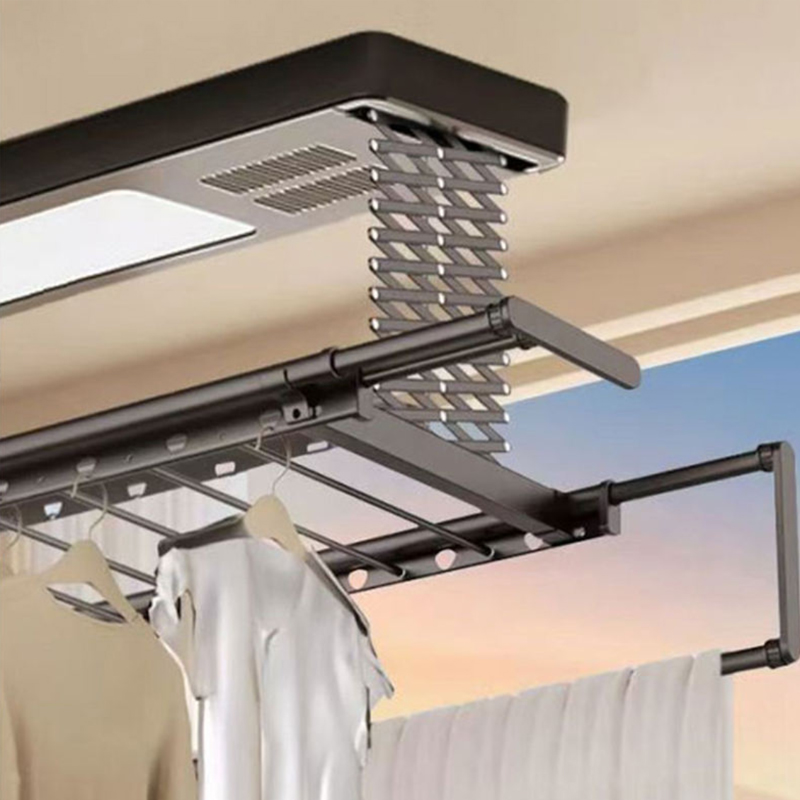
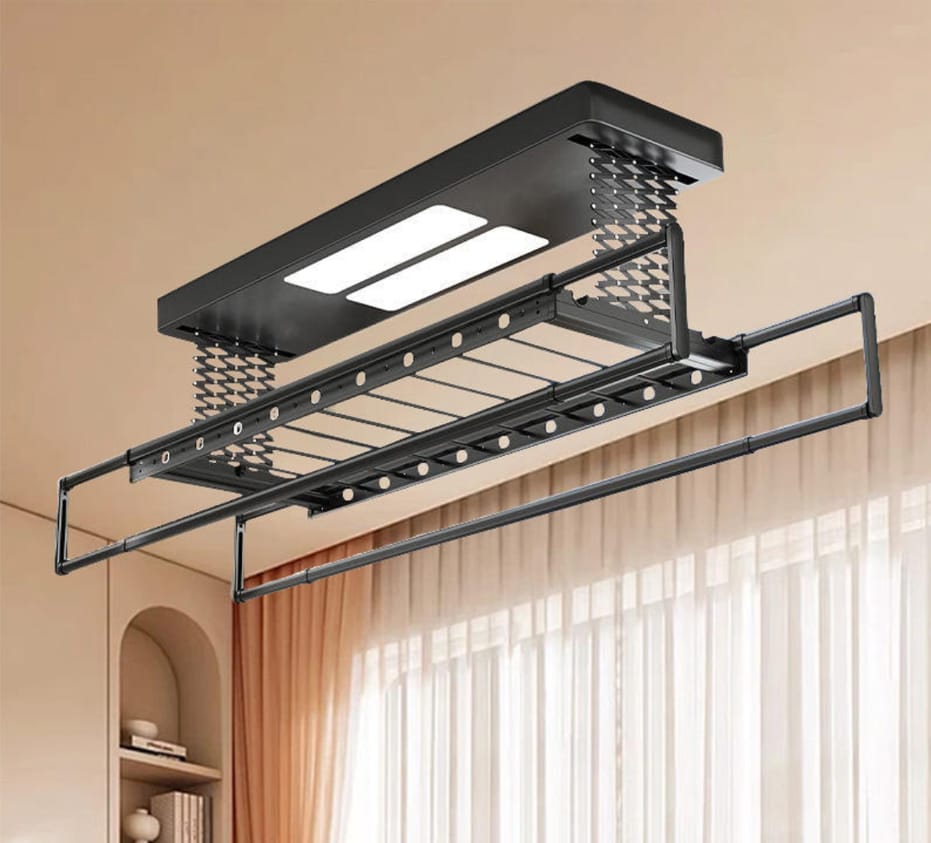
Where adjustable width is also useful, a retractable electric ceiling drying rack can combine vertical movement with rods that change the available hanging area. Instead of maintaining maximum width every day, the structure can adapt more closely to the actual laundry load.
An Electric Laundry Rack Is Not Automatically a Clothes Dryer
The words “electric” and “drying” can create confusion.
An electrically operated rack may use electricity only for lifting and lowering. Another model may combine lifting with airflow, lighting, or assisted drying functions. These products should not automatically be treated as equivalent to a tumble dryer.
The distinction matters because the drying process is different.
Air drying depends on moisture leaving wet textiles and moving into the surrounding air. Clothing arrangement, room ventilation, temperature, humidity, and exposed fabric area all influence the process. Powered airflow or other drying assistance may change conditions around the garments, but the rack still needs sensible spacing and placement.
The broader history and methods of washing and drying textiles are discussed in the Wikipedia overview of laundry, which also distinguishes between air-drying methods and powered clothes dryers.
For households comparing electric laundry rack functions, the first step should therefore be identifying what the electricity actually operates. A powered lift solves an accessibility and space problem. Air-assisted functions address a different part of the drying process.
Keeping those functions separate makes product selection more practical.
Three Laundry Loads Reveal Whether the Design Really Works
A drying rack can look highly capable when photographed with a neat collection of lightweight shirts. Real households are rarely that predictable.
A more meaningful evaluation is to imagine three very different laundry days.
The first is a light weekday load: shirts, underwear, socks, and several small garments. Here, maximum capacity is less important than convenient loading. Opening or extending the entire drying structure may be unnecessary.
The second is a towel-heavy load. Wet towels are relatively heavy and occupy considerable surface area. They need enough separation to avoid becoming dense barriers that restrict air around nearby garments.
The third is bedding. Sheets and duvet covers immediately test the effective width of the drying system. A rack may have many hanging points yet still struggle with large textiles if rods are too short or positioned too close together.
This is why practical capacity is more useful than counting rails.
| Laundry Situation | Most Important Rack Characteristic | Practical Reason |
|---|---|---|
| Everyday clothing | Easy lowering and convenient hanger positions | Reduces repetitive handling |
| Towels | Stable support and adequate spacing | Wet textiles create greater load and need exposed area |
| Bedding | Expandable width and clear surrounding space | Large fabrics require uninterrupted drying area |
| Small garments | Multiple organized hanging points | Prevents small pieces from consuming full-length rods |
| Mixed family load | Flexible arrangement | Different fabric sizes need different positions |
A good electric system should handle variation rather than perform well only when the laundry resembles the product photograph.
More Hanging Positions Are Not Always More Useful
It is tempting to judge a rack by how many garments can theoretically fit onto it.
Indoors, excessive density can work against drying.
A shirt pressed tightly between two wet towels receives less surrounding airflow. A sheet folded several times across a narrow section exposes less surface area. Multiple layers of clothing arranged directly above one another can make the drying zone crowded even when every available rail is technically being used.
The better target is usable separation.
This does not mean garments need huge gaps between them. It means the structure should make it possible to organize thick and thin items sensibly.
Electric movement can support this because the rack can be brought down to a level where users can see the entire arrangement rather than hanging clothes blindly above their heads.
That seemingly small usability advantage can lead to better garment placement.
Quiet Operation Matters Because Laundry Areas Are No Longer Isolated
In older homes, household equipment was often concentrated in utility areas separated from living spaces. Modern apartments frequently blur those boundaries.
A balcony may connect directly to the living room. A washing machine may sit near a kitchen. A drying rack may operate outside a bedroom window.
Motor noise therefore affects more than the few seconds during which the rack is moving.
A harsh start, vibration through the ceiling, or abrupt stopping can make an otherwise functional product feel intrusive. Smooth acceleration and controlled movement create a very different experience.
A ceiling clothes drying rack with electric lifting is most useful when the lifting mechanism becomes almost forgettable during everyday operation. Users should notice that the rack moved where they wanted it, not spend time thinking about the motor itself.
This is a broader principle in household automation: successful technology often feels less technological because it reduces attention rather than demanding more of it.
Controls Should Make One Repeated Task Simpler
Laundry equipment does not need a complicated interface.
Users perform a small number of actions repeatedly: lower the rack, stop it at an appropriate height, raise it again, and operate any additional drying functions available on the specific model.
If completing these actions requires navigating several menus, the control system has created another household task rather than removing one.
For this reason, good electric rack design should prioritize predictable interaction.
A physical remote can be convenient when users are standing beside the laundry. A wall control provides a fixed operating point. App control can be useful in some situations, but it should complement rather than complicate the normal routine.
The value of a control method should therefore be judged by frequency of use.
A function that looks impressive during a demonstration but is ignored after the first week contributes less than a simple button that works consistently every day.
Plan the Laundry Route Before Thinking About Features
The location of an electric laundry rack should connect logically with the washing process.
Imagine that the washing machine is installed in a bathroom but the rack is located at the opposite side of the apartment. Every load requires carrying wet laundry through living areas. Even an advanced drying system cannot eliminate that inefficient route.
A better layout reduces unnecessary movement between washing and drying.
Where possible, the drying area should sit close enough to the washing machine to make transferring laundry convenient while still offering suitable ventilation and sufficient space around hanging garments.
In balcony installations, window movement also matters. A rack filled with clothes should not prevent windows from opening or make routine cleaning difficult.
Cabinets, lighting fixtures, air-conditioning components, curtains, and ceiling dimensions should also be considered before installation.
The point is simple: the best electric rack cannot compensate for a poorly chosen location.
A Small Balcony and a Large Utility Room Need Different Answers
Electric laundry racks are often discussed as though one configuration suits every home.
A narrow balcony may benefit from a compact ceiling body and adjustable drying rods because permanent width is undesirable. A larger utility room may have enough space for greater fixed capacity without affecting movement.
An apartment occupied by one or two people will also create different loads from a family washing school uniforms, towels, bedding, and daily clothing.
Climate and ventilation further change priorities.
A naturally ventilated balcony may rely heavily on air drying. An enclosed laundry room may benefit more from thoughtful garment spacing and additional airflow support.
Instead of asking which configuration has the longest feature list, households should ask which functions solve problems that actually occur in their laundry space.
This avoids turning an everyday product into unnecessarily complicated equipment.
The Best Installation Position Is Usually Not the Absolute Highest Point
Because electric racks use vertical space, it can seem logical to install them as high as possible.
That is not always the most practical choice.
The rack still needs clearance around light fixtures, ceiling structures, windows, and surrounding furniture. Clothing suspended too close to the ceiling may also have less open space above it, depending on the room layout.
The lowered position matters just as much.
Users should be able to load laundry comfortably without the structure interfering with their head, shoulders, nearby counters, or appliance doors.
The vertical travel of the system therefore needs to connect two useful positions rather than simply provide the greatest possible movement distance.
A good installation creates a comfortable loading height and an unobtrusive upper position.
What Product Teams Should Test in a Real Laundry Space
Laboratory testing is essential, but a household drying rack also needs to make sense in an ordinary room.
One useful evaluation is to recreate a small balcony or laundry area rather than testing only in an open space.
Load the rack unevenly. Put several wet towels on one side and lightweight shirts on the other. Lower it while standing beside a washing basket. Open the nearby window. Walk underneath after it has been raised. Extend the rods with bedding attached. Operate the controls several times in succession.
These situations reveal questions that specifications alone cannot answer.
Does the structure remain level?
Can users easily reach the outer hanging positions?
Does the motor stop smoothly?
Do extended rods remain practical in a narrow room?
Does clothing interfere with surrounding fixtures?
Can the space below genuinely be used after the rack rises?
For distributors and product-development teams, these observations can be more valuable than simply comparing maximum dimensions.
Electric Movement Should Solve a Repeated Problem
Automation is most useful when it removes something inconvenient that happens frequently.
For an electric laundry rack, that problem is usually repetitive access to an overhead drying area.
The motor should therefore be judged as part of the household workflow rather than as an isolated specification.
If users still need stools, long poles, or awkward overhead reaching, the powered system has not solved the core problem. If lowering and raising becomes a simple part of the laundry routine, then electrification is delivering meaningful value.
The same principle applies to additional functions.
Every feature should have a clear reason to exist.
Lighting makes sense if the drying unit occupies a ceiling position that would otherwise require a separate fixture. Adjustable rods make sense when laundry volume changes substantially. Assisted airflow makes sense in conditions where natural circulation is limited.
Useful product design begins with problems and works toward functions, not the other way around.
When Does an Electric Rack Make More Sense Than a Folding Floor Rack?
Portable folding racks remain excellent solutions in many homes. They can move between rooms, require little permanent installation, and disappear completely when stored.
An electric ceiling rack solves a different problem.
It becomes more attractive when drying occurs frequently, floor space is valuable, overhead access is inconvenient, or repeatedly unfolding and storing a floor rack has itself become a household chore.
The distinction is therefore connected to frequency.
For occasional indoor drying, a portable rack may provide all the flexibility required. For a family using a drying area almost every day, a permanently available overhead system can reduce repeated setup and storage.
Neither approach is universally superior.
The better choice is the one that removes more friction from the household’s actual routine.
Conclusion
An electric laundry rack is most valuable when it improves the part of laundry that traditional appliances do not solve: moving wet clothes into an accessible, efficient drying space without surrendering the room to drying equipment.
Electric lifting can reduce overhead handling. Ceiling placement can return useful floor area. Adjustable rods can make capacity respond to different loads. Thoughtful control design can turn repeated operation into a simple habit rather than another technical task.
But none of these advantages exists in isolation.
The rack still needs the right position, sensible garment spacing, suitable room conditions, and a configuration that matches the household’s laundry patterns.
The strongest electric laundry rack is therefore not necessarily the one with the most functions. It is the one that makes the journey from washing machine to dry clothing noticeably easier while allowing the surrounding room to continue functioning as a home.
FAQ
What is an electric laundry rack?
An electric laundry rack is a powered clothes-drying structure, commonly installed overhead, that uses electric operation for functions such as raising and lowering the hanging area. Additional functions depend on the specific design.
Is an electric laundry rack the same as an electric clothes dryer?
No. A rack may use electricity mainly for movement or additional drying assistance, while a conventional tumble dryer removes moisture through a different enclosed drying process.
Is an electric laundry rack suitable for a small balcony?
It can be particularly useful in small balconies because ceiling placement keeps the supporting structure away from the floor. Installation dimensions and surrounding clearance should still be evaluated carefully.
What should be checked before installing an electric laundry rack?
Important considerations include ceiling conditions, available vertical travel, nearby windows and cabinets, electrical requirements, drying width, garment clearance, and the relationship between the rack and washing area.
Is an expandable rack useful for family laundry?
Expandable drying sections can be useful when laundry volume changes significantly, especially when larger items such as towels, sheets, or bedding need additional width.
Need Help Choosing the Right Electric Laundry Rack?
If you’re evaluating an electric laundry rack for apartments, balconies, residential projects, or different market applications, our team can help you compare lifting arrangements, drying capacity, installation conditions, and practical usage requirements. Contact us today to discuss a solution that makes everyday laundry easier while using residential space more efficiently.





