
Table of Contents
Introduction
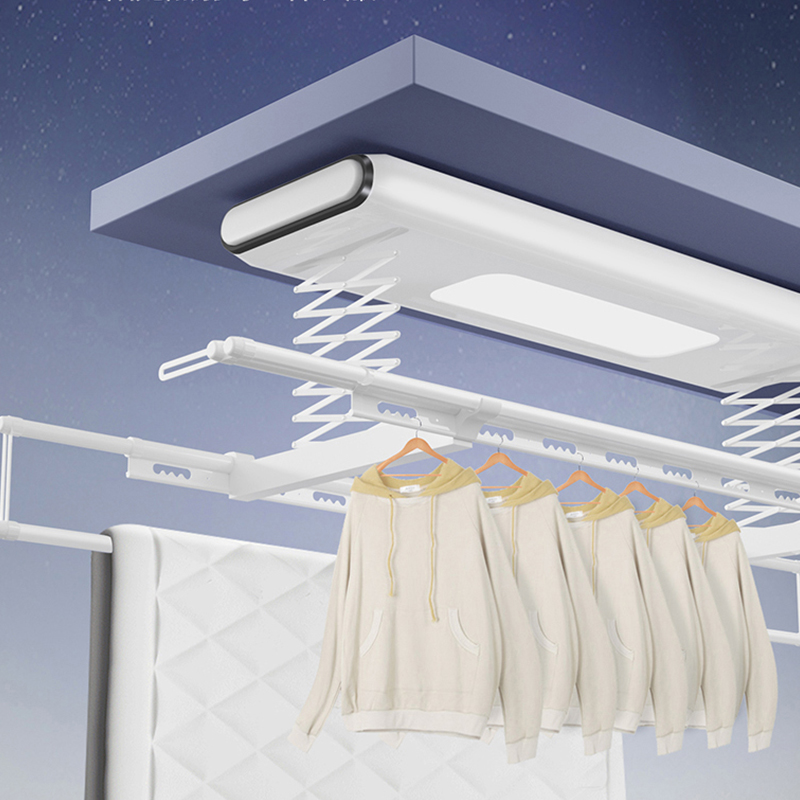
A ceiling mount drying rack can create useful laundry capacity without permanently occupying the floor, but the success of the system depends heavily on decisions made before the rack is installed. Ceiling height, mounting location, surrounding fixtures, garment length, loading position, and the way wet laundry moves through the room all affect whether the finished drying area feels convenient.
This makes ceiling mounting different from simply choosing a drying rack with enough rods. The product becomes part of the room itself. Once positioned overhead, its movement path has to coexist with windows, cabinets, lighting, appliances, doors, and normal household circulation.
A well-planned ceiling mount drying rack can turn unused upper space into a practical laundry zone. A poorly positioned one may technically fit the room while still making windows difficult to open, placing wet clothing directly above appliances, or forcing users to work around furniture every time the rack is lowered.
The better approach is to plan the complete operating space before focusing on individual product features.
The Ceiling Is Not Just Empty Space
Looking upward in a laundry room or balcony often reveals a large area that appears unused. This makes the ceiling an attractive location for drying equipment, particularly when the floor already supports washing machines, cabinets, baskets, or household storage.
However, the visible ceiling surface is only one part of the building assembly.
A ceiling is generally an interior overhead finish rather than the primary structural element itself. Different buildings may use drywall, suspended panels, concrete surfaces, or other ceiling systems, with structural elements located behind or above the visible finish.
For a ceiling mount drying rack, this distinction matters because wet laundry creates a real working load. The mounting method therefore needs to match the actual building conditions and the installation requirements of the drying system rather than relying only on the appearance of the finished ceiling.
The first installation question should consequently be structural suitability, not simply whether the product dimensions fit.
Start with the Rack in Its Lowest Position
One of the easiest planning mistakes is measuring only the rack when it is raised.
The lowest operating position is often more important because this is where users interact with the drying system. Clothes are placed onto rods or hangers, towels are arranged, and larger textiles may need to be spread across the available width.
If the rack lowers directly onto a washing machine, cabinet, countertop, or tall storage unit, the height-adjustment function becomes less useful.
A practical loading position should create a clear working zone around the user. People should be able to stand naturally beside the rack, reach the main hanging points, and move a laundry basket through the area without repeatedly repositioning furniture.
Planning from the lowest position first helps prevent a ceiling system from becoming easy to store overhead but awkward to use during the most active part of the laundry routine.
Then Measure the Laundry, Not Just the Rack
The rack itself occupies only part of the required space.
A shirt hanging beneath it adds substantial vertical depth. Trousers and dresses extend farther. Towels create broad hanging surfaces, while bedding may occupy both horizontal and vertical space around the structure.
This means installation planning should consider a complete occupied zone:
rack + hangers + garments.
A ceiling mount drying rack can clear the washing machine perfectly while empty and still allow long trousers to touch the appliance once laundry is added. The same problem can occur around windows, counters, shelves, and balcony furniture.
Using real garment lengths during planning provides a more accurate picture than relying only on the dimensions of the metal frame.
The Upper Position Should Release Useful Space
Raising the drying rack should produce a practical benefit.
If the upper position remains so low that household members still need to walk around hanging laundry, much of the space-saving advantage is lost. If it moves too close to surrounding ceiling features, the rack may create other conflicts.
The ideal upper position depends on the room.
In a narrow balcony, the objective may be to clear the main walking route and washing-machine area. In a dedicated laundry room, the rack may only need to rise enough to free worktops and cabinet access. In a multifunctional utility space, greater vertical clearance may be necessary so the room can return to other activities while clothes are drying.
A ceiling mount drying rack works best when the difference between its loading position and drying position creates a meaningful improvement in how the space can be used.
Ceiling Height Alone Does Not Determine the Best Installation
Two rooms with identical ceiling heights can require completely different rack positions.
A balcony with floor-to-ceiling windows needs clearance around the window system. A laundry room with wall cabinets may require the drying rack to stay farther toward the center. Another room may contain ceiling lights, beams, air-conditioning components, or ventilation equipment that restrict where the unit can sit.
For this reason, ceiling height should be treated as one measurement among several.
Useful planning dimensions include the distance between walls, window height, cabinet depth, appliance position, available vertical travel, garment length, rack width, and the direction in which users enter and leave the room.
The installation should follow the complete room geometry rather than simply centering the product on the ceiling.
Windows Are One of the Most Common Sources of Conflict
Balcony windows create a particularly important planning challenge because their movement is easy to overlook while the rack is empty.
Sliding windows usually require less interior swing space, but hanging garments can still block access to handles or glass panels. Inward-opening windows create a larger conflict because both the frame and the laundry may occupy the same volume needed by the window.
This becomes especially noticeable with shirts and towels positioned near the outer edges of the drying rack.
Before selecting the mounting point, windows should be tested in their fully open positions while the expected laundry zone is imagined below the rack. Long garments need to be included because they may create interference even when the rack body clears the window.
A small change in mounting position can often prevent years of repeated inconvenience.
Ceiling Lights and Drying Racks Compete for the Same Area
Lighting is another element that should be mapped before installation.
In compact balconies and laundry rooms, the most central ceiling position may already contain the primary light fixture. Mounting a drying rack directly around that location can create shadows, physical interference, or an awkward visual arrangement.
Moving the rack away from the light may solve the conflict but reduce the available drying zone. Moving the light instead may require additional room planning.
Some electric ceiling systems integrate lighting functions into the rack itself, which can reduce the need for separate fixtures in certain layouts. However, this should be considered as part of the overall room design rather than simply as another product feature.
The important point is that ceiling-mounted equipment shares one limited surface. Lighting, drying, ventilation, and building services need to be planned together.
Smooth Vertical Movement Is More Important Than Maximum Travel
A large lifting range can appear attractive in specifications, but users rarely benefit from movement that does not correspond to useful working positions.
The important question is where the rack stops.
During loading, the frame should be comfortable to reach. During drying, it should move high enough to release useful lower space. Movement between these positions should remain stable and predictable under ordinary wet-laundry loads.
An electric ceiling clothes drying rack with smooth lifting can use powered height adjustment to move between these working positions, while safety functions such as obstruction stopping and overload protection can support normal operation.
The value of the electric mechanism is therefore not simply that the rack moves. It is that movement makes the ceiling-mounted location practical for everyday users.
The Washing Machine Should Help Determine the Mounting Position
A good laundry layout reduces the distance wet clothes need to travel.
If the washing machine is located on one side of the balcony and the drying rack is installed at the opposite end only because that ceiling section was empty, every laundry cycle requires carrying a heavier basket across the space.
A more efficient arrangement places washing and drying functions close enough to create a natural sequence.
Wet clothes can leave the machine, move directly to the lowered rack, and then rise into the drying zone. This reduces unnecessary carrying and makes it easier to handle larger loads such as towels and bedding.
However, proximity should not create interference. The lowered rack and hanging garments still need to clear the appliance door or lid.
The objective is a short laundry route without overlapping operating zones.
Ceiling Mounting Works Best When the Floor Is Already Valuable
The strongest reason to move laundry overhead is usually not aesthetics. It is competition for floor space.
A large freestanding rack can work perfectly in a spacious utility room, but the same structure may block half of a narrow balcony. In compact apartments, every temporary floor object affects circulation.
Ceiling mounting separates the drying structure from the main walking surface.
The laundry still occupies physical volume, but the supporting frame no longer needs legs extending across the floor. This can keep access to washing machines, cabinets, windows, and storage areas more practical throughout the drying period.
This advantage becomes more significant as laundry frequency increases. A household drying clothes almost every day experiences floor occupation very differently from someone using a rack only occasionally.
Maximum Width Should Not Be Permanent Width
Households do not produce identical laundry loads every day.
Several shirts and small garments may need little drying width, while bedding suddenly requires much more. Designing the entire ceiling installation around maximum permanent dimensions can make the rack unnecessarily dominant during normal use.
Expandable structures offer another approach.
A ceiling drying rack with retractable rods can increase its available span when larger family loads or bedding require more room and return to a more compact configuration afterward.
This allows the ceiling mount drying rack to respond to changing laundry volume instead of forcing the room to permanently accommodate the dimensions needed for the largest possible load.
The maximum extension should still be included during installation planning because nearby walls, windows, cabinets, and other equipment must remain clear when the rods are fully deployed.
Bedding Should Be Included in the Installation Test
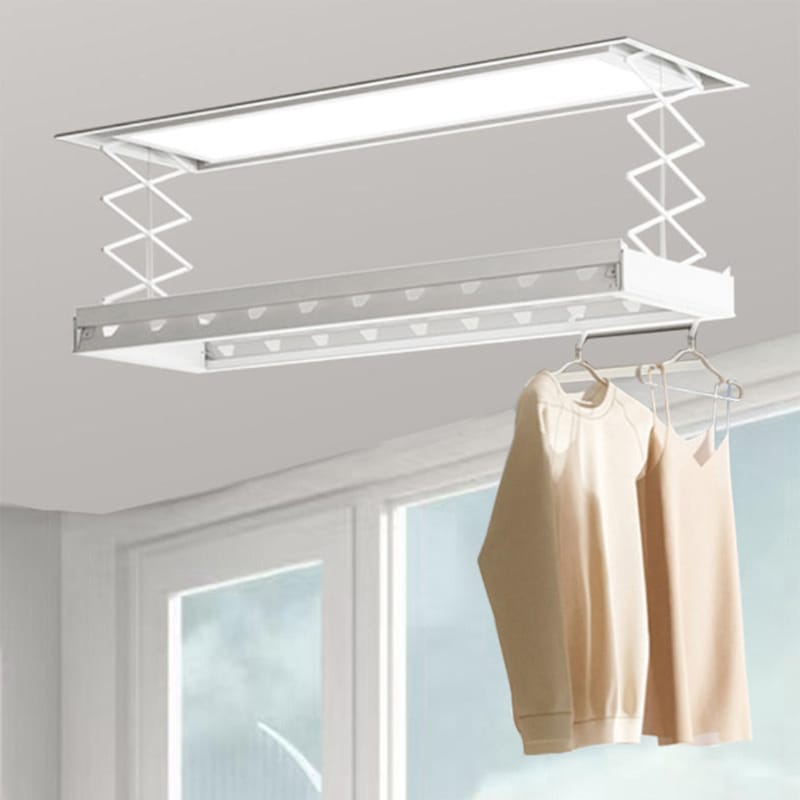
Shirts rarely expose the limitations of a ceiling rack.
Sheets and duvet covers do.
Large textiles require long usable spans and create substantial hanging surfaces below the rack. If the installation is too close to a wall or window, bedding can press against surrounding surfaces even when smaller clothing works perfectly.
The weight of wet bedding also places greater demands on the supporting system.
For households that air-dry sheets regularly, installation planning should therefore use the largest normal textile rather than the smallest everyday garment.
Spread the expected bedding width mentally across the rack and consider how far the fabric will hang downward. If the arrangement only works when the sheet is folded several times, the usable drying capacity may be lower than the rack dimensions suggest.
Wet Laundry Changes the Load Completely
A ceiling mount drying rack supports much more than the weight of its own frame.
Wet textiles retain water, and dense items such as bath towels, jeans, jackets, and bedding can create substantial additional load. Family laundry also tends to be unevenly distributed because users naturally fill the most accessible rods first.
The mounting system and rack structure should therefore be evaluated under realistic working conditions.
This does not mean users need to balance every shirt precisely. A household product should tolerate normal variations in loading within its intended limits.
However, the installation should always follow the rack’s specified requirements and the conditions of the actual ceiling structure.
A drying rack mounted overhead deserves more careful load consideration than a lightweight decorative object because the working load changes every laundry cycle.
A Narrow Balcony Needs a Different Layout from a Square Laundry Room
Room shape affects which direction the rack should follow.
In a long, narrow balcony, mounting the unit along the length of the room may preserve more usable circulation. Placing a wide system across the narrow dimension could create greater interference with windows and side walls.
A square laundry room offers more freedom, but cabinets and appliance access may determine the final orientation.
The rack does not necessarily need to be centered geometrically. The better position is the one that creates the clearest relationship between loading, drying, and surrounding household functions.
This is another reason installation planning should begin with movement through the room rather than aesthetic symmetry.
The Lowest Position Should Work for Different Household Members
Height adjustment is only useful if the loading position is genuinely accessible.
People in the same household may have very different heights and reach ranges. A rack that stops comfortably for one person may remain unnecessarily high for another.
Where the system allows flexible stopping positions, the user can bring the drying frame to a suitable working height rather than relying on one fixed level.
This flexibility can make overhead drying more practical for shared households.
The focus should be comfortable normal use rather than maximizing how far the rack can travel mechanically.
Curtains, Cabinets and Shelves Need Their Own Clearance
Ceiling mount drying racks often sit near other vertical household elements.
Curtains can move with airflow and enter the drying zone. Cabinet doors may open upward or outward into the space beneath the rack. Shelves can interfere with longer garments even if they do not touch the frame.
These conflicts are easy to miss when the installation is planned from an empty-room drawing.
The rack should be considered under real operating conditions: fully lowered, fully raised, expanded if adjustable, and loaded with representative garments.
Each surrounding object should also be considered in its active position.
A cabinet that fits while closed still needs to open.
Manual and Electric Ceiling Mounts Require Different Planning
Both systems use overhead space, but the user interacts with them differently.
A manual ceiling rack needs an accessible crank or operating point. The user must have enough room to stand comfortably while controlling the mechanism, so nearby walls, appliances, and cabinets influence where the control can be positioned.
An electric system shifts more of the operating interaction to buttons, remotes, or other controls. This can make height adjustment easier when the rack is used frequently, although electrical requirements become part of the installation plan.
Neither approach automatically uses ceiling space better.
The correct choice depends on usage frequency, desired functions, installation conditions, and how the household prefers to interact with the drying system.
Installation Planning Should Include the Empty Rack Too
Most attention naturally goes to the rack when it is full of laundry, but the system spends significant time empty.
Because a ceiling-mounted rack remains permanently installed, its raised appearance becomes part of the room.
The upper position should therefore feel visually and physically appropriate. The frame should not unnecessarily block lighting, create conflict with ceiling features, or hang lower than required when no laundry is present.
Expandable rods can be retracted, and adjustable systems can return to their normal upper position after clothing is removed.
The goal is not to make the rack invisible. It is to allow the room to feel like a normal living or utility space when drying is not taking place.
Airflow Should Influence Rack Position
Using ceiling space efficiently does not remove the need for sensible drying conditions.
A rack positioned tightly inside an enclosed corner may provide excellent spatial efficiency but limited room around the garments. Clothing still benefits from appropriate separation and surrounding air movement.
Balconies with natural ventilation can provide useful air movement, while enclosed laundry rooms may need more deliberate garment spacing.
The rack should therefore not be pushed into the smallest possible ceiling zone simply because the dimensions allow it.
Enough surrounding space should remain for garments to hang naturally rather than being pressed against walls, curtains, windows, or neighboring laundry.
Installation efficiency and drying efficiency need to be balanced.
Ceiling Mounting Can Improve Large-Garment Clearance
One benefit of adjustable overhead drying is the ability to use vertical height more intelligently.
Long trousers or dresses can be arranged while the rack is lowered and then moved upward to create greater clearance beneath them. This can be useful where a conventional floor rack would place long garments close to the floor or lower rails.
The same principle applies to towels and some household textiles.
However, the room still needs enough total height. Raising the rack does not help if long garments then interfere with upper windows, lights, or other ceiling-mounted equipment.
The entire vertical zone from ceiling to floor should be considered as one working volume.
Do Not Judge the Installation from the Empty Room
An empty room can make almost any drying rack look easy to accommodate.
The real test begins once appliances, baskets, furniture, doors, windows, and wet clothing are added.
A practical pre-installation exercise is to imagine one complete laundry cycle. Remove clothes from the washing machine, lower the rack, load several shirts, add towels, place a long garment on an outer rod, extend any adjustable sections, raise the system, and then use the rest of the room normally.
Can the window open?
Can the washing machine still be accessed?
Can someone walk through the area?
Can cabinets open?
Can clothing hang without touching surrounding surfaces?
If the room continues to work through that sequence, the mounting position is likely much more practical than one chosen only from product dimensions.
Common Ceiling Mount Planning Mistakes
The most common problems are rarely complicated technical failures. They usually come from ignoring ordinary household movement.
One mistake is placing the rack where it blocks the most useful window. Another is mounting it directly above a washing machine without accounting for long clothing. Installing too close to a cabinet can prevent doors from opening, while focusing only on the compact rack dimensions can cause problems once rods are extended.
Another mistake is choosing the absolute highest possible position without considering whether the lowered position will actually be comfortable.
A successful installation avoids these issues by treating the drying rack as moving household equipment rather than a static ceiling fixture.
A Ceiling Rack Should Improve the Laundry Workflow
The strongest ceiling installations do more than save space.
They improve the sequence of tasks.
Wet clothing moves a short distance from the washing machine. The rack lowers to an accessible height. Garments can be organized while the user remains in a comfortable position. The loaded rack then rises, freeing the area beneath it for normal household activity.
When drying is complete, the process reverses without requiring users to retrieve, unfold, carry, and later store a separate rack.
This workflow explains why ceiling-mounted drying can be particularly effective in homes where laundry is frequent and the drying location is predictable.
What Should Be Checked Before Installation?
A useful evaluation should cover both the building and the laundry routine.
| Planning Area | What to Check | Why It Matters |
|---|---|---|
| Ceiling | Suitable installation conditions | Supports the rack and working load |
| Lowest position | User reach and appliance clearance | Determines loading comfort |
| Highest position | Walking and workspace clearance | Determines space-saving benefit |
| Windows | Full opening path | Prevents daily interference |
| Cabinets | Door and drawer movement | Keeps storage usable |
| Garments | Longest normal clothing | Prevents contact below the rack |
| Bedding | Largest common textiles | Tests usable width and capacity |
| Lighting | Fixture position and shadows | Avoids ceiling conflicts |
| Expandable rods | Maximum extended dimensions | Ensures surrounding clearance |
| Laundry route | Distance from washing machine | Reduces unnecessary handling |
This type of room-based evaluation is more useful than selecting a ceiling mount drying rack according to capacity alone.
When Is a Ceiling Mount Drying Rack the Right Choice?
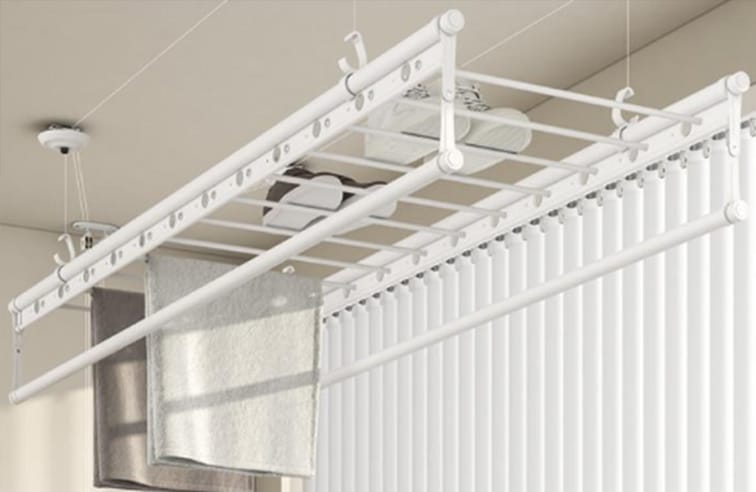
Ceiling mounting makes the most sense when floor space is valuable, the laundry area has a consistent location, and suitable overhead installation conditions are available.
It is particularly useful in balconies, compact laundry rooms, and apartments where a freestanding rack would repeatedly interfere with movement.
It may be less appropriate when the preferred drying location changes frequently or when building conditions make permanent ceiling installation unsuitable. In those situations, a portable folding rack can offer greater flexibility.
The correct choice follows the room and household routine rather than the product category itself.
Conclusion
A ceiling mount drying rack can transform unused overhead space into practical laundry capacity, but the quality of the result depends as much on installation planning as on the rack itself.
Ceiling conditions, loading height, upper clearance, window movement, cabinet access, appliance location, garment length, bedding width, wet-laundry load, lighting, and expandable dimensions all influence how naturally the system fits into everyday life.
The best installation does not simply place the rack where there is enough ceiling area. It creates a clear relationship between washing, loading, drying, and normal room use.
When the rack lowers, the laundry should be easy to reach. When it rises, the room should become easier to use. When it expands, surrounding fixtures should remain clear. When it is empty, the system should settle naturally into the architecture of the space.
That is what makes a ceiling mount drying rack genuinely space-efficient: not just being attached overhead, but making the entire laundry area work better.
FAQ
What is a ceiling mount drying rack?
A ceiling mount drying rack is a clothes-drying structure installed overhead so that laundry can use vertical room space instead of relying entirely on the floor. Depending on the design, the rack may be fixed, manually adjustable, electrically lifted, or equipped with retractable drying sections.
What should be measured before installing a ceiling drying rack?
Measure ceiling height, available width, the lowest and highest rack positions, window movement, cabinet clearance, appliance locations, lighting fixtures, garment length, and the maximum dimensions of any retractable rods.
Can a ceiling mount drying rack be installed above a washing machine?
It can be possible when the installation provides sufficient clearance for the appliance, its door or lid, the lowered drying frame, and the garments hanging from it. The complete operating space should be checked before choosing the final position.
Is an electric ceiling drying rack better than a manual one?
Neither is universally better. Electric systems can make frequent height adjustment more convenient, while manual systems provide mechanical adjustment without powered lifting. The better choice depends on installation conditions, frequency of use, and household preferences.
Is a ceiling mount drying rack suitable for bedding?
It can be when the drying structure provides sufficient rod length, load support, and surrounding clearance. Expandable rods can be particularly useful when large sheets or bedding occasionally require more drying width.
Need Help Planning the Right Ceiling Mount Drying Rack?
If you’re evaluating a ceiling mount drying rack for a balcony, apartment, laundry room, or other residential space, start with the complete operating area rather than the rack dimensions alone. Ceiling conditions, lowering distance, garment clearance, window movement, lighting, appliance access, and normal laundry volume should all work together so the finished installation improves both drying capacity and everyday room use.





