Table of Contents
Introduction
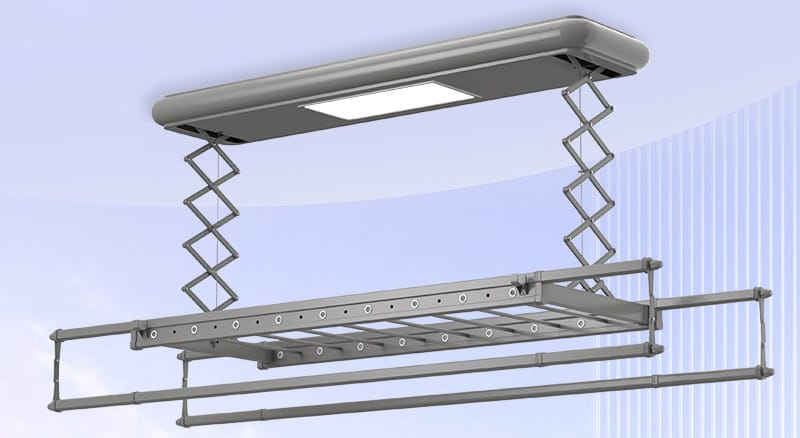
A laundry drying rack folding system is easy to judge when it is empty. You can see how thin it becomes, how neatly it fits against a wall, or how easily the frame collapses for storage. The more difficult question is how well it works once wet clothes are hanging from it.
That is where the real differences between folding drying racks appear.
During a normal laundry cycle, a rack must support wet garments, remain stable when the load is uneven, provide enough space for air to move between fabrics, and avoid blocking appliances, cabinets, doors, or walking routes. If it performs these tasks poorly, compact storage alone does not make it a good space-saving solution.
The folding mechanism also matters more than it first appears. Hinges, sliding rails, support arms, locking points, wall brackets, and telescopic sections experience repeated movement. These parts affect how stable the rack feels after opening and how confidently it can support daily laundry.
For this reason, choosing a laundry drying rack folding design should begin with the working configuration rather than the folded one.
This guide explains how folding structures work, which measurements matter, how different installation styles compare, and what to look for when matching a rack to your actual laundry routine.
Why Folding Design Matters in a Laundry Area
A laundry space has to support more than drying.
You may need room to open a washing machine, move baskets, reach cabinets, sort clothing, fold dry garments, and store household supplies. A drying rack that permanently occupies an important part of this area can make every other task less convenient.
Folding structures provide a way to make the drying zone temporary.
The rack expands when wet clothes need support and reduces its footprint when the job is finished.
This basic principle is closely connected to the traditional clothes horse, a portable frame used to support clothing during air drying. Modern designs take the idea much further through wall mounting, telescopic components, ceiling installation, powered movement, and adjustable drying rails.
The main advantage is not simply that the rack becomes smaller.
It is that the same physical space can perform different jobs at different times.
That makes folding especially useful in laundry areas where permanent dedicated drying space is limited.
Storage Space and Drying Space Are Not the Same
One of the most important ideas when evaluating a folding rack is the difference between storage efficiency and operating efficiency.
A rack may fold into a very slim structure.
That tells you how easy it is to store.
It does not tell you how much room it occupies while wet laundry is drying.
Imagine a freestanding rack that collapses to only a fraction of its open size. Once the side wings are extended and clothing is added, it may occupy a large area for several hours.
A wall-mounted rack creates a similar situation. It may sit almost flat against the wall when closed but project significantly into the room when fully extended.
The most useful measurements therefore include three different conditions.
| Measurement | What It Represents | Why It Matters |
|---|---|---|
| Folded footprint | Rack in storage position | Determines storage convenience |
| Open footprint | Rack fully prepared for use | Shows basic working-space requirement |
| Loaded footprint | Rack plus hanging garments | Reflects actual drying conditions |
| Rail length | Available hanging surface | Influences usable capacity |
| Rail spacing | Distance between garments | Affects airflow and organization |
| Vertical clearance | Space below drying rails | Important for trousers and long garments |
| Maximum extension | Full adjustable size | Important for telescopic designs |
The loaded footprint is usually the most realistic measurement.
Garments extend beyond the physical frame. Towels hang below rails. Shirts on hangers increase width. Bedding can occupy several sections at the same time.
A genuinely space-efficient laundry drying rack folding design needs to work when loaded, not only when stored.
Main Types of Laundry Drying Rack Folding Systems
Folding drying racks can be divided according to where they use space and how their structure changes.
Freestanding racks fold primarily for portability and storage.
Wall-mounted systems fold toward the vertical surface.
Retractable designs slide inward.
Telescopic racks extend their usable hanging length.
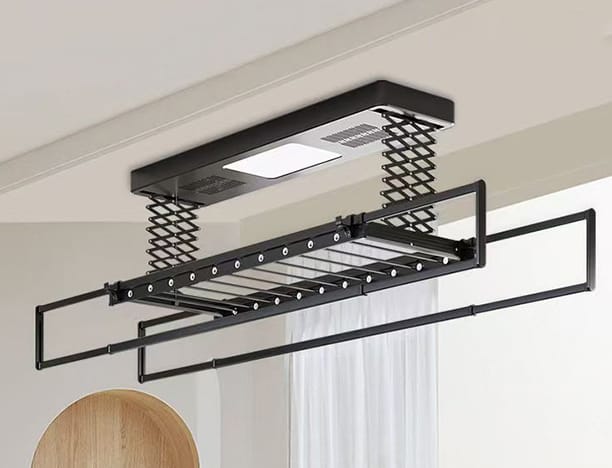
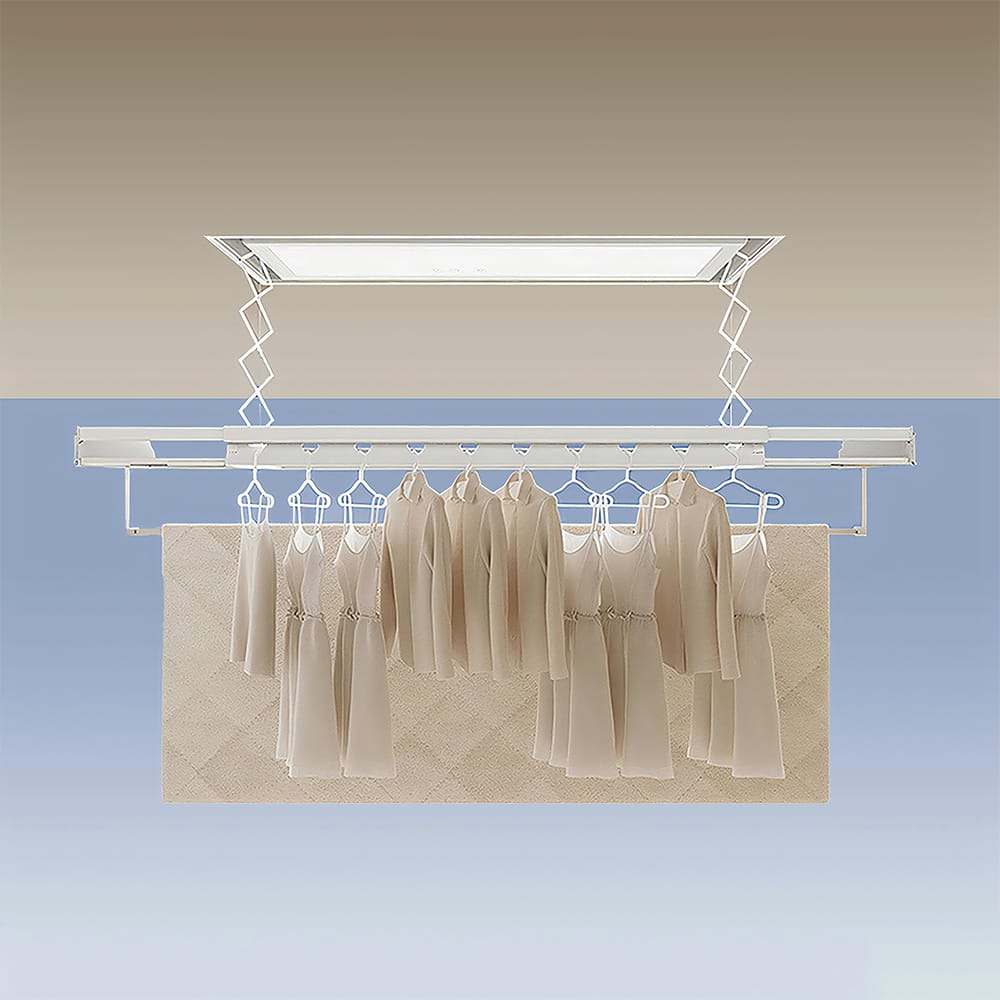
Ceiling-mounted systems may combine retractable rails with vertical lifting rather than conventional folding.
Each design solves a different spatial problem.
Understanding these differences prevents you from choosing a rack simply because the word “folding” appears in its description.
Freestanding Folding Racks
Freestanding racks are among the easiest systems to use because they normally require no permanent installation.
The frame opens when laundry needs to dry and collapses afterward.
Their main advantage is location flexibility.
You can move the rack according to available space, ventilation, or changes in the room layout. If the drying area needs to change frequently, this portability can be extremely useful.
The disadvantage is floor occupation.
The entire rack stands in the room throughout the drying cycle.
Large side wings or multi-level sections can make the working footprint considerably larger than expected.
This means freestanding folding racks work best when there is enough temporary floor space and a practical storage location after use.
If the rack must stay open almost continuously, the value of folding becomes much smaller.
Wall-Mounted Folding Racks
Wall-mounted systems shift the drying structure away from the floor.
A fixed mounting section remains attached to the wall while the drying rails fold or extend outward when required.
This can work especially well where an open wall exists near the washing area.
Unlike portable racks, the drying zone remains predictable. You know exactly where the rack will open every time.
However, wall-mounted designs require more careful clearance planning.
The rack itself may fit comfortably, but clothing hanging from the outer rails can interfere with nearby cabinets, doors, appliances, or movement.
The installation height also needs to balance two competing needs.
Higher positioning can keep garments away from working surfaces, but excessive height makes loading uncomfortable.
YIHUI’s fold away drying rack content reflects this type of flexible-space approach, where a drying structure provides useful capacity during laundry tasks while becoming less intrusive after use.
For a wall-mounted folding rack to work well, the entire operating zone—not only the mounting area—must remain available.
Telescopic and Retractable Folding Designs
Some racks do not fold through conventional hinges.
Instead, their drying rails slide inward or outward.
This is particularly useful when laundry volume changes substantially between cycles.
A smaller load may require only the basic structure. Towels, bedding, or a larger group of garments may require additional rail length.
Telescopic designs let the rack respond to those differences without permanently occupying maximum space.
The mechanical challenge is maintaining stability at greater extension lengths.
An extended rail creates more leverage on the supporting connection. A structure that feels rigid when fully retracted can behave differently after the outer sections are pulled outward.
Sliding interfaces also experience repeated contact.
They need to remain aligned so that the rail extends smoothly without becoming excessively loose.
For these systems, test or evaluate the rack at maximum extension rather than only in its most compact configuration.
Ceiling-Mounted Folding and Adjustable Racks
Ceiling-mounted drying changes the space-saving strategy.
Instead of trying to reduce the rack’s floor or wall footprint, it moves the drying area to a part of the room that is often underused.
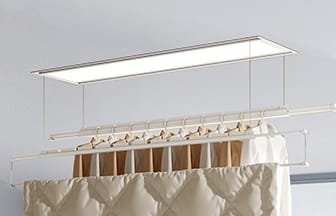
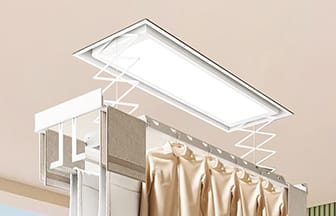
The rack can lower toward a comfortable loading position and rise after clothes have been arranged.
In this configuration, changing height may provide more practical value than folding the complete frame.
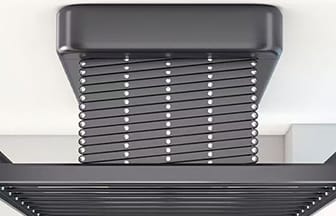
Some overhead systems also include telescopic drying rails, allowing both vertical position and horizontal capacity to change.
This combination can work particularly well when floor space is needed for appliances and circulation while wall areas are already occupied by cabinets or storage.
A ceiling clothes drying rack illustrates how an adjustable overhead design can create drying capacity without requiring a large freestanding frame in the main working area.
Ceiling installations require careful planning, however.
The rack’s movement path, ceiling structure, lighting, cabinet height, garment length, loading position, and surrounding fixtures all need to be considered before installation.
Folding vs Lifting: Two Different Ways to Save Space
Folding and lifting are often grouped together because both make a drying structure less intrusive.
Mechanically, they solve the problem differently.
Folding reduces dimensions.
Lifting changes position.
A floor rack becomes smaller when its legs and wings collapse.
A wall rack reduces projection when it rotates toward the wall.
A ceiling rack preserves floor space by raising the drying structure above the main working zone.
Neither method is automatically superior.
The right choice depends on where the available space is located.
If you have open floor area but need easy storage, conventional folding may be enough.
If you have a clear wall, a fold-down rack can preserve floor space.
If floor and wall areas are already valuable, moving the drying system upward may offer greater practical efficiency.
This is why space-saving decisions should begin with room geometry rather than product categories.
Why the Folding Mechanism Deserves Close Attention
A fixed drying rail experiences load but relatively little movement.
A folding joint experiences both.
Every time the rack opens or closes, the hinge moves through another operating cycle. Over time, this repeated movement can reveal differences in connection quality.
The same principle applies to telescopic rails and locking mechanisms.
A well-designed folding structure should move easily without feeling loose when it reaches the working position.
Support arms should hold their intended geometry.
Locking points should engage consistently.
Telescopic rails should remain aligned.
The rack should not rely on excessive friction or force to remain open.
For a laundry drying rack folding structure, these relatively small components may influence daily performance more than the visual thickness of the main frame.
Load Distribution Is More Important Than Maximum Load Alone
Load capacity is useful, but it does not tell the complete story.
Wet laundry rarely distributes itself perfectly across a rack.
A user may place several towels on one side, a group of shirts in the middle, and trousers on an extension arm.
This uneven arrangement changes how force travels through the structure.
A freestanding rack needs enough balance to resist tipping.
A wall rack transfers loads through folding arms and brackets.
A telescopic rail needs enough stiffness to support weight farther from the main frame.
A ceiling system transfers the load through suspension components and mounting points.
This means two racks with similar stated capacity may behave differently when the same laundry is arranged unevenly.
When possible, heavy wet items should be distributed across several structural sections instead of concentrated on one outer rail or folding wing.
The best rack makes balanced loading easy rather than requiring perfect user behavior.
How Materials Affect Folding Performance
Material selection influences more than corrosion resistance.
It also affects weight, rigidity, moving effort, and the design of folding components.
Aluminum is useful in many adjustable drying structures because relatively low component weight can make moving sections easier to handle.
This can be particularly valuable for larger folding wings, telescopic rails, or lifting frames.
Stainless steel can provide strong moisture resistance and structural performance.
Coated steel can also create durable frames when its protective finish and mechanical design are appropriate.
However, the main frame is only part of the rack.
Hinges, fasteners, brackets, sliding interfaces, cables, locks, and mounting components may use different materials.
These areas deserve attention because they experience both mechanical stress and repeated exposure to damp laundry conditions.
A rack made from a good main material can still perform poorly if its joints or connection components are unsuitable.
Overall construction matters more than a single material label.
Why Rail Layout Matters for Real Drying Capacity
A rack with more rails does not automatically provide better drying.
Wet clothing needs exposure to surrounding air.
If garments are packed closely together, sections of damp fabric can remain in contact with each other and receive less airflow.
Different textiles also use drying space differently.
Lightweight shirts can often hang relatively close together.
Towels need more exposed area.
Trousers require vertical clearance.
Bedding can occupy several rails at once.
This creates an important difference between nominal capacity and usable capacity.
Nominal capacity tells you how much the rack can physically hold.
Usable drying capacity considers whether the laundry can be arranged effectively.
A folding rack with adjustable sections can be valuable because additional rail length can be used to improve garment spacing rather than simply increase the number of items on the structure.
That often produces a more practical drying arrangement.
How Airflow Affects a Folding Drying Zone
Rack design and rack placement work together.
Moisture leaves wet clothing through evaporation and enters the surrounding air. If the area around the rack has limited air exchange, humid air can remain close to the fabric.
Garment spacing is the first consideration.
Avoid unnecessary overlap, particularly with thicker textiles.
Room placement is the second.
A rack positioned tightly between several large surfaces may receive less natural air movement than one placed in a more open zone.
This does not mean a rack needs an enormous empty area around it.
The goal is simply to avoid creating an enclosed mass of wet fabric.
When planning a folding drying zone, consider whether surrounding cabinets or walls will restrict both movement and airflow once the rack is fully loaded.
Single-Level and Multi-Tier Folding Structures
Multi-tier racks increase usable rail area vertically.
This can be highly efficient when the laundry consists mainly of small garments, socks, towels, or lightweight clothing.
However, more levels also reduce the amount of open vertical space between rails.
Long trousers or dresses may interfere with the tier below.
Thick garments can reduce airflow around adjacent levels.
Single-level racks provide less total rail length within the same footprint but can offer greater freedom for larger garments.
The better choice depends on typical laundry composition.
If most loads contain smaller individual items, multi-tier organization may work well.
For mixed loads containing shirts, towels, trousers, and bedding, a more open structure may provide greater flexibility.
The goal should be usable organization rather than maximum tier count.
How Often Will You Actually Fold the Rack?
This question is surprisingly important.
If the rack is used only occasionally, folding can provide substantial value.
You can open the structure for specific laundry loads and recover the space for other activities afterward.
But if you air-dry clothing almost continuously, the rack may remain open most of the time.
In that situation, compact storage becomes less important.
Permanent space efficiency becomes more important.
A ceiling-mounted or dedicated wall system may provide a smoother routine because there is no need to repeatedly set up and store a portable structure.
This does not make folding unnecessary.
It simply means the benefit of folding depends partly on how much time the rack actually spends folded.
A useful product feature should solve a recurring problem, not simply exist in the specification.
Planning a Laundry Drying Rack Folding Zone
Before selecting a rack, map the complete laundry workflow.
Begin with the washing area.
Where does the basket sit when wet clothing is removed?
Which direction does the appliance door open?
Where do you stand while hanging clothes?
Can cabinets still open when the rack is extended?
Will long garments touch a countertop or another surface?
Where will dry clothing be placed afterward?
These questions help identify conflicts before installation.
For wall-mounted racks, mark the complete extension zone.
For freestanding racks, mark the full leg and wing footprint.
For ceiling systems, consider both the raised and lowered positions.
For telescopic racks, use maximum extension rather than minimum dimensions.
A good drying zone should allow the laundry task to flow naturally without requiring repeated rearrangement of surrounding objects.
Choosing the Right Size
The largest rack that fits is not necessarily the correct size.
Start with a typical laundry load.
Estimate how much hanging length you actually use and which garments require the most space.
Then examine the room.
If increasing rack width begins to interfere with circulation or storage, additional theoretical capacity may not be useful.
Adjustable systems can help solve this problem because they provide extra space only when required.
You should also consider garment height.
A rail may fit perfectly above a cabinet, but trousers or dresses hanging from it may not.
Loaded dimensions are always more important than empty-frame dimensions.
Common Mistakes With Folding Drying Racks
One common mistake is prioritizing storage size over working performance.
A rack that folds extremely small but feels unstable when open has solved the wrong problem.
Another is ignoring the mechanical joints.
Users often focus on rail material while paying little attention to the hinges or telescopic connections that experience repeated movement.
Overloading one side is another common issue.
Even when the total weight remains within normal limits, concentrated loads can create unwanted stress on folding sections.
Poor placement can also reduce convenience.
A wall rack that blocks a cabinet or a floor rack positioned in the main circulation path creates the same inconvenience during every laundry cycle.
Finally, excessive rail density can reduce practical drying performance.
More rods are only useful when garments can still be arranged with appropriate spacing.
A Better Selection Method
Start with the space problem rather than the rack.
If temporary floor occupation is acceptable, a freestanding folding rack can provide excellent flexibility.
If you want to preserve the floor, evaluate wall-mounted options.
If walls are already used for storage, consider overhead drying.
Next, identify typical laundry volume.
Then consider garment type.
After that, evaluate the folding mechanism itself.
Look at hinges, extension joints, support arms, locking points, mounting components, and structural behavior when fully open.
Finally, check what happens after the rack is folded.
Does it have a practical storage location?
Does it remain attached to the wall?
Does it move overhead?
Will the space actually return to another useful function?
A successful folding rack should improve both sides of the cycle: drying and storage.
What Makes a Folding Rack Practical for Long-Term Use?
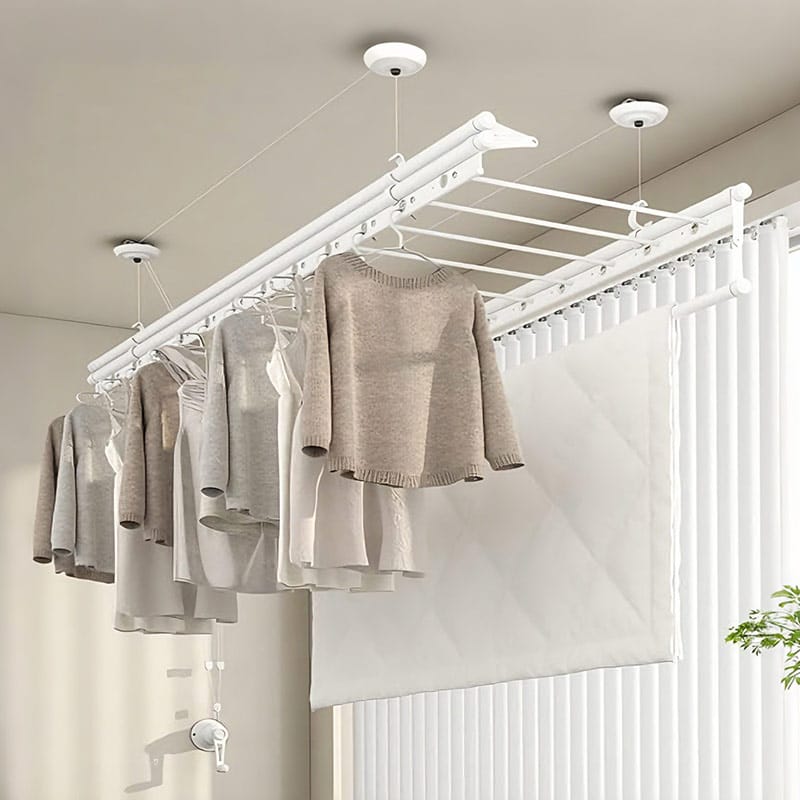
Long-term usability depends on repeated small details.
Opening should not require awkward force.
The working structure should remain stable.
Wet garments should be easy to distribute.
Rails should provide enough spacing flexibility.
The rack should not interfere with normal movement.
Folding should remain straightforward after repeated use.
These factors matter more over time than novelty features.
A good laundry drying rack folding design gradually becomes part of the room’s normal workflow. Users should not need to think constantly about how to position it or prevent it from interfering with other tasks.
When the system fits the space correctly, drying becomes easier because the rack behaves predictably at every stage.
Conclusion
A laundry drying rack folding system should be evaluated primarily as working equipment, not as a compact object in storage.
Folded size matters, but open footprint, loaded dimensions, rail spacing, structural stability, wet-laundry weight, joint quality, and airflow have a greater effect on everyday performance.
Freestanding racks provide mobility.
Wall-mounted racks preserve floor space.
Retractable and telescopic systems adapt capacity.
Ceiling-mounted designs move drying activity into vertical space and can reduce interference with both floors and walls.
The right choice depends on how often laundry is air-dried, which garments are normally involved, and which part of the room can support the drying zone with the least disruption.
Most importantly, folding should solve a real space problem.
The best rack is not simply the one that becomes smallest when closed. It is the one that provides stable, accessible drying capacity when open and returns useful space to the room when the laundry is finished.
FAQ
What is a laundry drying rack folding system?
A laundry drying rack folding system is a drying structure designed to reduce its footprint when full capacity is not required. It may use hinged frames, fold-down wall sections, telescopic rails, collapsible legs, or adjustable overhead structures. The goal is to provide usable drying space without permanently occupying the same area.
Is a folding laundry drying rack good for a small space?
Yes, when the rack’s working dimensions suit the room. A compact folded size alone does not guarantee good space efficiency. Measure the rack fully open and include garment overhang, appliance doors, cabinets, walking routes, and storage needs. Wall-mounted or ceiling systems can further reduce floor occupation.
Which material works best for a folding laundry drying rack?
Aluminum, stainless steel, and coated steel can all perform well. Aluminum is relatively lightweight and corrosion resistant, while stainless steel offers strong moisture resistance. The quality of hinges, brackets, telescopic sections, locks, fasteners, and surface treatments is just as important as the main frame material.
How much laundry can a folding drying rack hold?
Usable capacity depends on rail length, frame structure, load rating, garment type, and spacing. Thick towels and bedding require more room than lightweight shirts. Rather than filling every rail, arrange wet garments with enough separation for airflow and distribute heavier items across the structure instead of one folding section.
Should I choose a folding, wall-mounted, or ceiling drying rack?
Choose according to the space you want to preserve. A folding floor rack works well when portability matters, wall-mounted designs keep floors clear, and ceiling systems use overhead space when floors and walls are already valuable. Laundry frequency, garment types, installation conditions, and loading accessibility should guide the final choice.