Table of Contents
Introduction
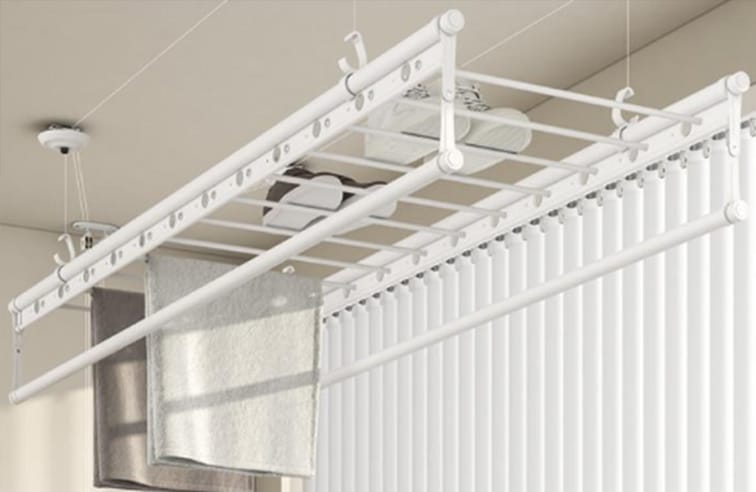
Laundry spaces have a simple problem: the area needed for drying clothes is often the same area needed for walking, opening appliances, carrying baskets, reaching cabinets, and folding garments. A conventional floor rack solves the drying problem but can create another one by occupying valuable working space for several hours at a time.
A ceiling hung drying rack approaches the layout differently. Instead of asking where another drying frame can fit on the floor, it uses the overhead zone that would otherwise contribute little to the laundry workflow. Clothing can be suspended above normal working surfaces while important floor and wall areas remain available for other tasks.
This does not mean every ceiling-mounted rack automatically provides better space efficiency. Installation height, garment length, usable rail spacing, structural support, ventilation, loading accessibility, and the way the rack moves all influence whether the system actually works well in daily use.
The most effective ceiling hung drying rack is therefore not simply one that hangs from the ceiling. It is a drying system designed around the relationship between vertical space and real laundry habits. When that relationship is planned correctly, overhead drying can increase practical capacity without making the room feel crowded.
This article explains how to evaluate that balance, from ceiling height and structural design to airflow, materials, lifting methods, load distribution, and long-term usability.
Why Ceiling Space Changes the Laundry Layout
Most laundry rooms are planned around two dimensions: floor area and wall width. Appliances occupy the floor, while cabinets, shelves, outlets, windows, and doors compete for wall space. The upper portion of the room is often used far less efficiently.
A ceiling hung drying rack introduces the third dimension.
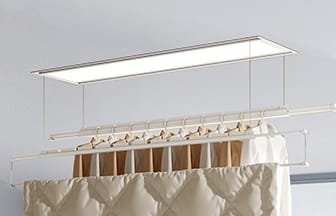
Instead of placing wet laundry beside the washing area, garments can occupy an overhead drying zone. The floor underneath can remain part of the circulation route or continue supporting baskets, work surfaces, and other laundry activities.
This is particularly useful because drying is not an instant task. Clothes may remain on the rack for hours, meaning any floor area used by a conventional rack stays unavailable for much of the laundry cycle.
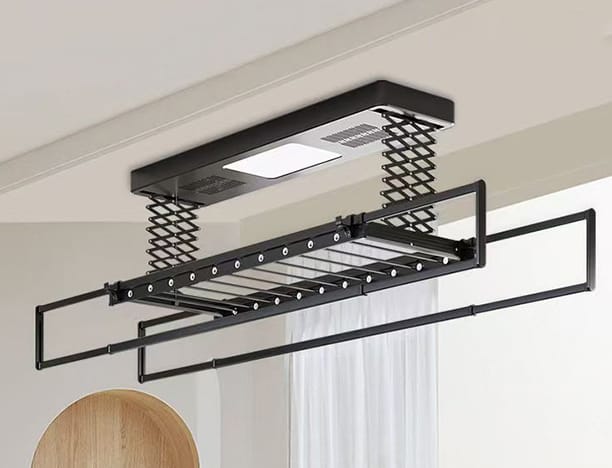
The principle itself has existed for a long time. A traditional overhead clothes airer uses suspended rails that can be positioned above the normal working area. Modern systems develop the same concept with improved lifting structures, adjustable rails, lighter materials, electric controls, and safety functions.
What has changed is not the basic physics of air drying. What has improved is the way users can access and manage overhead space.
A Ceiling Hung Drying Rack Does More Than Save Floor Space
Floor-space preservation is the most obvious advantage of overhead drying, but it is not the only one.
A well-positioned ceiling rack can separate drying from other stages of the laundry process. Washing takes place around the appliance, sorting may happen on a counter or in baskets, and dry garments may be folded elsewhere. The wet clothes do not need to occupy the same working height throughout this sequence.
That separation can make the room easier to organize.
It can also reduce the need to repeatedly unfold, relocate, and store a portable drying frame. A permanent overhead installation stays in a predictable location, so the drying zone becomes part of the room rather than temporary equipment that has to be accommodated each time.
The important word is “well-positioned.”
If the rack is installed where hanging garments interfere with a cabinet, doorway, lighting fixture, or commonly used work surface, the space has not really been saved. The obstruction has simply moved upward.
Good ceiling drying therefore depends on planning the entire loaded volume of the rack rather than considering only the dimensions of its frame.
Fixed, Manual, and Electric Ceiling Drying Racks
Ceiling-mounted racks can use several operating methods, and the best choice depends largely on how users need to access the drying rails.
A fixed ceiling rack has the simplest structure. The rails remain at one height, which can work when the installation position is already comfortable to reach. The disadvantage is that a rack low enough for convenient loading may also remain low while clothes are drying.
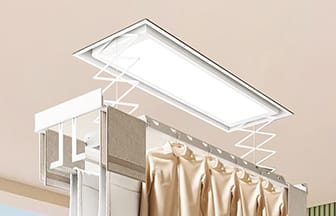
Manual lifting systems solve this conflict mechanically. The drying rails can be lowered toward the user and raised afterward. This allows the loading height and drying height to serve different purposes.
YIHUI’s manual clothes drying rack range follows this general ceiling-space approach, providing an option for users who want adjustable overhead drying without relying entirely on powered lifting.
Electric systems take the same principle and automate the vertical movement. Instead of manually adjusting the structure, a motor lowers and raises the drying frame.
The real advantage of electric operation is not simply convenience for its own sake. It allows the rack to stay high enough to preserve usable space while remaining accessible when wet garments need to be loaded or removed.
The three configurations therefore solve the same drying problem with different levels of adjustment. The right one depends on ceiling height, frequency of use, desired accessibility, installation conditions, and how much value height adjustment adds to the normal laundry routine.
How High Should a Ceiling Hung Drying Rack Be?
There is no single installation height that works for every room.
The correct position depends on both the user and the space below the rack.
A rack mounted too low can reduce head clearance and make the room feel crowded. Long garments may interfere with work surfaces or appliances underneath.
A rack mounted too high may solve those problems but create another: difficult loading.
This is why adjustable systems are useful. They allow the drying frame to occupy different heights at different stages of the laundry cycle.
During loading, the rack should be within comfortable reach so users do not need to repeatedly stretch upward while handling wet garments.
During drying, it can move higher to recover working space below.
Ceiling height alone should therefore not determine the installation position. Garment length also needs to be included in the calculation.
A shirt may hang comfortably above a cabinet where trousers or a long garment would touch the surface. Towels folded over rails behave differently again.
The correct planning measurement is not simply the distance from floor to rack. It is the distance from the floor to the lowest point of the longest garments normally placed on that rack.
How to Measure the Real Space Required
A ceiling hung drying rack needs to be measured in several operating conditions.
The first is its fixed installation footprint. This describes the ceiling area occupied by the main structure.
The second is its lowered position. This determines how much working clearance users need during loading and unloading.
The third is its normal drying position.
The fourth is the space occupied after garments are added.
These measurements provide a much more realistic view of installation requirements than product length and width alone.
| Measurement | What It Shows | Why It Matters |
|---|---|---|
| Ceiling footprint | Fixed installation area | Determines compatibility with ceiling fixtures |
| Lowered height | Loading position | Affects everyday accessibility |
| Raised height | Drying/storage position | Determines available space underneath |
| Rail length | Available hanging area | Influences practical capacity |
| Rail spacing | Separation between garments | Affects airflow |
| Garment clearance | Lowest point of hanging laundry | Prevents interference with surfaces below |
| Extension range | Maximum adjustable size | Important for telescopic or expandable rails |
The complete movement zone should remain clear of ceiling lights, cabinet doors, shelving, windows, and other equipment.
This becomes especially important with expandable racks. A compact system may fit easily in its normal configuration but approach surrounding objects once its outer rails are fully extended.
Planning should always use the largest realistic operating configuration.
Practical Capacity Is Different From Maximum Capacity
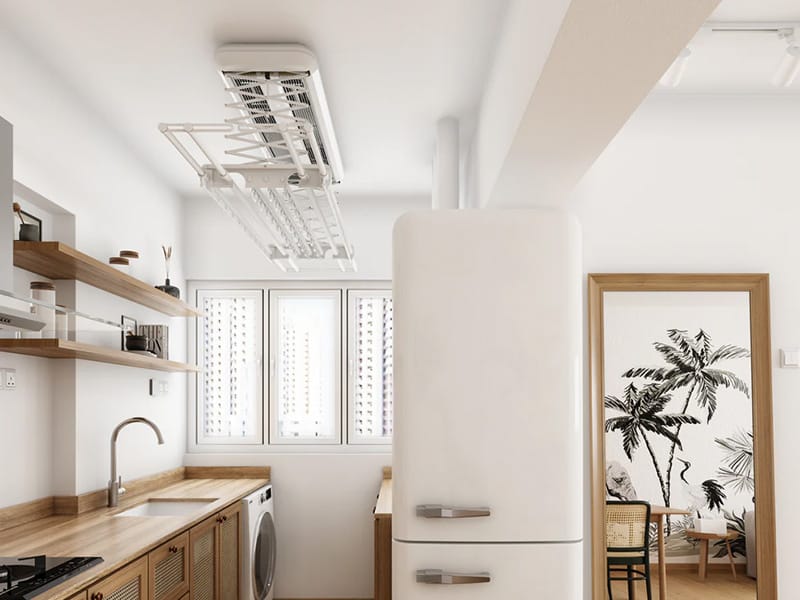
Drying rack capacity can be misunderstood because several different things are being measured at once.
Structural capacity refers to how much weight the rack is designed to support.
Hanging capacity describes how much rail length or how many hanging positions are available.
Practical drying capacity describes how much wet laundry can be arranged without excessive crowding.
The third measure is often the most important for everyday use.
A ceiling hung drying rack may have enough structural strength to support many garments, but that does not mean those garments should all be packed closely together.
A dense arrangement reduces the exposed surface area around damp fabric.
Thick towels, bedding, denim, and layered garments need more space than lightweight shirts. A rack that allows users to vary garment spacing may therefore provide better practical performance than one designed simply to maximize the number of hanging positions.
The most useful question is not “How many clothes fit?” but “How many clothes can be arranged effectively?”
That distinction produces a more realistic understanding of capacity.
Why Airflow Matters With Ceiling Drying
A ceiling rack does not change the basic process of air drying.
Water within wet textiles must evaporate into the surrounding air. Once moisture leaves the fabric, the humid air around the garments also needs to disperse.
This makes garment spacing and room ventilation important.
If towels or shirts remain tightly pressed together, the contacting surfaces receive less air movement. Thick sections can stay damp longer even when the outer surfaces begin to feel dry.
A ceiling installation should therefore provide enough room around the drying zone for air to circulate.
Positioning matters as well. A rack squeezed tightly between tall cabinets or installed in an enclosed overhead recess may not benefit from the same airflow as one located in a more open part of the room.
The ceiling itself does not automatically make drying faster. The benefit comes from using space efficiently while still creating suitable conditions around the garments.
For this reason, maximum rail density should not be the main design goal. Useful separation between clothes is often more valuable.
Ceiling Hung Drying Rack vs Floor Drying Rack
A floor rack and a ceiling rack can support similar laundry but use the room very differently.
The floor rack prioritizes portability. It can normally be moved without permanent installation and stored after use.
The ceiling rack prioritizes permanent space efficiency.
Neither is universally better.
| Factor | Ceiling Hung Drying Rack | Floor Drying Rack |
| Floor occupation | Very low | High while drying |
| Permanent installation | Required | Usually not required |
| Position flexibility | Low after installation | High |
| Vertical space use | Excellent | Limited |
| Loading height | Adjustable on lifting models | Normally fixed and accessible |
| Storage requirement | Usually remains overhead | Requires storage when folded |
| Room planning | More important | Relatively simple |
| Best advantage | Keeps working area clearer | Easy relocation |
A floor rack is often practical when there is enough temporary floor space and users want to move the drying area according to conditions.
A ceiling hung drying rack becomes more attractive when the floor needs to remain available throughout the drying period.
Frequency matters too.
If only a few garments are air-dried occasionally, permanent ceiling installation may be unnecessary. If air drying is a routine part of laundry care, an overhead system can reduce the repeated setup and storage associated with portable racks.
Ceiling Hung Drying Rack vs Wall-Mounted Rack
Wall-mounted racks also preserve floor area, so the comparison is less obvious.
The difference is which vertical surface the room can afford to dedicate to drying.
A wall-mounted rack works well when there is a wide, unobstructed wall at a convenient height. Many designs fold or retract toward the wall after use.
However, laundry rooms often use walls intensively. Cabinets, shelving, switches, windows, doors, counters, and storage can leave surprisingly little uninterrupted mounting area.
A ceiling rack avoids much of this competition.
Its disadvantage is accessibility. Without a lifting system, overhead rails may be less convenient to reach.
This is where manual and electric height adjustment become important. They allow users to access a ceiling system without permanently positioning it at working height.
The correct decision should therefore follow the layout. If an unused wall already provides an excellent drying position, there may be little reason to move the function overhead. If walls are valuable and the ceiling is comparatively free, suspended drying can be the more efficient option.
Materials and Structural Design
A ceiling drying rack is a suspended structure, so material selection should be considered together with the way the complete assembly carries load.
Aluminum can be useful because it combines relatively low component weight with corrosion resistance. Lower moving weight is particularly valuable in systems that regularly raise and lower.
Steel components may be used where different structural characteristics are required.
But focusing exclusively on the visible rails misses important parts of the system.
Mounting brackets transfer weight into the ceiling. Suspension elements carry the drying frame. Joints connect moving sections. Fasteners secure interfaces. Telescopic rails may experience repeated sliding.
A strong rail connected to a poorly designed joint does not create a strong ceiling rack.
The complete load path matters.
Wet laundry places force on the rails. The frame transfers that force into the suspension system. The suspension system transfers it into the ceiling mounting structure.
Every component along that path contributes to stability.
For long-term use, connection quality can therefore matter as much as the main frame material.
Why Wet-Laundry Load Distribution Matters
A stated maximum load does not describe every real operating situation.
Laundry is rarely arranged with perfect symmetry.
Heavy towels may be placed on one end while shirts occupy the other. Bedding can concentrate weight along one rail. Users may fill extension sections before the central area.
The total weight may remain within the rack’s intended range while the distribution becomes uneven.
For a suspended rack, balanced loading helps reduce unnecessary stress on individual rails, cables, brackets, or extension components.
This becomes even more important when telescopic sections are extended outward because loads positioned farther from the center can act differently on supporting connections.
Good rack design should tolerate normal variation in laundry placement, but users should still distribute heavier items across the available structure whenever practical.
Thinking about weight distribution is more useful than focusing only on the largest possible load number.
Manual vs Electric Lifting for Daily Use
The practical difference between manual and electric lifting becomes clearer when you think about repeated laundry cycles rather than individual operations.
A manually adjusted ceiling rack can provide the same fundamental benefit of changing height. It keeps the drying structure overhead while allowing users to lower it when necessary.
For occasional use, that may be entirely sufficient.
An electric system reduces the physical effort required for repeated adjustment. If the rack is lowered and raised frequently, powered operation can make the process more consistent.
A ceiling clothes drying rack with motorized lifting can also integrate movement protection into the system, making the rack more than a simple powered version of a fixed rail.
However, powered operation introduces additional components.
Motor performance, suspension stability, control response, safety behavior, electrical installation, and maintenance access become part of the evaluation.
The best option therefore depends on usage frequency and the value of automated height adjustment rather than simply whether electric operation is available.
Safety Features That Matter in a Suspended Rack
Any ceiling-mounted drying system should be treated as suspended equipment.
Secure installation is the foundation of safe operation.
The ceiling structure must be suitable for the mounting method, and fixing points need to support both the rack and the expected laundry load.
Moving systems introduce additional considerations.
The rack should travel smoothly through its intended range. Users should understand where it stops and whether surrounding objects can enter the movement path.
Automatic systems can incorporate protection against abnormal operating conditions, but these functions should complement rather than replace proper installation and loading.
Clearance is equally important.
A raised rack should not interfere with ceiling equipment. A lowered rack should not collide with cabinets or stored objects. Long garments should remain clear of work surfaces or equipment where possible.
Safety is therefore partly a product feature and partly a room-planning issue.
The two cannot be separated.
How a Ceiling Rack Fits a Small Laundry Space
Small spaces benefit most from products that use dimensions traditional furniture ignores.
A ceiling hung drying rack is a good example because it turns vertical room volume into functional capacity.
But the objective should not be to fill every available overhead area.
A compact laundry room still needs visual and physical breathing room.
The rack should be positioned where its drying load creates the least conflict with other tasks. Above a clear working zone may be practical, while directly above frequently opened tall cabinets may not be.
Loading height should also receive more attention in small rooms because there may be limited space to step backward or reposition a basket.
The system should come to a comfortable working position without forcing the user into an awkward stance.
When designed correctly, the result is not simply more drying capacity. It is better separation between activities.
The floor remains available for movement. Walls remain usable for storage. The drying zone moves overhead.
That is the real value of vertical-space planning.
How to Judge Whether Ceiling Installation Is Right for You
A ceiling rack makes the most sense when overhead space solves a genuine limitation.
If the laundry area already has generous floor space and portable drying works comfortably, permanent installation may provide little additional value.
If a large unused wall is available, a simple wall-mounted rack may solve the problem efficiently.
Ceiling installation becomes more compelling when the floor must remain clear, wall space is heavily used, air drying happens regularly, and users still need meaningful hanging capacity.
Ceiling height and structure must also be appropriate.
An extremely low ceiling can limit garment clearance, while complicated overhead fixtures can restrict the usable installation zone.
Frequency should be part of the decision as well.
The more often the rack is used, the more valuable a predictable permanent drying zone becomes.
The decision should therefore come from the room and routine rather than from the product category alone.
Common Ceiling Rack Planning Mistakes
One common mistake is measuring only the rack rather than the hanging laundry.
The frame may fit perfectly while long garments interfere with surfaces underneath.
Another mistake is installing the rack at a height based only on drying clearance. If users cannot comfortably load it, the space-saving advantage quickly becomes inconvenient.
Rail count can also be overemphasized. Filling every available hanging point may create overcrowding and reduce airflow between wet textiles.
Users sometimes overlook the ceiling environment as well. Lighting fixtures, vents, beams, cabinets, and the rack’s movement path all need to be assessed together.
Load distribution is another area that deserves attention. Concentrating heavy wet laundry at one end can affect the structure differently from a balanced load.
Finally, ceiling mounting should not be chosen only because it looks cleaner than a floor rack.
It should improve the way the entire laundry space functions.
Building a Better Laundry Workflow Around Overhead Drying
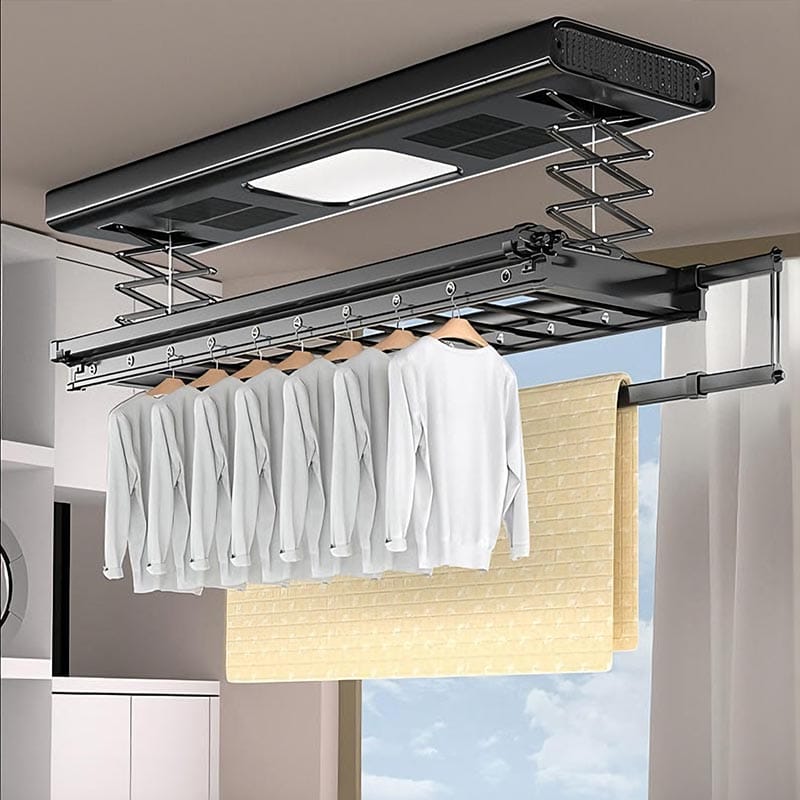
A useful ceiling drying system should fit naturally between washing and garment storage.
Consider where the laundry basket is placed after clothes leave the washer. The rack should lower to a position where garments can be transferred without repeated walking or difficult reaching.
After loading, the drying zone should move out of the main working area.
Once the laundry is dry, users should be able to lower the rack, remove garments, and transfer them toward folding or storage without rearranging the room.
This workflow is where overhead drying delivers its greatest advantage.
The rack is accessible when the user interacts with it and unobtrusive during the much longer period when the laundry is simply drying.
That is a more meaningful definition of space efficiency than product dimensions alone.
Conclusion
A ceiling hung drying rack can create substantial drying capacity without permanently giving up valuable floor space, but its effectiveness depends on much more than ceiling mounting.
The strongest installations balance loading height, garment clearance, practical rail spacing, structural support, material selection, load distribution, airflow, and room layout.
Fixed racks provide simplicity when accessible overhead space is available. Manual lifting systems separate loading and drying heights without powered operation. Electric racks make repeated height adjustment easier and can add controlled movement and safety functions.
Whichever system is selected, the room should be evaluated in three dimensions.
The floor needs to support circulation and appliances. Walls may need to support storage. The ceiling can become a dedicated drying zone when its structure and height allow it.
A well-planned ceiling rack does not simply move laundry upward. It creates a more organized relationship between washing, hanging, drying, and using the surrounding space.
That is what makes overhead drying particularly valuable: the rack provides the capacity you need without asking the rest of the room to stop functioning while clothes dry.
FAQ
What is a ceiling hung drying rack?
A ceiling hung drying rack is a laundry drying structure suspended from the ceiling rather than placed on the floor. Designs may be fixed, manually adjustable, or electrically operated. By using overhead room volume, the rack can preserve floor and wall space while providing dedicated hanging capacity for air-drying garments.
Is a ceiling hung drying rack suitable for a small laundry room?
Yes, especially when floor space is limited and walls are already occupied by appliances or storage. The rack uses vertical space that might otherwise remain unused. Ceiling height, garment length, lowered loading position, surrounding fixtures, ventilation, and structural mounting conditions should all be evaluated before installation.
How much weight can a ceiling hung drying rack hold?
Capacity varies according to frame design, rails, suspension components, mounting method, and manufacturer specifications. Wet laundry is heavier than dry clothing, so users should consider both total load and distribution. Heavy towels, bedding, and similar items should be spread across the structure rather than concentrated on one side.
Is a manual or electric ceiling drying rack better?
Manual systems provide adjustable overhead drying with relatively simple operation, while electric models reduce the effort required to repeatedly raise and lower the rack. The better choice depends on usage frequency, ceiling height, desired convenience, installation conditions, maintenance expectations, and whether powered height adjustment solves a meaningful daily need.
Does a ceiling hung drying rack help clothes dry faster?
Ceiling mounting alone does not guarantee faster drying. Drying performance depends on fabric thickness, garment spacing, temperature, humidity, and surrounding airflow. A ceiling rack can create an organized drying zone, but clothes should still be arranged with enough separation for air to move around damp surfaces effectively.