
Table of Contents
Introduction
Laundry equipment creates a strange space problem. When clothes are wet, households may need a surprisingly large drying area, yet once those clothes are dry, the same area immediately becomes unnecessary. Collapsible laundry drying racks are designed around this changing requirement by providing temporary drying capacity that can shrink, fold, retract, or move away when the laundry cycle is complete.
That sounds similar to any ordinary folding rack, but a genuinely useful collapsible design involves more than placing hinges between several metal tubes. The structure has to transform repeatedly between compact storage and stable working positions while remaining easy to handle. Its joints, legs, rails, locking points, folded geometry, and load distribution all influence whether that transformation feels natural after months of everyday use.
For apartments, balconies, laundry rooms, shared homes, and other spaces that cannot remain permanently occupied by drying equipment, the important question is not simply how small a rack becomes. A better question is how effectively it expands when needed, how comfortably it supports real laundry, and how completely it gives the space back afterward.
Collapsible Should Mean More Than Simply Foldable
The terms collapsible and foldable are often used interchangeably, but the idea of a collapsible rack is broader. Folding usually describes sections rotating around joints, while a collapsible structure may also use sliding rails, retractable parts, telescoping elements, detachable zones, or several coordinated movements to reduce its stored volume.
This distinction matters because different collapsing methods create different household experiences. A rack that folds flat may fit behind a door, while a telescoping design might become shorter without becoming completely flat. Another structure may reduce both width and height so that it can fit inside a utility cabinet.
The general concept of folding appears across many product types because changing a structure from a larger working form into a more compact form can make storage and transportation easier. In laundry equipment, however, the mechanism also has to reverse that process frequently while still supporting wet textiles once opened.
The best collapsible laundry drying racks therefore combine compactness with controlled transformation rather than treating collapsed dimensions as the only objective.
The Rack Has Two Jobs, and They Are Almost Opposites
When open, the rack should feel rigid. When stored, it should become compact and movable. These two requirements pull the design in opposite directions because stiffness usually benefits from strong connections and broad support, while easy collapsing requires movable joints and changing geometry.
Good product design has to reconcile these needs. Hinges should move smoothly while avoiding excessive looseness when the rack is open. Sliding sections should adjust without feeling unstable. Legs should close conveniently but create a dependable footprint once deployed.
This is why an empty collapsible rack can be misleading. The product may look perfectly stable until wet jeans, towels, or bedding are added. Conversely, a very rigid structure may handle laundry well but become frustrating if users need several awkward steps to reduce it for storage.
A useful rack has to succeed in both conditions instead of optimizing one at the expense of the other.
Temporary Drying Space Is Different from Permanent Laundry Space
A dedicated laundry room can accommodate equipment that remains in place every day. A living room, bedroom, balcony, or shared utility area usually cannot. In these environments, drying capacity has to coexist with other household activities.
Collapsible laundry drying racks are particularly useful because they create a temporary zone rather than permanently defining part of the room as a laundry area. The rack can occupy the space while clothing is wet and then disappear into storage once the load is complete.
This changes how households can use limited floor area. A balcony can return to seating, plants, or normal access. A bedroom corner can become available again. A utility passage does not need to remain narrowed by an empty drying structure.
The actual space-saving value therefore appears after drying, not while the rack is full.
Collapsed Volume Matters More Than One Folded Measurement
Manufacturers often communicate a single folded width or thickness, but storage is three-dimensional. A rack can become very thin while remaining tall and wide, or very short while creating a bulky bundle that is difficult to place anywhere.
Households should think about the intended storage location before deciding which measurement matters most. A narrow gap beside a wardrobe favors a thin, flat folded profile, while a utility cabinet may require reductions in both height and width. Storage beneath furniture introduces another completely different shape requirement.
Collapsed geometry also influences handling. A structure that becomes compact but leaves several arms protruding may catch on door frames. A rack that closes into one controlled rectangular form can often be easier to move even if its dimensions are slightly larger.
The most efficient collapsible design is therefore not necessarily the smallest possible object. It is the shape that fits realistically into unused household space.
Half-Open Capacity Can Be More Valuable Than Maximum Capacity
Laundry loads vary significantly during the week. One cycle may contain only several shirts and undergarments, while another includes towels, trousers, children’s clothing, and household textiles. Requiring the rack to occupy its full dimensions for every load makes collapsibility less useful during the drying stage itself.
Independent sections can improve this relationship. A side wing may remain closed for a small load, while both sides can open when additional space is required. Multi-level structures can allow selected zones to remain unused without affecting the stability of the active sections.
This means the rack is not limited to two configurations. Instead of simply collapsed or fully expanded, it can provide intermediate capacities that better match real laundry volume.
That adaptability is especially useful in small homes because maximum capacity may be required only occasionally. Allowing the working footprint to respond to each load reduces unnecessary occupation of the room.
Wet Laundry Determines Whether the Structure Is Truly Stable
Collapsible racks have numerous joints and movable connections, which makes realistic load testing particularly important. Dry display garments place relatively little stress on the frame, while wet towels, denim, sweatshirts, and bedding create much greater structural demands.
The problem becomes more noticeable when the load is uneven. Households rarely distribute every garment with perfect symmetry, so several heavy items may be placed on one wing while another section remains almost empty. If the rack twists, leans, or allows a folding joint to move under this ordinary condition, the apparent capacity does not translate into dependable use.
A strong collapsible structure should keep its working geometry stable once opened. Users should not need to repeatedly adjust legs or redistribute every garment simply to keep the rack behaving normally.
For practical evaluation, wet household textiles reveal much more than an empty-frame inspection.
Different Laundry Loads Need Different Types of Collapse and Expansion
A rack does not only need enough space; it needs the right shape of space. Shirts benefit from hanger positions, bath towels need wide exposed surfaces, long trousers need vertical clearance, and bedding requires uninterrupted span.
| Laundry Type | Main Drying Requirement | Useful Collapsible Feature |
|---|---|---|
| Shirts and blouses | Separated hanging positions | Adjustable hanger sections |
| Towels | Strong, open rails | Wide sections that remain rigid |
| Jeans and trousers | Load support and clearance | Stable frame with suitable height |
| Small garments | Organized compact capacity | Multi-level or dedicated zones |
| Bedding | Long continuous span | Extendable or retractable rods |
| Small weekday load | Limited working footprint | Independent folding sections |
| Large family load | Maximum usable area | Full expansion with stable support |
This is why simply increasing the number of bars does not automatically improve a collapsible laundry drying rack. The drying structure should change in ways that correspond to the textiles households actually handle.
Joint Quality Determines How the Rack Ages
Collapsible racks move far more frequently than fixed drying structures. Every opening and closing cycle places movement through hinges, pivots, sliders, locking components, and connection points.
A joint may feel precise when the product is new but gradually develop unwanted movement if tolerances, materials, or connections are poorly matched. Small amounts of looseness at several joints can combine to make the entire rack feel unstable even when no single component has failed.
Good designs control movement rather than simply permitting it. Rotating sections should follow a predictable path, and fully opened joints should settle into positions that resist accidental collapse. Sliding members should remain aligned instead of becoming difficult to operate after repeated cycles.
For collapsible laundry drying racks, long-term mechanical quality is therefore inseparable from everyday convenience.
Opening the Rack Should Not Require an Empty Room
Some collapsible products become compact during storage but need a surprisingly large area while being opened. Wings may swing outward through wide arcs, legs may need to spread simultaneously, or multiple sections may require the user to walk around the frame.
This behavior becomes inconvenient in exactly the small spaces where collapsible products are most useful. A narrow balcony may provide enough space for the rack once open but not enough clearance for a large folding movement.
A better opening sequence keeps moving parts relatively close to the final working footprint. Users should be able to deploy the rack beside furniture or appliances without temporarily clearing a much larger section of the room.
The path taken during transformation matters almost as much as the final dimensions.
Closing Should Be Just as Intuitive as Opening
When laundry is finished, users want the room back. If closing the rack requires remembering a complicated sequence of locks, releases, and rotating sections, the structure may simply remain open.
A collapsible rack should encourage completion of the full laundry cycle. After garments are removed, the user should be able to reduce the structure efficiently without repeatedly repositioning it or forcing joints into alignment.
Hand placement deserves particular attention because moving parts can create narrowing gaps. Frequently handled areas should make it reasonably clear where users are expected to grip the structure during closing.
The goal is not maximum closing speed. Predictable and controlled movement is more valuable because it remains comfortable after hundreds of repetitions.
Portability Begins After the Rack Has Collapsed
Collapsibility and portability are related but not identical. A rack can reduce to a smaller size and still be awkward to carry if its weight is poorly distributed or sections do not stay closed.
A practical folded structure should remain controlled while being moved through doorways or placed into storage. Loose wings that reopen during carrying reduce convenience, while protruding rails can make a compact rack difficult to maneuver through narrow spaces.
Balance also matters. A long folded rack with most of its weight concentrated toward one end may require two-handed handling even when the overall frame is relatively light.
For households that regularly move the rack between a balcony and indoor room, these carrying characteristics become part of normal product performance rather than occasional details.
Indoor and Outdoor Movement Changes What the Rack Needs to Do
Portable collapsible racks are often used in more than one location. A household may dry clothing outdoors when conditions are suitable and bring the rack inside when weather changes. The same structure might be used near a sunny window during one season and in a utility room during another.
Repeated movement places additional demands on the product. The rack has to pass through doors, cross floor transitions, and tolerate being opened on different surfaces. Materials and connection points also experience changing environmental conditions.
A folding drying clothes rack can therefore be evaluated not only by its maximum drying area but by how effectively its folding mechanism, loaded stability, rail arrangement, and portable format work together across different household environments.
For users who frequently change drying locations, flexibility of placement can be more important than maximum capacity.
A Collapsible Rack Should Not Become Difficult When Partly Loaded
Laundry does not always leave the rack all at once. Shirts may dry before thick towels, or a family member may remove several garments while others remain.
This creates changing weight distribution during use. A collapsible rack should remain stable as garments are added and removed rather than relying on the final full load for balance.
The same issue appears when users want to adjust one section while another section still contains clothing. Some structures allow an unused wing to be folded inward, but this is only practical if the movement does not disturb the active drying zone.
Designing for changing loads makes the rack more adaptable throughout the drying cycle instead of only at the beginning and end.
Large Capacity and Easy Collapse Must Be Balanced Carefully
Adding more rails, levels, and wings can increase capacity, but every additional section also creates more moving components. Eventually, a rack can become so mechanically complicated that the benefit of collapsibility begins to decline.
Large side wings also generate greater leverage at their joints. Taller multi-level frames may require broader bases. Extendable rods need enough overlapping support to remain rigid when fully opened.
The strongest designs therefore avoid maximizing every dimension simultaneously. Instead, they distribute capacity in ways that preserve controlled movement and structural stability.
A smaller number of genuinely useful drying sections can outperform a highly complex rack filled with marginal hanging positions.
Retractable Systems Show Another Way to Reduce Drying Equipment
Not every space-saving rack collapses toward the floor. Ceiling-mounted systems can reduce their presence by retracting rods and moving vertically instead of being carried into storage.
This approach is useful in homes where available storage is limited but overhead space is relatively open. A rack can remain permanently installed while changing its usable dimensions according to the laundry load.
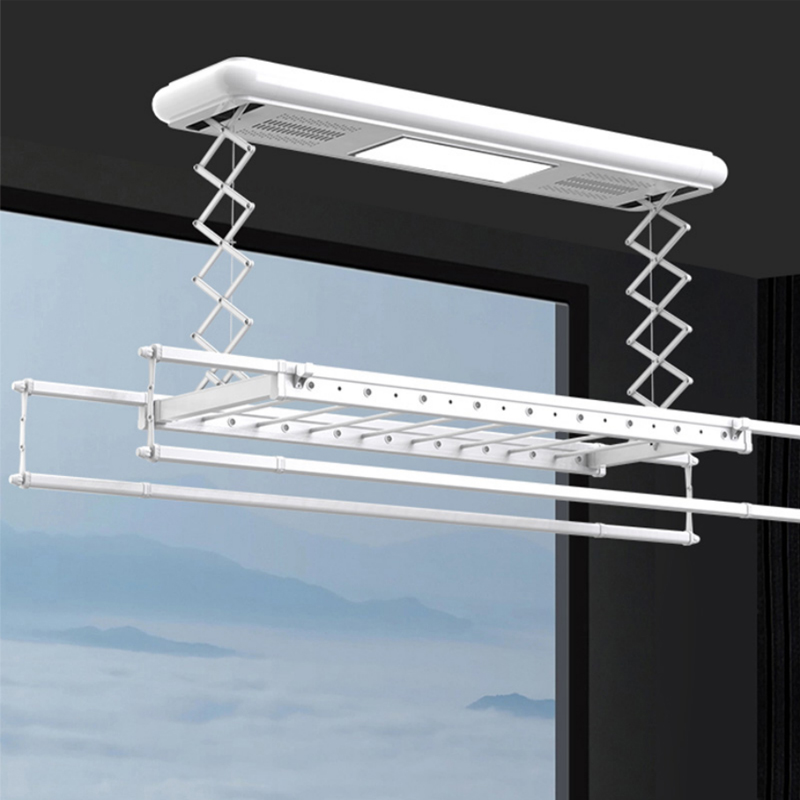
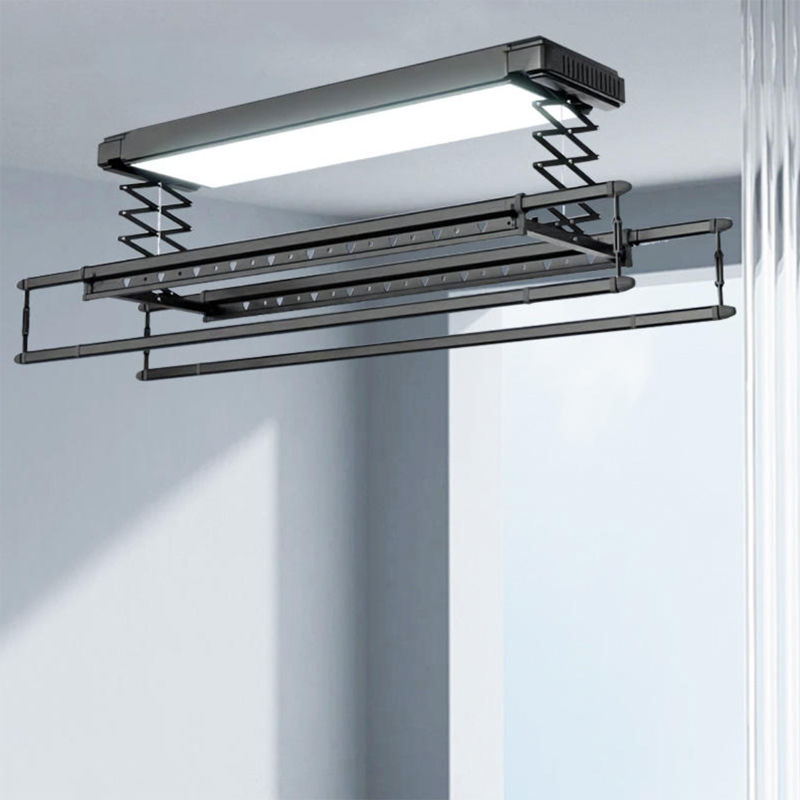
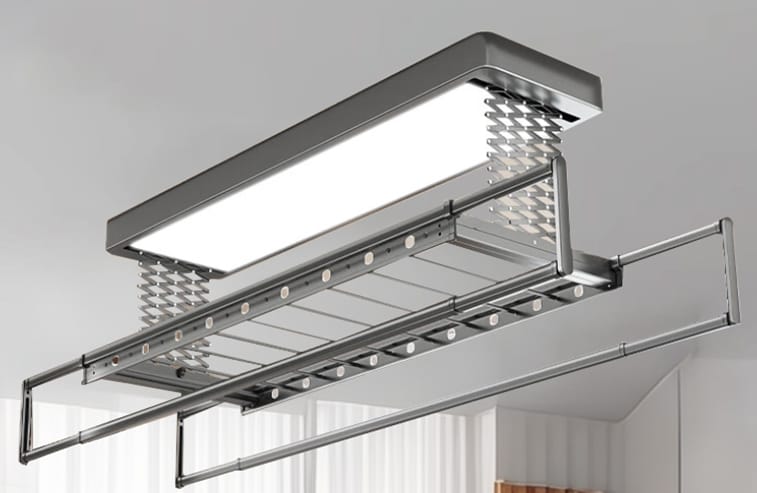
For example, an electric ceiling drying rack with retractable poles uses extendable sections to increase hanging width for larger laundry and then reduce that width when the additional span is unnecessary. The structure solves the changing-capacity problem differently from a freestanding collapsible rack, but the underlying principle is similar: the drying equipment should occupy its largest form only when the laundry requires it.
This distinction helps households think beyond a single product format when floor storage is already limited.
Collapsible Does Not Automatically Mean Small
Some collapsible laundry drying racks provide substantial open capacity. Their advantage is not that they remain small during use, but that their large working size is temporary.
This is an important distinction for families. A household may need enough drying area for multiple washing cycles on weekends but still want the room completely clear during the rest of the week.
In this case, a large collapsible rack can make more sense than a permanently compact rack that never provides enough space for bedding or towels.
The relevant comparison is therefore between open usefulness and stored intrusion. A product can be large in one state and space-efficient overall if the transition between those states is practical.
Airflow Can Be Lost When a Collapsible Rack Has Too Many Levels
Multi-level collapsible racks can provide impressive hanging area within a relatively small footprint, but stacking laundry vertically introduces another consideration. Garments on upper and lower levels can interfere with one another if spacing is too tight.
Long shirts may extend into the level below, while towels placed across broad rails can reduce open air around nearby clothing. The result may be high theoretical capacity but limited practical separation.
Different levels work best when they are assigned to textiles that fit naturally within the available vertical space. Small garments can occupy compact zones, while longer clothing should remain where it has unobstructed clearance.
Good rack design makes this organization intuitive rather than forcing users to discover through trial and error which sections conflict.
Storage Location Should Be Chosen Before Rack Size
Households often choose drying capacity first and think about storage afterward. With collapsible laundry drying racks, reversing that order can produce a better result.
Start by identifying realistic unused areas. Measure the gap beside the washing machine, the space behind a door, a section of utility-room wall, or an available storage cupboard. Then determine what folded geometry can fit there comfortably.
This creates a clear boundary for product dimensions while still allowing the open form to expand into temporary floor space during drying.
A rack that fits the laundry but has no practical storage location has only solved half of the household problem.
Apartment Use Makes Repeated Transformation More Important
Small apartments place more pressure on multifunctional space. A single room may need to accommodate laundry in the morning, normal household activity in the afternoon, and guests in the evening.
In this environment, collapsibility becomes less about occasional storage and more about daily transformation. The rack has to open and close frequently enough that mechanical convenience becomes highly visible.
Heavy mechanisms, awkward locks, uncontrolled joints, or bulky folded forms can quickly become frustrating. By contrast, a structure that moves smoothly between states allows the household to treat drying space as temporary rather than permanent.
This is where mechanical simplicity can be more valuable than adding more drying sections.
Shared Homes Need a Rack That Is Easy to Understand
In a shared apartment, dormitory, or multi-person household, several people may use the same drying rack. They may not all open, load, and close it in exactly the same way.
A product that depends on one specific technique can therefore create problems. Locking positions should be clear, the rack should provide obvious feedback when fully opened, and folding should not require knowledge of hidden release points.
The structure also needs to tolerate different loading habits. One person may distribute garments carefully, while another may place several towels on the nearest available rail.
Collapsible racks used by multiple people benefit from forgiving mechanical behavior because the product cannot rely on one experienced user.
Product Evaluation Should Include Repeated Collapse Cycles
Testing a collapsible rack once demonstrates only that it can move. It does not show how the product behaves after extended household use.
Repeated opening and closing helps reveal changes in joint resistance, frame alignment, locking behavior, and overall rigidity. The test becomes more meaningful when realistic laundry loads are periodically added between cycles.
Product teams should also evaluate the rack in confined spaces rather than only in open environments. Opening it beside a wall, carrying it through a doorway, storing it vertically, and retrieving it again all reflect the conditions that determine whether collapsibility is genuinely useful.
The full product experience begins before the first garment is hung and continues after the rack returns to storage.
What Makes a Collapsible Rack Feel Better Over Time?
Users gradually stop thinking about product specifications. What remains is the repeated physical experience of using the rack.
If it opens without resistance, remains steady while loaded, provides enough room for ordinary clothing, and closes into a convenient shape, it becomes part of the household routine without demanding much attention.
If joints constantly need adjustment or the rack occupies an awkward storage position, those inconveniences become more noticeable with every laundry cycle.
This is why successful collapsible laundry drying racks often depend on relatively ordinary details executed well: predictable hinges, sensible proportions, appropriate rail spacing, stable legs, controlled movement, and a folded form that stays folded.
Convenience is accumulated through repetition.
When Is a Collapsible Rack the Right Approach?
A collapsible drying rack is particularly appropriate when the drying location needs to serve other purposes after laundry is finished. Apartments, bedrooms, flexible utility areas, rental homes, and seasonal indoor drying situations all benefit from equipment that can be removed from the active space.
It is also useful when drying locations change. A portable collapsible rack can follow sunlight, ventilation, weather, or household activity instead of remaining tied to one installation point.
A permanent ceiling-mounted solution may make more sense when laundry is frequent and storage space is scarce. In other cases, the ability to completely remove the drying equipment remains the stronger advantage.
The choice should follow household behavior rather than the assumption that one rack structure works everywhere.
Conclusion
Collapsible laundry drying racks solve a problem that exists before, during, and after drying. They need to create enough temporary area for wet clothing, remain structurally stable while loaded, and then reduce into a form that can leave the living space when the laundry is complete.
Their effectiveness therefore depends on much more than whether the frame folds. Collapsed volume, partial deployment, joint quality, opening path, carrying balance, wet-load stability, rail arrangement, and storage location all shape the everyday experience.
The strongest designs recognize that household laundry is variable. Some days need only a few hanging positions, while others demand space for towels, bedding, and several categories of clothing. A rack that changes with those conditions can provide useful capacity without forcing the home to accommodate its largest dimensions permanently.
For compact living spaces, that is the real value of collapsibility: not simply making the rack smaller, but making the drying area temporary.
FAQ
What are collapsible laundry drying racks?
Collapsible laundry drying racks are drying structures designed to reduce their overall size when not in use through folding, retracting, sliding, telescoping, or other movable components.
Are collapsible drying racks suitable for apartments?
Yes. They are especially useful where the same floor area needs to serve several purposes because the rack can be reduced and stored after laundry is dry.
Can a collapsible rack handle towels and jeans?
It depends on the rack’s structure and intended load. Wet heavy textiles place greater demands on rails, joints, and supporting legs, so realistic load stability should be evaluated carefully.
Is folded thickness the most important storage measurement?
Not always. The most important dimension depends on where the rack will be stored. Height, width, thickness, and overall folded shape should all be compared with the available storage space.
Is a retractable ceiling rack the same as a collapsible floor rack?
No. A freestanding collapsible rack usually reduces its structure for carrying or storage, while a retractable ceiling rack remains installed and reduces its occupied dimensions or moves vertically. Both approaches can help manage changing laundry capacity.
Need Help Choosing the Right Collapsible Laundry Drying Racks?
If you’re evaluating collapsible laundry drying racks for apartments, family homes, balconies, flexible laundry areas, or different residential applications, the most useful starting point is the complete use cycle rather than maximum rack size alone. Consider how the structure opens, how much real laundry it supports, where it will stand while loaded, and exactly where it will go once drying is complete. A well-matched drying rack should make temporary capacity easy to create without turning storage into another household problem.





