Table of Contents
Introduction
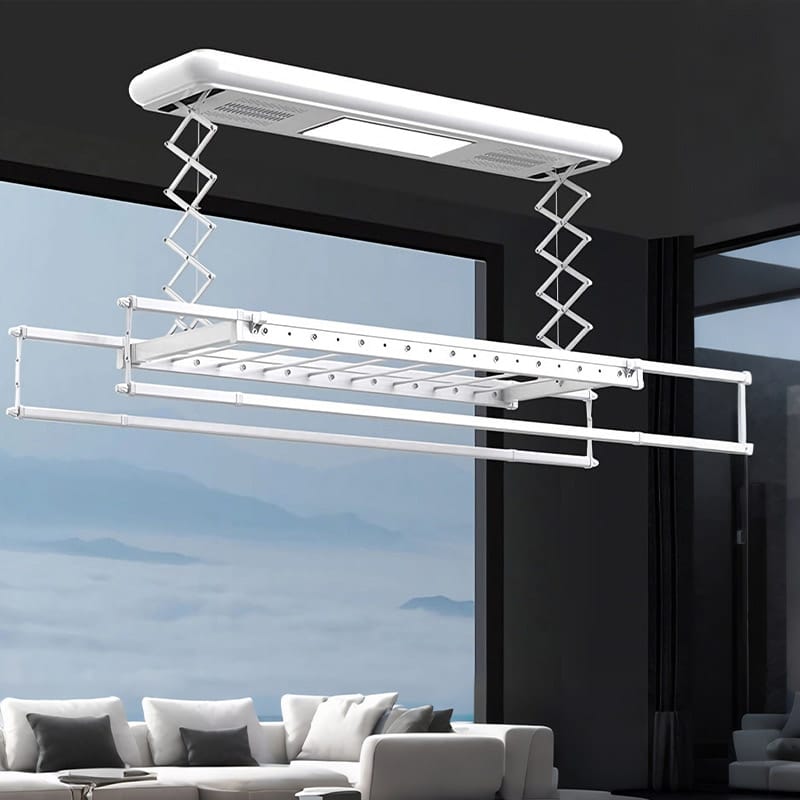
Choosing the best drying racks for laundry is not simply a matter of finding a frame with enough bars to hold wet clothes. The right drying rack should work with your available space, normal laundry volume, garment types, ventilation conditions, and daily routine.
A rack that performs well in a large open area may become inconvenient in a compact laundry room. A freestanding model can offer flexibility, but it may also occupy valuable floor space. A wall-mounted rack keeps the floor clear but requires an unobstructed wall. Ceiling-mounted systems take advantage of overhead space, while automatic racks add adjustable height and easier access.
This is why there is no single rack design that works best for every user.
The more useful approach is to compare drying systems according to how they manage space, support wet garments, maintain airflow, and fit into the complete laundry process. This guide examines seven common options and explains where each one performs best.
What Defines the Best Drying Racks for Laundry?
Before comparing individual designs, it helps to define what “best” actually means.
A good drying rack needs enough structural stability to support wet laundry without excessive movement or deformation. It should provide enough usable rail space for clothes to hang with reasonable separation rather than forcing garments tightly together.
Space efficiency is equally important. Laundry areas often contain washing equipment, cabinets, baskets, shelves, doors, work surfaces, and storage. A drying rack should fit around these functions instead of making them more difficult to use.
Accessibility also deserves attention. Hanging wet towels or bedding on a rack above comfortable reaching height can quickly become inconvenient. Similarly, a large floor rack may be easy to load but frustrating if you need to move around it throughout the day.
Air movement is another practical consideration. Air drying depends on moisture evaporating from fabric into the surrounding environment. Garments therefore need sufficient exposure rather than simply being placed on as many rails as possible.
The best drying racks for laundry balance these requirements:
- Practical hanging capacity
- Structural stability
- Efficient use of space
- Comfortable loading and unloading
- Suitable garment spacing
- Appropriate material selection
- Easy integration into everyday laundry routines
These criteria provide a more reliable comparison than judging racks by appearance or maximum dimensions alone.
1. Ceiling-Mounted Drying Racks for Maximum Floor Space
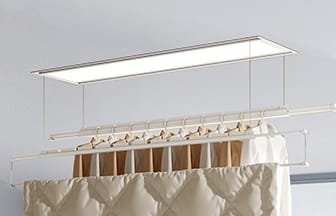
Ceiling-mounted racks are one of the most efficient options when floor space needs to remain available.
Instead of placing laundry in the normal walking and working area, these systems create a drying zone above it. The basic idea has existed for generations through designs such as the overhead clothes airer, where clothing is raised toward the ceiling after loading.
The principle remains highly practical today.
In a laundry room, floor space is often more valuable than ceiling space. Washing equipment, baskets, cabinets, and people all need access to the lower portion of the room, while the upper area may otherwise remain unused.
A ceiling-mounted rack allows both spaces to serve different functions.
During loading, the rack can be positioned where garments are accessible. During drying, it can remain higher and leave more usable space underneath.
This makes ceiling systems particularly useful for compact rooms, narrow utility areas, or spaces where walls are already occupied by cabinets and shelves.
However, ceiling racks require more planning than portable alternatives. Ceiling structure, mounting points, lowered height, raised height, garment length, lighting fixtures, cabinets, and other obstacles should all be considered before installation.
A well-planned ceiling rack can be highly space-efficient. A poorly positioned one can interfere with doors, storage, or normal movement.
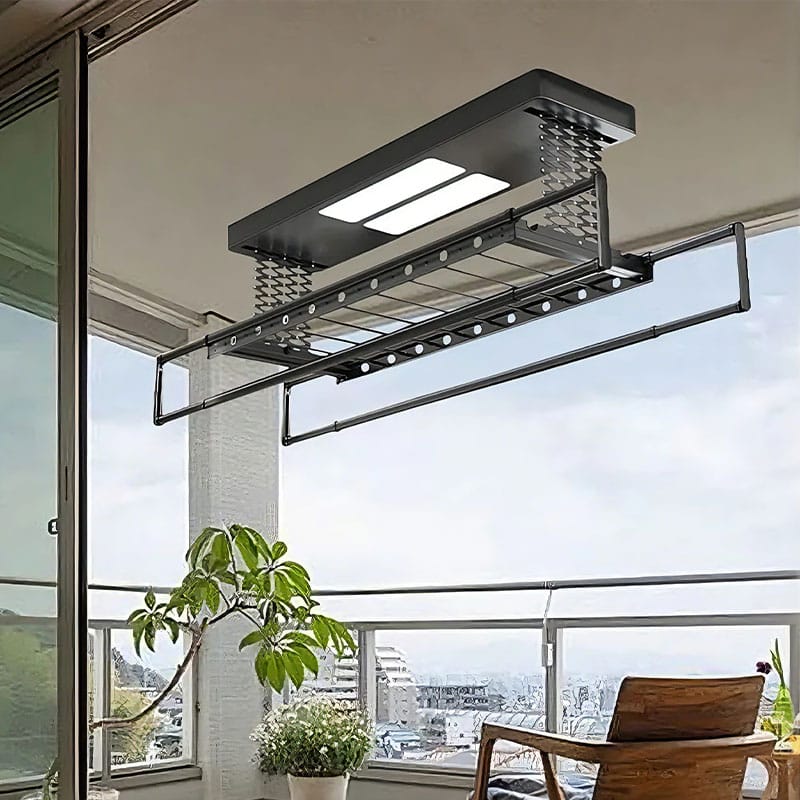
2. Automatic Ceiling Racks for Easier Daily Operation
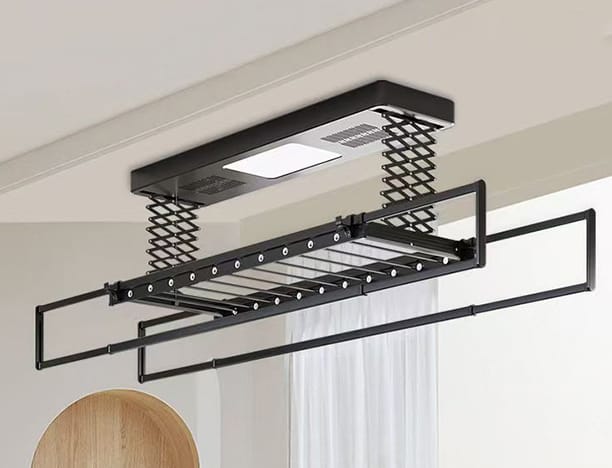
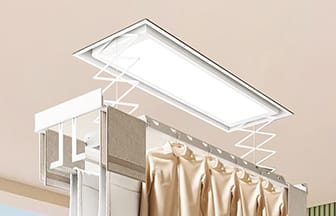
Automatic ceiling racks use the same overhead-space principle but add powered lifting.
This addresses one of the main weaknesses of traditional elevated drying systems: accessibility.
If a rack needs to remain high enough to preserve usable space below, it may also become difficult to reach. Automatic lifting allows the drying rails to descend toward the user for loading and rise again afterward.
This can make a noticeable difference when handling wet towels, trousers, shirts, or other heavier garments.
YIHUI’s automated clothes rack range reflects this approach by combining overhead installation with adjustable operation. Depending on the configuration, automatic drying systems can also integrate functions such as lighting, airflow, remote control, expandable rails, and movement protection.
The important benefit is not automation itself. It is the ability to separate loading height from drying height.
A rack can stay out of the main working zone when not being loaded while remaining accessible when you actually need it.
Automatic systems contain more mechanical and electrical components than simple manual racks, so product evaluation should include more than rail material. Motor performance, suspension stability, control behavior, safety functions, moving components, and installation quality all contribute to long-term usability.
For frequent laundry routines, however, automatic height adjustment can make overhead drying considerably easier to manage.
3. Manual Lifting Ceiling Racks for Simple Vertical Storage
Manual ceiling racks provide another way to use vertical space without depending on powered operation.
Instead of a motor, these systems use a mechanical lifting arrangement to adjust rack height. The concept is straightforward: lower the rack when clothes need to be loaded, then raise it when laundry is drying.
This can be a practical middle ground between fixed ceiling racks and automatic systems.
A hand ceiling drying rack is especially relevant where users want overhead drying space while keeping operation relatively straightforward.
The quality of a manual system depends heavily on its mechanical components.
Cables, pulleys, cranks, brackets, rails, and connection points need to work together smoothly. Uneven loading can also affect how the system moves, particularly when heavier garments are concentrated on one side.
Manual lifting requires slightly more user effort than motorized adjustment, but it still solves the key accessibility issue associated with fixed ceiling racks.
For users who value vertical space but do not require automatic operation, this design can provide a balanced solution.
4. Wall-Mounted Drying Racks for Open Vertical Surfaces
Not every room needs a ceiling system.
If you have an unused wall, a wall-mounted drying rack can provide excellent space efficiency without occupying permanent floor area.
Many wall racks fold or retract when empty. This allows the drying structure to remain compact between laundry cycles and extend only when clothing needs to be hung.
Their biggest strength is straightforward access. Unlike elevated ceiling rails, wall-mounted racks can usually be installed at a comfortable height.
They can work particularly well beside washing areas, above low cabinets, or on dedicated utility walls.
The limitation is available wall space.
A wall may appear empty at first glance but still contain switches, doors, windows, shelves, outlets, storage units, or other elements that affect installation.
The rack also needs clearance when open.
This is easy to underestimate because users often measure only the rack itself. Once garments are hanging from the outer rails, the actual drying area extends farther into the room.
Wall-mounted designs therefore work best when a clear section of wall can be intentionally dedicated to drying.
5. Foldable Drying Racks for Occasional Laundry Needs
Foldable racks are among the most flexible drying solutions.
They can be opened when needed and stored after laundry has dried. Many require no permanent installation, making them easy to reposition as room use changes.
For occasional air drying, this flexibility can be more valuable than permanent space optimization.
A foldable rack may work well when only certain garments are air-dried or when the main laundry area has enough temporary floor space.
It can also serve as additional drying capacity when a fixed system is already full.
The disadvantage becomes obvious during regular use.
Once unfolded and loaded with garments, the rack occupies floor area. In a small room, this can interfere with walking, appliance doors, cabinets, baskets, or normal sorting activities.
Storage should also be considered. A folding rack becomes compact when closed, but it still needs somewhere to go.
For this reason, foldable racks tend to perform best as flexible or secondary drying solutions rather than permanent fixtures in very limited spaces.
6. Freestanding Metal Drying Racks for Flexible Placement
Freestanding metal racks remain popular because they combine straightforward construction with flexible positioning.
Metal frames can provide useful structural rigidity while supporting longer rails and multiple drying levels. Aluminum, stainless steel, and coated steel are commonly used depending on the product structure and intended application.
The main advantage is mobility.
The rack can be repositioned according to ventilation, available room space, garment quantity, or changing household routines. There is no need to commit to a fixed wall or ceiling location.
Freestanding racks are also easy to access because their drying rails are normally positioned within comfortable reach.
However, the same mobility that makes them convenient also means they rely on floor space.
A loaded rack cannot always be folded away immediately. For several hours, it may occupy part of a walkway or work area.
Stability should therefore be considered carefully. A rack should remain balanced even when clothes are not perfectly distributed.
Wide leg spacing, appropriate frame geometry, reliable joints, and a stable center of gravity are all more important than how heavy the rack looks.
For spaces with sufficient floor area, a well-designed freestanding rack remains one of the simplest and most adaptable choices.
7. Retractable and Expandable Racks for Variable Laundry Loads
Laundry loads are not always the same size.
Some days may involve only a few shirts, while other cycles include towels, bedding, trousers, and larger garments. This makes adjustable drying capacity particularly useful.
Retractable and expandable racks are designed around this problem.
Rather than maintaining the same footprint all the time, the rack can change according to the amount of laundry being dried.
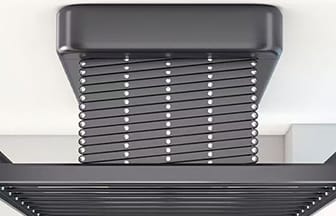
A telescopic rail may extend to provide additional hanging length. Folding arms can open when necessary. Ceiling systems may include expandable sections that remain compact when additional capacity is not required.
This improves space efficiency because the rack does not permanently occupy the area needed for its maximum capacity.
However, moving sections need careful evaluation.
Telescopic connections, sliding mechanisms, folding joints, and extension arms experience repeated mechanical use. The stability of these components can influence how the rack feels after long-term operation.
Expandable capacity is most useful when it remains structurally stable in both compact and extended configurations.
For users with changing laundry volumes, this flexibility can be more valuable than simply choosing the largest fixed rack available.
Comparison of the Best Drying Racks for Laundry
Different drying rack types solve different practical problems. The following table provides a straightforward comparison.
| Drying Rack Type | Space Efficiency | Installation | Accessibility | Flexibility | Best Suited For |
|---|---|---|---|---|---|
| Ceiling-mounted rack | Very high | Permanent | Depends on height | Moderate | Maximizing floor space |
| Automatic ceiling rack | Very high | Permanent | High | High | Frequent use and easy height adjustment |
| Manual ceiling rack | Very high | Permanent | Good | Moderate | Vertical drying with manual operation |
| Wall-mounted rack | High | Permanent | High | Moderate | Rooms with unused wall space |
| Foldable rack | Moderate | Usually none | High | Very high | Occasional drying |
| Freestanding metal rack | Moderate | None | High | Very high | Flexible placement |
| Retractable/expandable rack | High | Varies | High | Very high | Changing laundry volumes |
No column produces a universal winner.
If maintaining open floor space is the priority, ceiling-mounted systems are difficult to beat. If easy relocation matters most, freestanding and foldable racks are more practical.
If users want both overhead storage and convenient loading height, an automatic ceiling rack can provide a stronger balance.
The best choice depends on which practical limitation matters most in your space.
How to Choose the Right Drying Rack for Your Available Space
Space should be evaluated in three dimensions rather than by floor area alone.
Start with the floor.
Measure the open area after accounting for appliances, cabinets, baskets, door swings, and walking paths. If very little floor space remains, a permanent freestanding rack may create daily inconvenience.
Next, examine the walls.
A clear wall can support a folding or retractable drying system. Measure not only wall width but also how far the rack and clothes will project into the room.
Then consider the ceiling.
In many laundry areas, this is the least-used surface. If ceiling height and structure are appropriate, overhead drying can significantly increase usable capacity without removing important space elsewhere.
You should also think about the rack in different operating positions.
An automatic or manual lifting rack has both a loading position and a drying position. A folding wall rack has both stored and extended dimensions. An expandable rack has minimum and maximum configurations.
Measuring only one of these positions gives an incomplete picture.
The best drying racks for laundry should fit the room throughout their full operating range.
Why Laundry Type Matters More Than Rail Count
Manufacturers often describe drying capacity through rail length, hanger positions, or the number of bars.
These numbers are useful, but they do not fully describe everyday performance.
Different garments consume drying space differently.
A lightweight shirt on a hanger requires relatively little horizontal rail space. A thick towel needs more exposed surface area. Long trousers and dresses require vertical clearance. Bedding can occupy several rails at once.
This is why the largest number of rods does not necessarily produce the greatest useful capacity.
Imagine two racks with similar overall dimensions.
The first has many rails packed closely together. The second has fewer rails with more room between them.
The first may offer greater theoretical hanging capacity. The second may make it easier to separate thick garments and maintain airflow.
A better approach is to consider the types of laundry you handle most frequently.
For shirts and lightweight clothing, hanger positions may be especially useful.
For towels and bedding, longer rails and greater spacing may matter more.
For mixed loads, adjustable hanging arrangements usually offer the most flexibility.
Capacity should therefore be measured by how well the rack accommodates real garments, not simply by the number of places where something can technically be hung.
The Importance of Airflow During Indoor Drying
Air drying works through evaporation.
Moisture leaves the fabric surface and enters the surrounding air. As a result, drying performance depends not only on rack construction but also on how garments are arranged and how air moves around them.
Tightly packed laundry can slow the process.
When two damp garments touch each other, the surfaces between them receive less airflow. Thick fabrics and folded sections are particularly affected.
Leaving appropriate space between garments allows more fabric surface to remain exposed.
Room ventilation also matters because moisture released from laundry increases the amount of water vapor in the surrounding air.
The rack should therefore be positioned where air can circulate reasonably well rather than being tightly enclosed between furniture and walls.
This helps explain why simply buying a larger rack does not guarantee better drying.
Effective drying capacity is the combination of hanging space and garment exposure.
When comparing the best drying racks for laundry, rail spacing and room airflow deserve almost as much attention as total rack size.
Materials and Construction Quality to Check
Drying racks regularly interact with moisture and wet textile loads, so material selection is an important part of durability.
Aluminum can provide a useful balance between relatively low weight and corrosion resistance. This is particularly valuable for racks containing lifting or telescopic components where reducing moving weight can simplify operation.
Stainless steel can also perform well in humid environments, depending on grade and construction.
Coated steel uses surface protection to help isolate the underlying metal from moisture.
However, focusing only on the main frame material can be misleading.
Joints, fasteners, cables, brackets, hinges, end connections, and sliding sections may experience different types of stress from the main rails.
A strong metal tube connected through a weak joint does not create a strong rack.
The same applies to corrosion resistance. A durable rail surface does not compensate for poorly protected screws or repeatedly worn moving areas.
When examining construction quality, look at the complete load path.
Ask how weight moves from the clothes into the rails, from the rails into the frame, and from the frame into the wall, ceiling, or floor.
This provides a much better indication of practical durability than material labels alone.
Fixed Capacity vs Adjustable Capacity
One useful way to compare drying racks is to consider whether you need the same capacity every day.
Fixed racks are simple and predictable. Their dimensions remain unchanged, which makes room planning easier.
However, their maximum size is always present.
Adjustable systems can offer a better compromise when laundry volume changes regularly.
Telescopic rails, folding sections, retractable bars, or extendable hanger positions allow users to create more drying space only when necessary.
This can be particularly useful in multipurpose laundry rooms where space has to serve several activities.
The main consideration is mechanical quality.
Every adjustable connection introduces a moving point into the structure. Repeated extending, folding, sliding, or retracting can place wear on joints and interfaces.
A good adjustable rack should therefore feel stable both when compact and when fully extended.
Flexibility has little value if maximum extension produces excessive movement or uneven loading.
Common Mistakes When Choosing the Best Drying Racks for Laundry
The first common mistake is selecting the largest rack that physically fits.
Maximum size is not the same as practical size.
A rack that technically fits between two cabinets may still obstruct their doors when garments are hanging. A floor rack may fit beside a washing area but leave insufficient room to carry baskets through the space.
The second mistake is focusing entirely on maximum load.
A high load rating is useful only when that capacity can be distributed effectively across the rack. Concentrating heavy wet items on a single extension or one side of the frame can create different stresses from evenly distributed laundry.
Another mistake is ignoring garment length.
A ceiling rack positioned above a work surface may hold shirts comfortably but cause long garments to rest against the surface below.
Users also sometimes underestimate the importance of loading height.
If every laundry cycle requires repeated stretching or awkward lifting, even a very space-efficient rack can become frustrating.
Finally, avoid choosing solely from appearance.
A drying rack is working equipment. Rail arrangement, mounting method, adjustment range, airflow, structural stability, and accessibility affect daily performance more directly than decorative styling.
A Practical Five-Step Selection Method
Choosing between several promising options becomes easier when you follow a consistent process.
First, identify the space you are most willing to use.
If floor space is readily available, a portable rack may be sufficient. If floors need to remain clear, consider wall or ceiling installation.
Second, evaluate normal laundry volume.
Use your typical cycle rather than an unusually large load as the main reference point.
Third, look at garment types.
If you frequently dry towels, bedding, long clothing, or heavier garments, make sure the rail arrangement and vertical clearance support them properly.
Fourth, consider how often the rack will be used.
Occasional air drying may justify a simple foldable structure. Frequent daily use makes loading height, operating convenience, and permanent space efficiency more important.
Fifth, evaluate the complete structure.
Check rails, joints, brackets, moving components, mounting points, and load distribution rather than concentrating on one specification.
This method usually produces a better result than starting with a particular product type.
Which Drying Rack Works Best for Different Needs?
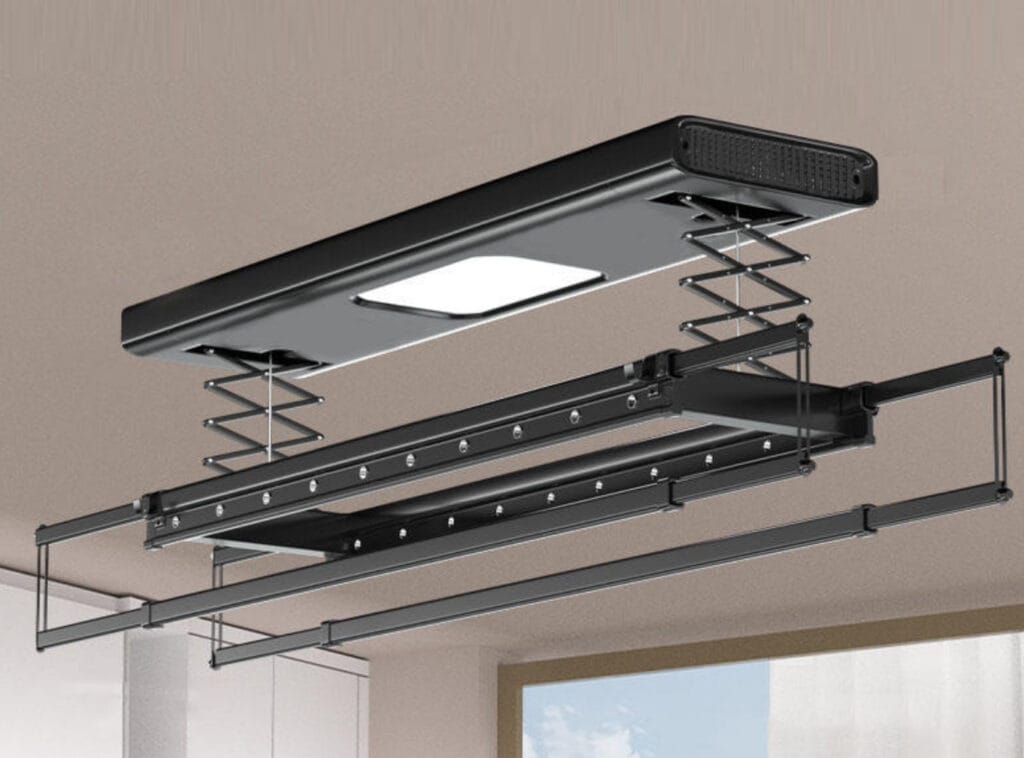
If your main concern is saving floor space, ceiling-mounted racks generally offer the strongest advantage because they turn overhead space into a functional drying zone.
If easy loading is equally important, automatic ceiling systems add adjustable height to that space-saving approach.
If you prefer simple mechanical operation, a manual ceiling rack provides many of the same spatial benefits without powered lifting.
If you have a large clear wall, a folding wall-mounted rack can create a compact dedicated drying area.
If your drying needs are occasional, a foldable portable rack may provide all the flexibility required.
If you frequently move the drying area, a freestanding metal rack is easier to reposition.
If laundry volume changes substantially between cycles, expandable or retractable systems provide more adaptable capacity.
The best drying racks for laundry are therefore not necessarily the most complex models. They are the ones whose design removes the biggest inconvenience from your normal laundry routine.
Conclusion
Selecting the best drying racks for laundry becomes much easier when you stop looking for a universal winner and start evaluating how each design fits your actual space.
Ceiling-mounted racks make excellent use of overhead areas. Automatic versions improve accessibility by allowing the drying rails to move between loading and drying positions. Manual lifting systems offer a simpler way to use the same vertical space.
Wall-mounted racks work well when unused wall surfaces are available, while freestanding and foldable options provide greater placement flexibility. Retractable and expandable designs are particularly useful when laundry volume changes from one cycle to another.
Whichever style you choose, pay attention to more than overall dimensions.
Consider garment spacing, ventilation, material construction, joint stability, usable capacity, loading height, installation conditions, and how the rack interacts with appliances and storage.
A well-chosen drying rack should make laundry easier without making the surrounding room harder to use.
When the design matches your available space and normal drying habits, the rack becomes a practical part of the laundry workflow rather than an obstacle that has to be managed every time clothes are washed.
FAQ
What are the best drying racks for laundry in small spaces?
The best drying racks for laundry in small spaces are usually ceiling-mounted, wall-mounted, foldable, or retractable designs because they reduce permanent floor use. The right choice depends on available ceiling height, wall clearance, typical laundry volume, loading accessibility, and room layout.
Are ceiling drying racks better than freestanding racks?
Ceiling racks are better when preserving floor space is the main priority, while freestanding racks provide easier relocation and require no permanent installation. Ceiling systems suit organized long-term drying areas, whereas portable racks are useful when flexibility and changing placement matter more.
Is an automatic drying rack worth choosing for regular laundry?
An automatic rack can be useful for frequent drying because motorized height adjustment allows the rails to lower for loading and rise afterward. Its value is greatest when overhead space is available but direct access would otherwise be inconvenient. Structure, controls, safety functions, and installation should also be evaluated.
What material is best for a laundry drying rack?
Aluminum, stainless steel, and appropriately coated steel can all work well. Aluminum offers relatively low weight and corrosion resistance, while stainless steel provides strong resistance to humid conditions. Overall performance also depends on joints, fasteners, surface treatment, frame design, and manufacturing quality.
How much drying rack capacity do I really need?
Choose capacity according to your normal laundry load rather than the largest load you might occasionally wash. Consider garment size, wet weight, rail length, spacing, and vertical clearance. A slightly smaller rack with better garment separation can provide more practical drying capacity than an overcrowded larger rack.