Table of Contents
Introduction

A drying rack may look like a simple household structure, but its material, frame design, mounting method, rail spacing, and load distribution all affect how well it performs with wet laundry. When the rack is used frequently, these details become more important because moisture, repeated loading, moving components, and everyday handling gradually test the structure.
A metal drying rack laundry setup is often chosen when users want a more stable and durable alternative to lightweight drying solutions. Metal structures can support different configurations, from portable floor racks and folding wall systems to manual ceiling racks and automated overhead designs. The material alone, however, does not determine whether a rack is suitable.
A thick-looking frame can still perform poorly if its joints are weak. A large rack can provide less useful drying space if garments are packed too closely together. A corrosion-resistant material may still develop problems if fasteners, cables, or connection points are not designed for humid laundry environments.
For this reason, selecting a metal drying rack should involve more than asking whether it is made from aluminum or steel. You need to evaluate how the complete structure works with your laundry volume, available space, garment types, ventilation, and daily routine.
This guide explains the practical differences that matter when comparing metal drying racks and helps you identify which design is appropriate for your space.
Why Metal Is Commonly Used in Laundry Drying Racks
Wet laundry creates a surprisingly demanding working environment for a rack. Clothing becomes heavier after washing, moisture is repeatedly introduced around the structure, and users constantly load, unload, fold, extend, lift, or reposition the equipment.
Metal works well in these conditions because it can provide structural rigidity without requiring excessively bulky components. This allows manufacturers to create long rails, telescopic sections, lifting frames, folding joints, and relatively slim profiles while maintaining useful mechanical strength.
Another advantage is design flexibility. A metal frame can be used for a basic clothes horse, a wall-mounted rack, an overhead manual system, or a more complex motorized structure. The same general material category therefore supports very different laundry layouts.
That does not mean every metal rack performs equally well. Material grade, tube dimensions, surface treatment, connection methods, fasteners, rail design, and manufacturing consistency all influence how the finished rack behaves.
Instead of asking whether metal is good for a drying rack, a more useful question is: how has the metal been used in the complete structure?
Aluminum, Stainless Steel, and Coated Steel: What Is the Difference?
The phrase metal drying rack laundry can refer to several different material systems. Aluminum, stainless steel, and coated steel are among the most common, and each brings different characteristics to the final product.
Aluminum is particularly useful when designers need to balance structural stability with lower component weight. This can be valuable in ceiling-mounted or lifting systems because every part of the rack becomes part of the moving load. Aluminum also develops a natural oxide layer that contributes to corrosion resistance.
Stainless steel offers strong corrosion resistance when an appropriate grade is selected and can work well for rails, frames, and components that regularly encounter moisture. Its higher density, however, means the same component geometry may weigh more than an aluminum equivalent.
Coated steel can provide strong structural performance while surface treatments help separate the underlying metal from moisture and air. Its long-term performance depends heavily on coating quality and whether the surface remains intact during use.
The important point is that material labels should not be evaluated in isolation.
| Material | Main Characteristic | Typical Advantage | What to Check |
|---|---|---|---|
| Aluminum | Lightweight metal structure | Useful for lifting and ceiling systems | Profile thickness, joints, surface finish |
| Stainless steel | Strong corrosion resistance | Suitable for humid laundry environments | Steel grade, welding and connection quality |
| Coated steel | Strong structural potential | Useful for frames and supporting structures | Coating coverage and surface durability |
| Mixed-metal structure | Combines different material properties | Can optimize weight, strength, and function | Compatibility of connections and components |
A thoughtfully designed mixed-material structure may outperform a rack made entirely from one metal because different components perform different jobs. The rail used to support clothing does not necessarily have the same engineering requirements as a mounting bracket, cable mechanism, fastener, or motor housing.
How Structure Affects a Metal Drying Rack More Than Appearance
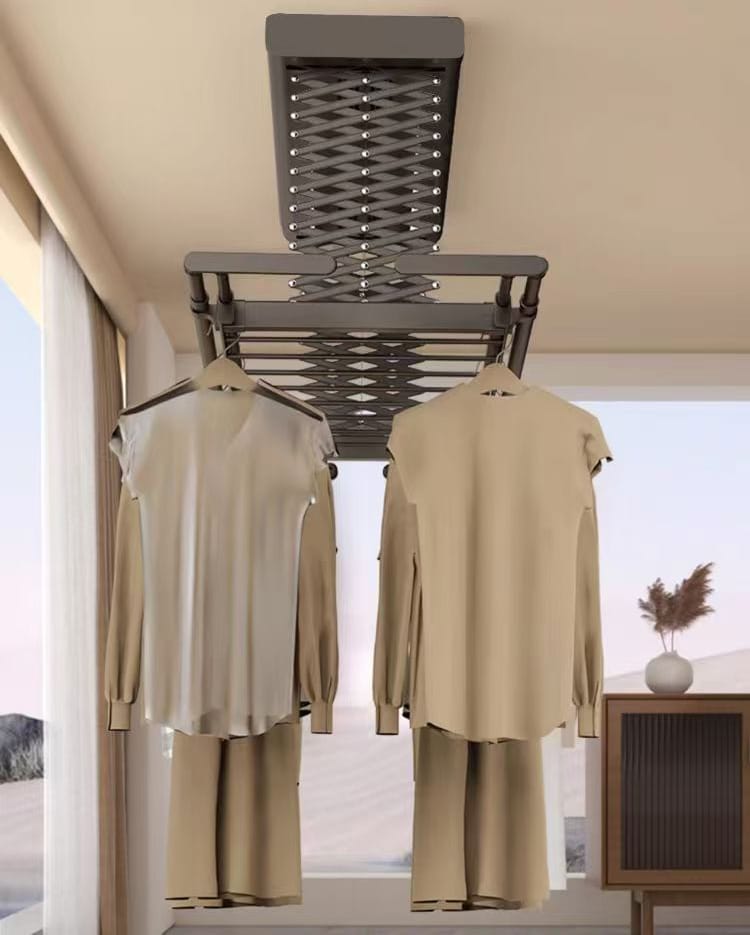
One of the easiest mistakes to make is judging structural strength by how thick or heavy a drying rack looks.
Actual stability comes from how loads travel through the system.
When wet clothing is hung on a rail, the weight travels from the rail into joints, supporting arms, brackets, cables, mounting points, and eventually the wall, ceiling, or floor. Every transition is part of the structural path.
For a freestanding rack, leg geometry and frame bracing influence whether the rack remains stable when clothing is placed unevenly on one side.
For a wall-mounted rack, the connection between the folding frame and wall brackets becomes particularly important.
For a ceiling-mounted system, suspension components and mounting points must support both the rack itself and the laundry hanging below it.
This is why a metal drying rack laundry design should be considered as a complete assembly rather than a collection of individual metal bars.
Repeated movement also matters. Folding joints, telescopic poles, pulleys, cables, motors, and lifting mechanisms experience repeated operating cycles. A rack that feels stable when new should also be designed so that routine movement does not quickly create looseness or misalignment.
Freestanding, Wall-Mounted, or Ceiling-Mounted Metal Drying Rack?
The best configuration depends largely on where you have usable space.
A freestanding metal rack provides the greatest placement flexibility. It can be moved when necessary and usually requires no structural installation. This makes it practical when the drying area changes regularly.
The tradeoff is floor space. Once loaded with laundry, the rack may occupy an important walking or working area. This becomes more noticeable in compact laundry rooms where appliances, baskets, storage, and doors already compete for floor area.
Wall-mounted racks solve this problem by transferring the drying area to an unused vertical surface. Folding versions can stay relatively compact when empty. Their limitation is that sufficient wall width and extension clearance must remain available.
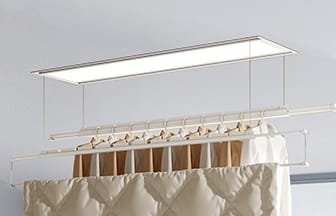
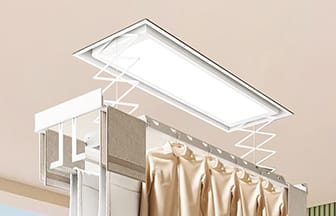
Ceiling-mounted systems take the concept further by moving drying space overhead. This allows laundry to occupy an area that would otherwise contribute little to storage or movement.
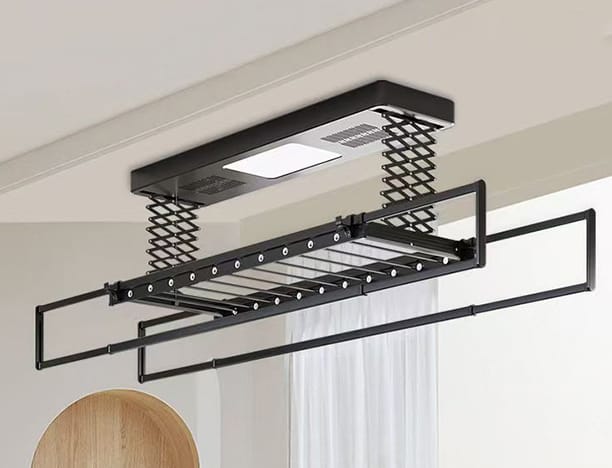
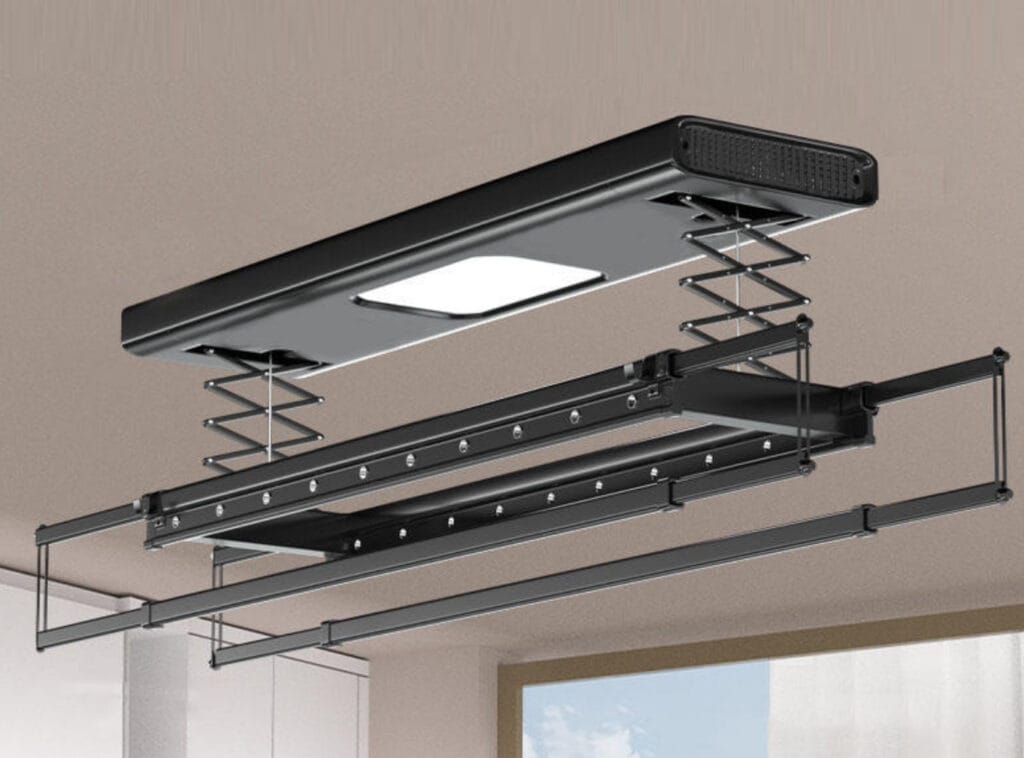
YIHUI’s automated clothes rack solutions demonstrate how an overhead structure can combine a metal drying frame with adjustable positioning, allowing the rack to move between a convenient loading position and a higher drying position.
The best configuration is therefore not determined solely by rack capacity. It depends on which part of the room—floor, wall, or ceiling—can be used without interfering with everyday activity.
Manual vs Automatic Metal Drying Rack Laundry Systems
Metal drying racks can also be divided according to how they move.
A fixed rack has no height adjustment and relies on the user being able to access its drying rails directly. This simplifies the structure but places greater importance on installation height.
Manual lifting systems introduce mechanical movement without requiring motorized operation. A hand ceiling drying rack can use a mechanical lifting arrangement to bring the rack down for loading before returning it to a higher drying position.
Automatic systems perform the same basic spatial function using powered lifting. Their value becomes clearer when the rack is installed above normal reaching height or used frequently.
The difference is not simply “manual versus electric.” It is about how users interact with vertical space.
A fixed ceiling rack may use space efficiently but become inconvenient if users regularly reach upward while holding heavy wet garments. A lifting mechanism solves this accessibility problem by separating loading height from drying height.
Automatic systems introduce additional engineering considerations because motors, control systems, movement protection, electrical components, and mechanical transmission become part of the product. These systems should therefore be evaluated for movement stability and safety as well as material quality.
Manual systems contain fewer powered components, but cable condition, crank mechanisms, load balance, and mounting stability remain important.
Neither approach is universally better. Frequency of use, installation height, laundry volume, preferred operation, and room layout should guide the decision.
What Load Capacity Really Means
Load capacity is one of the most commonly misunderstood specifications for a metal drying rack laundry setup.
A rack’s maximum stated load does not necessarily describe the most practical everyday operating condition. There is a difference between the total weight a structure can support and the amount of laundry that can be arranged effectively for drying.
Imagine a rack capable of supporting a large number of wet garments. If those garments must be pushed tightly together to fit, the structural capacity may be sufficient while drying performance becomes less efficient.
Load distribution is equally important.
Ten kilograms placed evenly across several rails can affect a rack differently from the same weight concentrated on one extending arm. Heavy towels or bedding placed entirely on one side may create uneven forces on joints, cables, or mounting points.
For this reason, users should consider three forms of capacity:
Structural capacity describes how much load the complete system is designed to support.
Hanging capacity describes the available rail length, hanger positions, or drying areas.
Practical drying capacity describes how much laundry can be arranged while maintaining useful spacing and airflow.
The third measure is often the most meaningful in everyday use.
A well-designed drying rack should therefore make it easy to distribute garments rather than simply providing the greatest possible number of hanging points.
Why Rail Spacing Matters for Drying Performance
Drying racks do not dry clothing simply because they hold garments above the floor. The rack’s role is to expose damp fabric to surrounding air so moisture can evaporate.
That means spacing matters.
When two wet garments remain pressed against each other, the contacting surfaces receive less air movement. Thick towels, trousers, bedding, and layered clothing are particularly sensitive to this problem.
A rack with many narrowly spaced rails may appear to offer greater capacity, but the actual drying result depends on how those rails are used.
This creates an important design balance.
Rails should provide enough hanging positions for normal laundry loads while still allowing users to separate garments according to fabric thickness and size.
Long items require vertical clearance as well. Dresses, trousers, and bedding can lose much of the benefit of an elevated rack if their lower sections bunch together on furniture or other clothes.
Airflow around the rack should also be considered at room level. Moisture removed from clothes enters the surrounding air, so effective ventilation helps move humid air away from wet fabric.
The practical lesson is simple: do not evaluate a metal drying rack by the number of rods alone. Evaluate the usable space between those rods and around the hanging garments.
Corrosion Resistance and Surface Treatment
Because drying racks regularly support damp textiles, corrosion resistance is an important part of long-term performance.
However, corrosion should not be considered only at the visible rail surface.
A metal drying rack laundry structure contains multiple interfaces: screws, joints, end caps, mounting brackets, telescopic sections, cables, weld areas, and moving components. These areas may experience different amounts of moisture and mechanical wear.
For aluminum structures, surface finishing can improve appearance, surface consistency, and resistance to environmental exposure.
Stainless steel performance depends partly on alloy composition and manufacturing quality. Damaged or poorly processed areas can behave differently from the main material.
Coated steel relies on its protective layer. Scratches, impact damage, poorly covered edges, and worn contact points can expose the underlying substrate.
Laundry racks with telescopic or folding sections present another challenge because contact between moving components may gradually wear surface finishes.
A useful inspection therefore goes beyond asking, “Will the rail rust?”
Look at how the rack is assembled. Consider where water may remain, which parts rub against each other, and whether fasteners and connection points receive appropriate protection.
Material durability is a system-level characteristic.
How to Evaluate a Metal Drying Rack for a Small Laundry Space
Small laundry rooms require a different selection mindset.
The goal is not simply to find the smallest rack. A very small rack may save space but require multiple drying cycles, which can make laundry management less convenient.
Instead, evaluate space in three dimensions.
Floor area tells you whether a freestanding rack can remain open without interfering with movement.
Wall area tells you whether a folding or retractable rack can extend without blocking cabinets, doors, switches, or appliances.
Ceiling area tells you whether an overhead system can provide drying capacity without consuming either of those areas.
This is why ceiling-mounted metal racks can be particularly efficient in rooms where floor and wall space already serve important functions.
Measure the rack in its operating position, not only its stored position.
For a folding wall rack, calculate how far it projects into the room with clothes hanging from it.
For a ceiling rack, consider both its raised and lowered height.
For a freestanding rack, include the space occupied by garments extending beyond the outer frame.
A useful layout keeps the normal circulation path open even while laundry is drying.
If the rack forces you to move it every time you access the washing machine or open a cabinet, the problem is not necessarily the size of the room. It may be that the rack type is incompatible with the room.
Choosing a Metal Drying Rack for Different Garments
Laundry is not a uniform load.
Light shirts, thick towels, trousers, bedding, sweaters, and long garments place different demands on a drying rack.
Shirts and light garments can often be arranged efficiently on hangers. A rack with dedicated hanger positions can keep them separated while using horizontal rail space efficiently.
Towels need broader exposure because folding a thick wet towel over several layers slows moisture movement from the inner fabric.
Long trousers, dresses, and similar garments require sufficient vertical clearance.
Bedding needs a different type of capacity. Large textile surfaces can occupy substantial rail length and may place concentrated loads on extending sections.
Sweaters and other garments that are better supported rather than suspended may require a flat drying solution rather than a conventional hanging rail.
This is why the question “How many clothes can this rack hold?” is often too simplistic.
A more useful approach is to look at what you wash most often.
If daily loads mainly contain shirts and smaller clothing, hanger capacity may matter most. If towels and bedding are frequent, usable rail length and structure become more important. If your laundry is mixed, adjustable or expandable drying space offers greater flexibility.
Safety Features Worth Checking
Safety becomes especially important when a metal rack is mounted above the normal living or working area.
The first requirement is secure structural installation. The ceiling or wall must be appropriate for the mounting system, and fasteners need to suit both the substrate and expected load.
Balanced loading is also important. Users should avoid concentrating heavy wet laundry on one side unless the rack has specifically been designed for that loading pattern.
Moving systems require additional attention.
Manual lifting mechanisms should move smoothly without abrupt slipping or uncontrolled lowering. Cables and mechanical components should remain aligned throughout their operating range.
Automatic racks should manage lifting and lowering predictably. Depending on the design, overload protection, obstruction response, controlled movement, and stopping functions can add another layer of protection.
Users should also consider what surrounds the rack. Cabinet doors, lighting fixtures, ceiling fans, shelves, furniture, and other structures can enter the movement path of a lifting system.
Safe operation therefore begins during room planning, not after installation.
Common Mistakes When Selecting a Metal Drying Rack Laundry Setup
One common mistake is assuming heavier always means stronger.
Material mass alone does not determine structural performance. Geometry, joints, mounting quality, reinforcement, and load distribution may be more important than how heavy the rack feels.
Another mistake is choosing based entirely on maximum dimensions.
A long rack may technically fit a room while making nearby cabinets difficult to open. A wide floor rack may provide excellent capacity but leave no practical walking route.
Ignoring wet-laundry weight is another problem. Dry garments can make a rack appear stable during initial testing, while a full load of freshly washed towels or bedding creates a much more demanding condition.
Users also frequently focus on rail count without considering spacing. More rails do not automatically mean better drying performance.
Finally, material should not become the only selection criterion.
A metal rack can still be poorly suited to a particular room if its installation type, operating height, folding direction, extension range, or capacity does not match the user’s routine.
The best product is not necessarily the strongest rack or the largest rack. It is the rack whose structure and layout solve the actual drying problem.
A Practical Metal Drying Rack Selection Method
A useful selection process begins with five questions.
First, where is the unused space?
If you have free floor area and need portability, a freestanding rack may be sufficient. If the floor is crowded but one wall is clear, a wall-mounted design may fit better. If both areas are valuable, look upward.
Second, what does a normal laundry load contain?
Do not size the rack around an exceptional load that occurs only occasionally. Base the main drying capacity on regular use.
Third, how often will the rack move?
A folding, retractable, manual lifting, or automatic system experiences repeated movement, which makes joint construction and mechanical quality especially important.
Fourth, how will clothes receive airflow?
Visualize garments hanging from the rack rather than looking at the empty frame. There should be enough space to separate heavier items when necessary.
Fifth, can the rack be used without disrupting the room?
The most successful drying setup usually feels almost invisible to the rest of the laundry routine. It should not require repeated furniture movement, obstruct appliance access, or make basic tasks harder.
These questions provide a much more reliable decision framework than comparing products by material name or rail count alone.
Conclusion
Choosing the right metal drying rack laundry setup requires more than selecting a material that looks strong.
Aluminum, stainless steel, and coated steel can all perform effectively when they are used in a well-designed structure. What matters is how the rails, joints, supports, fasteners, lifting components, and mounting system work together.
Space is equally important. Freestanding racks provide flexibility, wall-mounted racks make use of vertical surfaces, and ceiling-mounted systems can transform otherwise unused overhead space into a practical drying area.
Then there is the laundry itself. Garment weight, fabric thickness, rail spacing, airflow, and load distribution determine how useful the available capacity actually becomes.
Instead of searching for the largest or strongest rack, start with your normal laundry routine. Measure the real working space, identify the garments you dry most often, consider where wet clothes can hang without restricting movement, and evaluate how easily the rack can be accessed.
A well-selected metal drying rack should feel like part of the laundry space rather than another object occupying it. When material, structure, capacity, airflow, and installation are considered together, the result is a drying system that remains practical through repeated everyday use.
FAQ
Is a metal drying rack laundry setup better than a plastic rack?
Metal racks generally provide greater structural rigidity and can support designs such as long rails, folding frames, telescopic sections, and ceiling lifting systems. Plastic can still work for lightweight applications. The better choice depends on expected loads, moisture exposure, rack design, frequency of use, and installation requirements.
Which metal is best for a laundry drying rack?
There is no single best metal for every rack. Aluminum provides a useful balance of low weight and corrosion resistance, stainless steel offers strong corrosion resistance, and properly coated steel can provide structural strength. Construction quality, joints, surface treatment, and overall design matter as much as material type.
Can a metal drying rack be used in a small laundry room?
Yes. The key is choosing the right installation style. A large freestanding rack may occupy valuable floor area, while wall-mounted or ceiling-mounted metal racks can use vertical space more effectively. Measure doors, cabinets, appliances, operating clearance, and garment length before deciding which configuration fits.
How do I prevent a metal drying rack from rusting?
Choose materials and surface finishes designed for repeated moisture exposure, keep the rack reasonably dry between laundry cycles, maintain room ventilation, and inspect scratches, joints, fasteners, and moving sections periodically. Corrosion resistance depends on the entire structure rather than only the visible drying rails.
How much weight should a metal drying rack hold?
The required capacity depends on the size and type of laundry you normally dry. Rather than choosing the highest possible rating, consider wet garment weight, rail distribution, mounting conditions, and everyday drying volume. Heavy towels and bedding should be distributed across the structure instead of concentrated on one section.