Table of Contents
Introduction
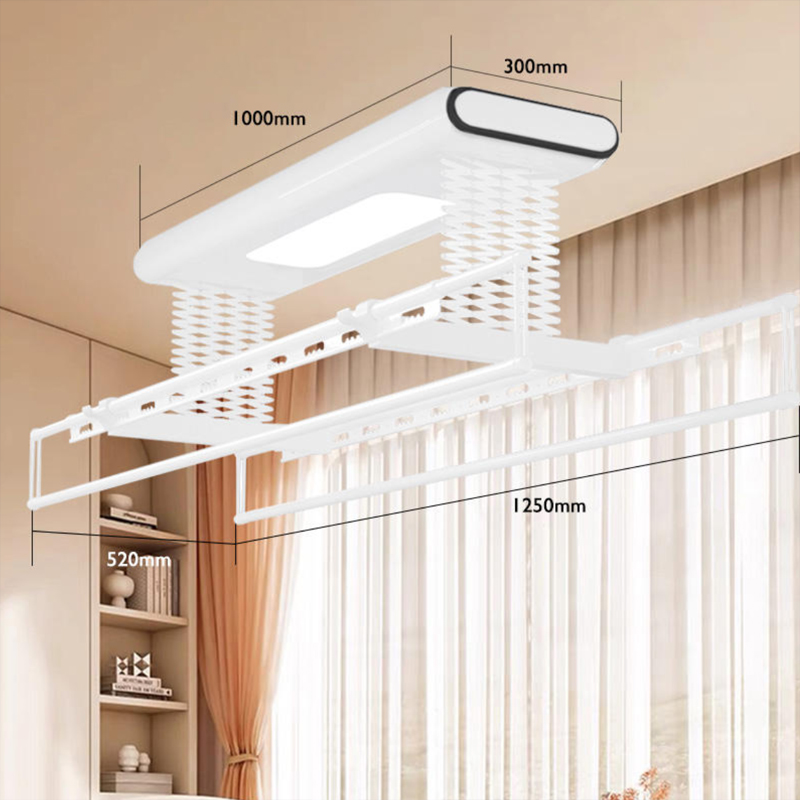
Laundry spaces are changing. Instead of being treated as purely functional corners filled with appliances and temporary drying equipment, they are increasingly being planned around efficient use of space, flexible storage, convenient workflows, and technology that reduces repetitive manual tasks.
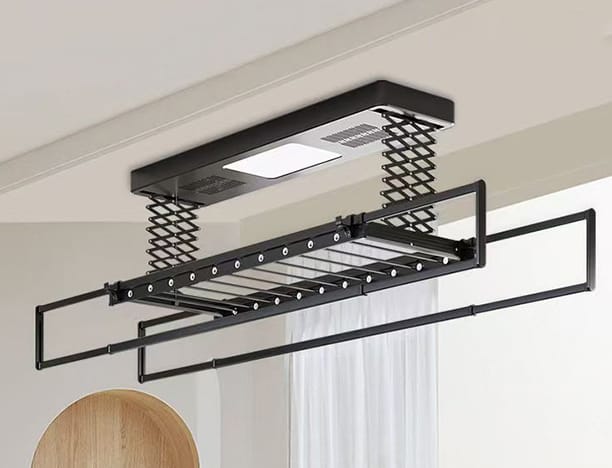
That shift helps explain the growing relevance of the clothes drying electric rack. Unlike a conventional floor rack that must be unfolded whenever wet laundry needs to dry, an electric system can use overhead space, lower toward the user for loading, and return upward when clothes are ready to dry.
The idea fits naturally with several broader design priorities shaping modern laundry areas: keeping floors clear, making small rooms perform more than one function, reducing visual clutter, and creating equipment that adapts to the user rather than forcing the user to adapt to the equipment.
However, an electric drying rack should not be selected simply because it contains a motor or remote control. The real value comes from the combination of structural design, lifting stability, usable drying capacity, rail spacing, safety protection, material durability, installation conditions, and daily convenience.
This guide looks at how clothes drying electric rack systems fit into changing laundry habits in 2026, what features genuinely matter, and how to distinguish useful engineering from features that add complexity without solving a real laundry problem.
Why Clothes Drying Electric Rack Systems Fit Modern Laundry Spaces
One of the most important changes in laundry-room planning is that space is becoming more multifunctional.
A laundry area may also contain storage, garment-care equipment, household supplies, work surfaces, baskets, cabinets, or other utility functions. When several activities have to share the same room, permanent floor occupation becomes inefficient.
Traditional freestanding drying racks create exactly this problem. They are simple and flexible, but when fully loaded they can take over a large portion of the usable floor.
An electric ceiling rack approaches the problem vertically.
Instead of asking where another object can be placed on the floor, it asks whether unused overhead space can perform the drying function.
This changes the relationship between drying capacity and room size. A compact laundry area does not necessarily need a compact drying load if vertical space can be used efficiently.
The rack can descend toward a comfortable loading height, support wet garments during arrangement, and then rise toward the ceiling so the lower portion of the room becomes usable again.
That is why the value of electric lifting is not merely technological. Its main benefit is spatial.
A properly designed system allows one physical area to serve two functions at different heights.
Trend 1: Laundry Equipment Is Moving Off the Floor
Space-saving design is often misunderstood as simply making products smaller.
In practice, the more effective strategy is often moving functions away from the most valuable areas.
Floor space is valuable because people need it for walking, carrying baskets, opening appliance doors, accessing cabinets, sorting clothing, and performing routine household tasks.
Ceiling space typically performs far fewer functions.
A clothes drying electric rack uses this imbalance to its advantage.
When wet clothes are positioned overhead, the floor underneath does not necessarily become unusable. Depending on installation height and garment length, the same area can continue serving other purposes.
This is especially useful when drying is not a short activity. Wet clothing may remain on a rack for hours, so even a folding floor rack temporarily occupies the room for a significant part of the laundry cycle.
Moving the drying zone upward reduces this conflict.
This does not mean every ceiling position is automatically suitable. Lighting fixtures, doors, tall cabinets, ventilation outlets, and the movement path of the rack must still be considered.
The principle is therefore not simply “install it on the ceiling.” It is “use overhead space without creating a new obstruction.”
Trend 2: Height-Adjustable Laundry Equipment Is Becoming More Practical
Fixed-height equipment assumes that one working position suits every stage of a task.
Laundry does not work that way.
A high position is useful when clothes are drying because it keeps garments away from the main working area. The same height can be inconvenient when users need to hang wet shirts, arrange trousers, spread towels, or remove dry garments.
Electric lifting solves this contradiction by creating separate loading and drying positions.
During loading, the rack can move downward. Once garments are arranged, it can return upward.
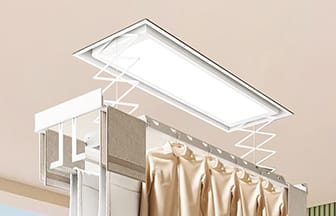
An electric ceiling drying rack can also incorporate expandable rails, giving the structure another form of adjustment beyond vertical movement.
This distinction matters when evaluating the practical benefit of automation.
The strongest electric drying systems are not automated merely because automation sounds modern. Their powered movement solves a specific ergonomic problem: the best position for drying is not always the best position for handling clothes.
When technology addresses that conflict directly, it creates meaningful value in everyday use.
Trend 3: Smart Laundry Is Becoming Part of the Connected Home
The concept of a smart home has gradually moved beyond obvious categories such as lighting, climate control, and security.
Laundry equipment increasingly fits into the broader idea of home automation, where household devices use powered controls, sensors, programmed functions, or connected interfaces to reduce repetitive manual actions.
A clothes drying electric rack represents a relatively straightforward form of this idea.
At its most basic level, the system replaces manual lifting with powered vertical adjustment. More advanced configurations may integrate remote operation, lighting, airflow functions, position control, or protection mechanisms.
However, smart functionality should always be evaluated according to usefulness.
A feature is valuable when it improves one of four things:
daily convenience, drying conditions, space utilization, or operational safety.
If a function does not meaningfully improve one of these areas, it may add complexity without improving the drying experience.
For example, motorized lifting has a clear purpose because it changes accessibility. Automatic stopping can have a clear safety purpose. Integrated airflow may help improve air movement around wet fabrics.
The useful question is therefore not “How many smart functions does the rack have?”
It is “Which functions solve problems that occur during normal laundry use?”
That difference helps users avoid selecting products based on feature count alone.
How a Clothes Drying Electric Rack Actually Works
The visible drying rails are only one part of an electric rack.
A typical system combines a fixed installation structure, suspension or lifting components, a motorized drive, drying rails, electronic controls, and supporting safety mechanisms.
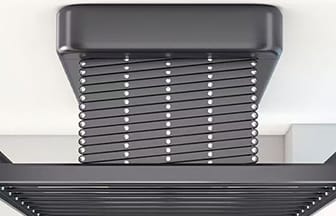
When the lifting command is activated, the motor drives the mechanism that changes the rack’s vertical position. The drying frame descends toward a usable loading height or rises toward its storage and drying position.
This movement must remain controlled and balanced.
If one side moves inconsistently, the rack may tilt. If the suspension system does not distribute weight properly, concentrated loads can affect mechanical performance. If stopping behavior is abrupt, repeated operation may place unnecessary stress on connections.
This is why motor power alone is not a sufficient indicator of quality.
A good system depends on cooperation between the motor, suspension structure, frame, cables or drive components, sensors, mounting points, and control logic.
The best design is one where users hardly notice these engineering details because the movement feels smooth and predictable.
Electric Drying Rack vs Traditional Drying Rack
Electric and traditional drying racks can both perform the basic function of supporting wet clothing, but they approach space and accessibility very differently.
| Factor | Clothes Drying Electric Rack | Traditional Floor Rack | Wall-Mounted Rack |
|---|---|---|---|
| Floor space use | Very low | High during use | Low |
| Height adjustment | Motorized on suitable models | Usually fixed | Usually fixed |
| Permanent installation | Yes | No | Usually yes |
| Loading accessibility | Adjustable | Easy | Depends on mounting height |
| Storage after use | Raised overhead | Must be folded or moved | May fold against wall |
| Drying capacity flexibility | Can include extendable rails | Depends on frame | Limited by wall width |
| Mechanical complexity | Higher | Low | Low to moderate |
| Best advantage | Vertical space utilization | Portability | Efficient wall use |
| Main planning requirement | Ceiling and movement clearance | Available floor area | Clear wall area |
The comparison shows why an electric rack should not automatically be considered a replacement for every traditional design.
A portable rack may still be more appropriate where installation is undesirable or the drying area changes frequently.
A wall rack may be an efficient solution when there is a large unused wall and no need for adjustable height.
Electric ceiling systems become particularly useful when floor and wall areas already have important functions and the ceiling provides a better location for permanent drying equipment.
The decision should therefore begin with the room, not the technology.
What Makes an Electric Drying Rack Truly Space-Saving?
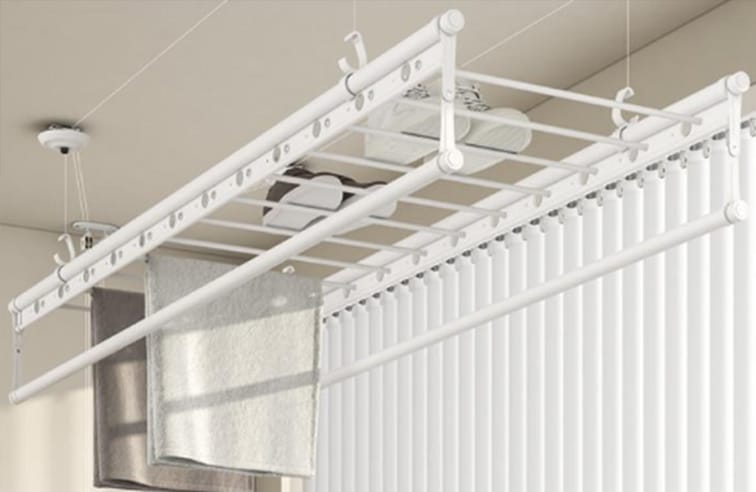
The phrase “space-saving” appears frequently in household equipment descriptions, but its practical meaning deserves closer examination.
A product saves space only if it reduces interference with activities that matter.
Moving a drying rack from the floor to the ceiling can save valuable floor area, but poor installation can simply transfer the obstruction somewhere else.
For example, a ceiling rack may interfere with cabinet doors when lowered. Long clothes might touch a countertop underneath. A rack positioned too close to lighting or other ceiling equipment can create unnecessary conflicts.
True space efficiency requires planning the complete movement envelope.
This includes:
the rack’s raised dimensions, lowered dimensions, extended dimensions, garment length, surrounding fixtures, and the space required for people to load it comfortably.
A clothes drying electric rack with telescopic rails introduces another variable because its width or hanging length may change according to the laundry load.
This flexibility can be useful because maximum capacity does not need to occupy maximum space every day.
Instead, users can expand drying space when handling bedding or larger loads and maintain a more compact configuration during lighter laundry cycles.
That is a better example of space-saving design than simply making every component smaller.
Why Rail Design Matters as Much as Motorized Lifting
Electric lifting attracts attention because it is the most visible difference between an automatic rack and a conventional one.
For actual drying performance, however, rail design is equally important.
A rack needs enough usable hanging length to support typical laundry without forcing garments into excessive contact.
If shirts, towels, or trousers remain tightly packed together, air movement around damp surfaces is reduced.
This creates an important difference between theoretical capacity and practical drying capacity.
Theoretical capacity measures how many garments can physically be placed on the rack.
Practical drying capacity considers whether those garments can remain sufficiently separated for air to reach damp fabric surfaces.
A high-quality rack should provide flexible spacing rather than simply maximizing the number of bars.
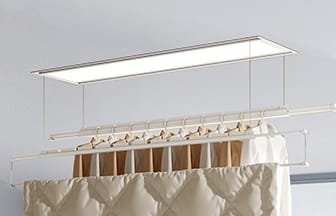
Hanger positions can work efficiently for shirts, dresses, and lightweight garments. Longer rails provide more flexibility for towels and bedding. Extendable poles can accommodate changing laundry loads without permanently enlarging the complete structure.
The best layout therefore depends on garment variety.
A rack designed primarily around shirts may not handle bedding efficiently. A structure optimized for large textiles may use more space than necessary for smaller daily loads.
Versatility comes from allowing the rack to adapt to both.
Airflow Is Still Essential Even with an Electric Rack
Motorized lifting does not change the basic physics of air drying.
Water must still evaporate from wet fabric and move into the surrounding air.
For this reason, airflow should remain part of any clothes drying electric rack selection process.
Garment spacing is the first factor.
Wet fabrics pressed closely together expose less surface area to moving air. Thick towels, jeans, layered clothing, and bedding are especially likely to dry unevenly if arranged too densely.
Room ventilation is the second factor.
As moisture evaporates, the surrounding air becomes more humid. If that humid air remains trapped around the clothes, further evaporation can become less effective.
A drying rack should therefore be positioned where room airflow can move around the garments.
Some electric systems also incorporate airflow-assisted functions. These can improve air circulation around hanging garments, but they should complement proper spacing rather than compensate for an overloaded rack.
There is an important practical lesson here: more capacity should not mean tighter packing.
A rack that technically supports a large number of garments may provide poorer drying conditions than a slightly smaller load arranged with appropriate spacing.
Trend 4: Flexible Capacity Is Replacing Fixed Maximum Size
Modern household equipment increasingly needs to accommodate changing demands rather than one fixed scenario.
Laundry is a good example.
One cycle may contain lightweight shirts and smaller garments. Another may include towels, long trousers, bedding, or bulky textile items.
Choosing a drying rack solely for the largest possible load can result in an oversized structure that occupies unnecessary space most of the time.
Expandable drying racks offer another approach.
Telescopic rails or extension poles allow users to increase hanging length when necessary while keeping the main structure more compact for normal loads.
YIHUI’s range of automated clothes rack systems includes different configurations based around powered lifting and adaptable drying structures, reflecting the broader move toward flexible rather than fixed laundry layouts.
Adjustability does introduce additional mechanical considerations.
Sliding components, extension joints, locking points, and rail connections experience repeated use. They should remain stable when partially extended and when operating at their full intended length.
A flexible rack is useful only when flexibility does not reduce structural confidence.
Materials Matter More in a Moving System
Material selection is important in any drying rack, but an electric rack creates additional demands because parts of the structure move repeatedly.
Aluminum can be particularly useful in lifting systems because it combines relatively low weight with corrosion resistance.
Reducing the weight of moving components can help create a more manageable mechanical structure while still providing useful rigidity.
Steel components may be used where greater localized strength or particular structural characteristics are needed.
What matters is not whether every visible section uses the same metal. Different parts of the rack perform different mechanical roles.
Rails support clothing.
Mounting brackets transfer load into the ceiling.
Suspension components carry the frame.
Extension mechanisms accommodate movement.
Fasteners hold structural interfaces together.
The quality of the complete rack therefore depends on how these components work together.
Surface treatment should also be considered because drying equipment frequently encounters damp fabric and humid air.
Moving sections create additional wear points where surfaces contact each other repeatedly.
For this reason, durability should be evaluated at joints, connections, telescopic sections, cables, and mounting points rather than only on the most visible rail surfaces.
Safety Features Should Be Evaluated Before Extra Convenience Features
A clothes drying electric rack is suspended equipment with powered movement, so safety deserves more attention than decorative or secondary features.
The first requirement is suitable installation.
The ceiling structure and fixing method must be capable of supporting the rack, its components, and the intended laundry load.
The second requirement is controlled movement.
The rack should raise and lower smoothly rather than moving unpredictably.
Obstruction response can also be important. If an object interferes with the movement path, an appropriate protection mechanism can help reduce unnecessary stress on the system or surrounding objects.
Overload protection serves a different purpose by helping prevent operation outside intended load conditions.
YIHUI’s current ceiling drying rack specifications include features such as automatic stopping when an obstruction is detected and overload protection, illustrating the type of safeguards that can be incorporated into motorized drying equipment.
However, electronic protection does not replace correct use.
Laundry should still be distributed reasonably across the frame rather than concentrated heavily on one side. The movement area should remain free from cabinets, furniture, fixtures, or stored objects.
Smart protection works best when combined with appropriate installation and normal operating discipline.
Energy Efficiency: What Users Should Actually Consider
Energy efficiency is becoming increasingly relevant when people evaluate household technology, but comparisons should remain realistic.
An electric drying rack uses electricity primarily for powered features such as lifting, lighting, airflow, or additional functions depending on the model.
The motor normally operates only while the rack changes position rather than continuously throughout the entire drying period.
If airflow or other powered functions are used, their operating time becomes more relevant.
This makes feature control important.
Users should be able to activate functions when they provide practical value rather than operating everything automatically for every load.
For example, a light may be useful when handling laundry in a darker working area but unnecessary during the entire drying cycle.
Airflow assistance may be valuable under certain indoor conditions but may not be required for every garment load.
Efficient product design therefore does not simply mean reducing electrical specifications. It means giving users appropriate control over when powered functions operate.
The most efficient feature is often one that can remain off when it is not needed.
How to Choose the Right Clothes Drying Electric Rack
A useful selection process should begin with measurements rather than product features.
Start by measuring the installation area.
Record ceiling length and width, but also identify lighting fixtures, cabinets, doors, vents, shelves, and other objects that may enter the rack’s operating area.
Then determine the required loading height.
The main advantage of electric lifting is lost if the lowest position still requires uncomfortable reaching.
Next, consider your normal laundry volume.
Do not choose capacity based entirely on an exceptional load. A rack should primarily handle the type and quantity of clothing you dry most frequently.
Garment type matters as well.
Long clothing requires vertical clearance. Towels need enough rail area to avoid excessive folding. Bedding requires longer support. Shirts can often use hanger positions efficiently.
After that, evaluate the mechanism.
Look at movement stability, suspension design, control method, stopping behavior, safety protection, extension mechanisms, and the structural relationship between the moving frame and fixed ceiling unit.
Finally, consider maintenance access.
Motors, moving components, connections, and controls should not become impossible to inspect after installation.
This complete process gives a much clearer picture than comparing models by motor specifications alone.
Common Mistakes When Selecting an Electric Drying Rack
One common mistake is treating automation as the main selection criterion.
A rack can have many electronic functions and still perform poorly if its basic structure, hanging layout, or installation does not suit the room.
Another mistake is selecting maximum capacity without considering garment spacing.
If every rail must be filled tightly to reach the advertised capacity, the practical drying arrangement may be less useful than expected.
Installation height is also frequently overlooked.
Users may focus on how high the rack rises while paying less attention to how low it descends. For everyday convenience, both positions matter.
Another error is ignoring the extended footprint.
Telescopic rails can increase capacity, but the expanded structure still needs clearance from walls, cabinets, and surrounding fixtures.
Finally, users sometimes assume that powered drying features eliminate the need for room ventilation.
They do not.
Moisture still needs somewhere to go after it leaves the fabric. Good garment spacing and appropriate room airflow remain essential parts of indoor drying.
Is a Clothes Drying Electric Rack Right for Every Laundry Space?
Not necessarily.
The main strength of an electric rack is its ability to make ceiling space accessible.
If a room already has abundant floor space and the drying rack needs to move frequently between locations, a portable design may remain more practical.
If there is a large unused wall and only a small amount of laundry is normally air-dried, a folding wall system may solve the problem with less mechanical complexity.
An electric ceiling rack becomes more compelling when several conditions occur together.
Floor space is valuable.
Ceiling space is available.
Laundry is air-dried frequently.
Fixed high racks are inconvenient to reach.
Users want the drying structure to disappear from the main working zone after loading.
Those conditions create a situation where motorized lifting addresses a genuine spatial and ergonomic problem.
That is the right way to evaluate smart laundry equipment: start with the problem, then determine whether technology improves the solution.
What the 2026 Direction Means for Electric Drying Racks
The most useful trend in laundry design is not simply the addition of more technology.
It is better integration.
Rooms are being expected to perform more functions while remaining organized. Equipment needs to occupy less permanent working space. Controls should reduce repetitive effort. Adjustable components should adapt to different loads rather than forcing every user into the same configuration.
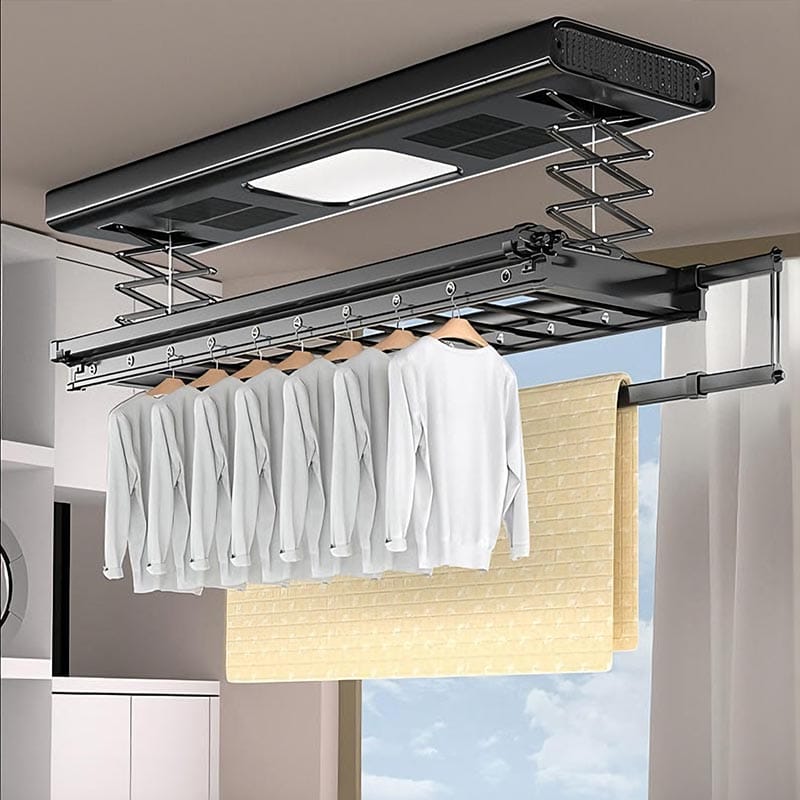
A clothes drying electric rack fits this direction because it combines several ideas in one structure: vertical space utilization, height adjustment, flexible drying capacity, controlled movement, and potentially integrated laundry functions.
The next stage of product development should continue focusing on these practical improvements rather than adding technology for its own sake.
Quieter movement can improve daily comfort.
Better obstruction detection can improve operational confidence.
More adaptable rails can increase useful drying capacity.
Improved structural design can reduce unnecessary weight.
Better controls can allow powered functions to operate only when needed.
These developments all share one characteristic: they solve recognizable laundry problems.
That is ultimately what determines whether a smart drying product remains useful after the novelty of automation has disappeared.
Conclusion
The clothes drying electric rack is becoming increasingly relevant because modern laundry spaces need to do more with the area they already have.
Its strongest advantage is not simply that it uses electricity. It is that motorized height adjustment turns ceiling space into accessible drying space.
When the rack lowers, users can arrange wet garments comfortably. When it rises, the floor and working area become available again. Expandable rails can adapt to changing laundry loads, while integrated safety and control functions can make repeated operation more predictable.
However, choosing an electric rack still requires careful evaluation.
Motorized lifting cannot compensate for weak construction. High capacity cannot compensate for poor garment spacing. Smart controls cannot compensate for an unsuitable installation position.
The best system balances structural stability, useful capacity, airflow, material durability, safety, comfortable loading height, and space efficiency.
As laundry areas become more compact, multifunctional, and technology-oriented, electric ceiling drying systems have a clear role to play. The most successful designs will be those that make laundry simpler without making the equipment itself unnecessarily complicated.
FAQ
What is a clothes drying electric rack?
A clothes drying electric rack is a powered laundry system that uses a motor to adjust the position of the drying frame. Ceiling-mounted models can lower the rails for convenient loading and raise them afterward, helping use overhead space while keeping important floor areas available for other laundry activities.
Is a clothes drying electric rack suitable for a small laundry room?
Yes, especially when floor and wall space are limited but suitable ceiling space remains available. A ceiling-mounted electric rack moves the drying area vertically, allowing wet clothes to remain above the main working zone. Installation clearance, lowered height, garment length, and nearby fixtures should still be measured carefully.
What features should I look for in an electric clothes drying rack?
Focus first on smooth lifting, structural stability, suitable load capacity, durable materials, practical rail spacing, obstruction protection, overload protection, and appropriate installation design. Expandable rails, lighting, airflow functions, and remote control can add convenience when they match your normal laundry routine.
Does an electric drying rack dry clothes automatically?
Motorized lifting alone does not actively dry clothes; it mainly changes rack height. Some systems add airflow or other assisted functions, but moisture still needs to evaporate from the fabric and move into the surrounding air. Garment spacing, indoor ventilation, fabric thickness, and humidity continue to influence drying.
How do I choose the right size clothes drying electric rack?
Measure the complete usable ceiling area and consider the rack in both raised and lowered positions. Account for cabinets, lighting, doors, vents, garment length, and extended rails. Then match usable hanging capacity to your normal laundry volume rather than selecting the largest structure that can physically fit the room.