Table of Contents
Introduction
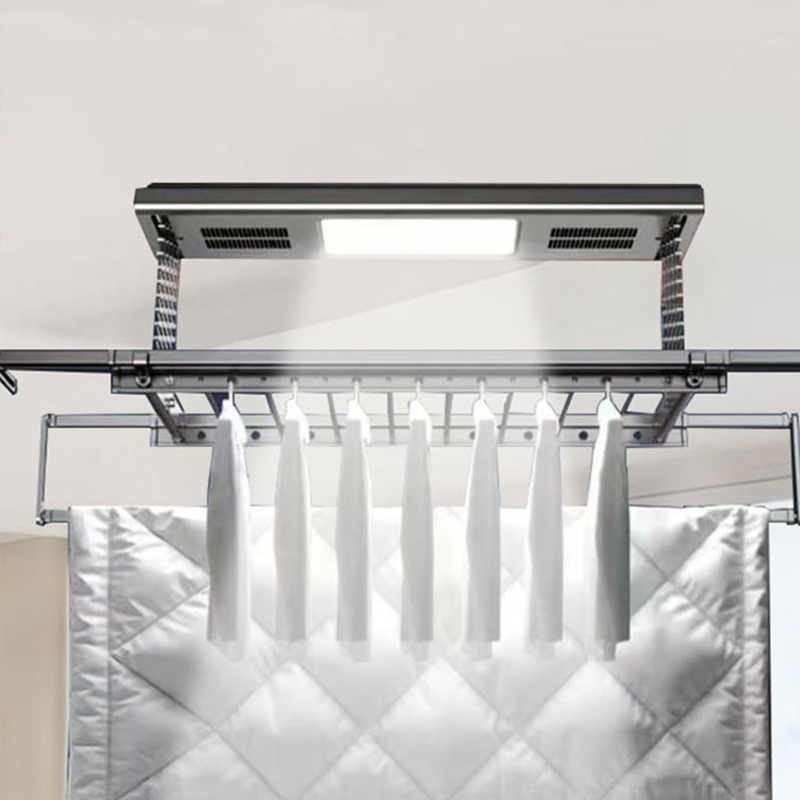
A foldable drying clothes rack seems simple until you start using one every week. Once wet shirts, towels, trousers, bedding, and delicate garments are involved, details such as frame stability, rail spacing, folding direction, open dimensions, storage thickness, material, and airflow become much more important than they appear in an empty product photo.
The biggest appeal of a folding drying rack is flexibility. It provides drying space when you need it and reduces its physical footprint when laundry is finished. That makes the design particularly relevant for laundry rooms and multipurpose spaces where floor area, wall surfaces, cabinets, appliances, and storage all compete for room.
However, folding alone does not make a rack space-efficient.
A rack may become very thin when stored but occupy a large section of floor when opened. A wall-mounted model may sit neatly against the wall but block a cabinet when extended. A large multi-tier rack may offer impressive capacity but provide poor airflow if garments are packed closely together.
The right way to choose a foldable drying clothes rack is therefore to examine how it performs throughout the complete laundry cycle: opening, loading, drying, unloading, folding, and storage.
This guide explains the factors that matter most and helps you distinguish genuinely practical folding designs from racks that only look compact when they are empty.
What Makes a Foldable Drying Clothes Rack Different?
A traditional fixed drying rack maintains roughly the same structure whether it is being used or not. A foldable rack changes configuration.
That movement can happen in several ways.
Freestanding racks normally use hinged legs or folding wings. Wall-mounted designs rotate toward the wall after use. Retractable racks slide inward. Telescopic rails increase or decrease hanging length, while some overhead systems combine height adjustment with extendable drying sections.
The common idea is adaptable capacity.
Instead of dedicating permanent room to the maximum drying load, the user expands the structure only when additional drying area is required.
This design principle becomes particularly useful when the laundry area serves more than one purpose. Once the rack is folded, the same space can return to circulation, storage, garment care, or other daily tasks.
The important distinction is that foldability describes movement rather than overall quality.
A rack with many folding sections is not automatically more useful than one with a simpler frame. Every hinge, joint, sliding rail, and rotating arm must remain stable while supporting wet laundry.
The best design uses movement only where movement provides a practical benefit.
Start With Open Size, Not Folded Size
One of the easiest mistakes is choosing a drying rack because its folded dimensions look impressively small.
Those dimensions matter for storage, but they tell you very little about how the rack will behave during the hours when clothing is actually drying.
Measure the operating footprint first.
For a freestanding foldable rack, consider its full width and depth with every drying wing open.
For a wall-mounted design, measure the distance from the wall to the outermost rail after extension.
For a multi-level model, consider how far garments themselves extend beyond the frame.
Long dresses, trousers, shirts on hangers, and towels can increase the effective drying footprint considerably.
A useful way to evaluate a foldable drying clothes rack is to think in three dimensions:
| Measurement | What It Tells You | Why It Matters |
|---|---|---|
| Folded size | Storage requirement | Determines where the rack can stay between uses |
| Open rack size | Working footprint | Shows how much room the structure occupies |
| Loaded footprint | Real drying space | Includes garments extending beyond the frame |
| Rail height | Garment clearance | Affects trousers, dresses and long items |
| Rail spacing | Practical drying capacity | Influences airflow between garments |
| Maximum extension | Largest usable configuration | Important for adjustable or telescopic racks |
The loaded footprint is often the most important measurement because that is the condition in which the rack remains for the longest period.
If the rack blocks a walkway or appliance every time clothes are drying, its compact folded dimensions do little to solve the actual space problem.
Freestanding Foldable Racks: Best When Portability Matters
Freestanding folding racks remain one of the most familiar air-drying solutions.
Their main advantage is flexibility. They usually require no permanent mounting, can be moved between suitable areas, and can be folded for storage after use.
This makes them practical when the drying location changes according to ventilation, available space, or laundry volume.
A traditional clothes horse follows this general principle: a portable structure provides temporary support for air-drying garments without requiring permanent installation.
Modern versions may include multiple levels, side wings, hanger sections, wheels, telescopic rods, or combinations of these features.
The drawback is floor occupation.
Even if the frame disappears into a narrow storage area after use, it must stand somewhere while the laundry dries.
This can become inconvenient when the rack remains open for much of the day.
For occasional drying or spaces with enough open floor area, that tradeoff may be completely reasonable. For compact rooms where every walkway matters, another configuration may work better.
Wall-Mounted Foldable Racks: Better When Floor Space Is Limited
Wall-mounted folding racks address the floor-space problem by creating drying capacity from a vertical surface.
The rack remains attached to the wall and opens only when needed. After the garments are removed, the drying section folds or retracts toward the mounting surface.
This arrangement can work particularly well near a laundry area where one wall is intentionally reserved for garment drying.
The advantage is predictable organization.
Instead of carrying a portable rack into the room and finding temporary space for it, the drying zone always remains in the same location.
But installation planning matters.
A wall that appears empty may still need clearance for cabinet doors, switches, shelves, appliance doors, windows, or normal movement.
The extended rack can also project significantly farther into the room once clothing is hanging from the outer rails.
YIHUI’s existing guide to the best clothes drying rack foldable discusses compact folding and storage as key selection considerations, but the real decision should include both the stored and extended configurations.
Wall mounting works best when you can deliberately assign part of the room as a temporary drying zone.
When Ceiling Space Works Better Than Folding Floor Space
Sometimes the most efficient foldable drying clothes rack is not a conventional floor model at all.
If floor area is already occupied by appliances and storage, and wall surfaces are also valuable, the ceiling may offer more usable space than either.
Overhead racks change the basic strategy.
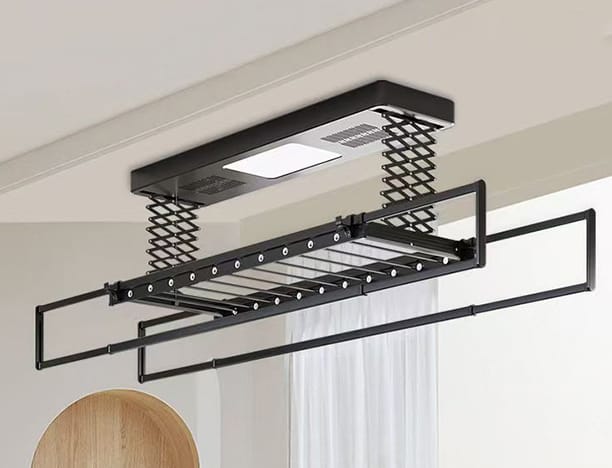
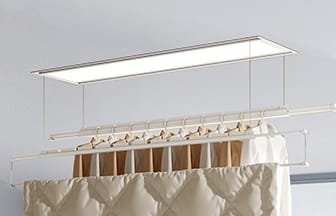
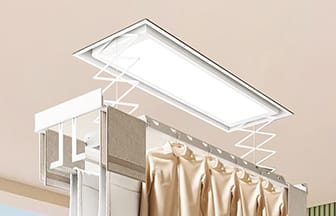
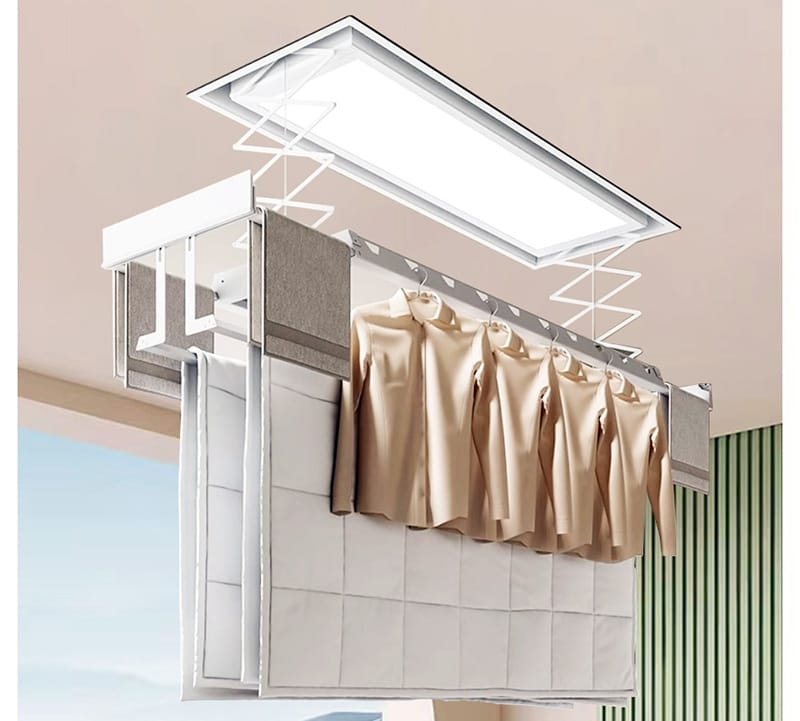
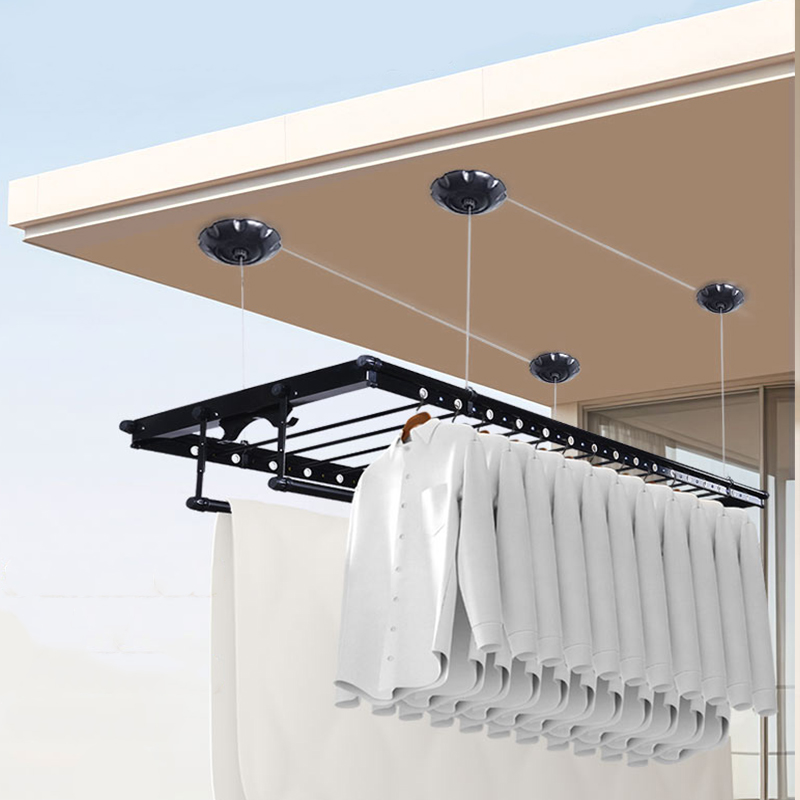
Instead of folding a structure away horizontally, the drying area can move vertically. A manual or automatic lifting system lowers toward the user during loading and rises after the clothes have been arranged.
This makes the drying zone accessible without permanently occupying the normal working height of the room.
For frequent laundry routines, vertical movement can sometimes provide more practical space management than repeatedly setting up and storing a floor rack.
The distinction is important.
A foldable rack saves space by changing its physical dimensions.
A lifting rack saves space by changing its physical position.
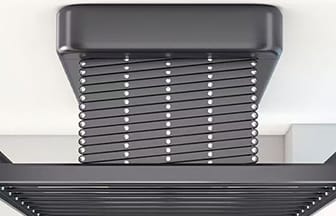
YIHUI’s automated clothes rack range includes overhead configurations with lifting and expandable drying structures, illustrating how foldable, retractable, and height-adjustable ideas can work together within the same overall space-saving approach.
The better method depends on which area of the room is genuinely available.
Check the Folding Mechanism Before the Main Frame
People naturally look at the largest tubes or rails when judging drying-rack strength.
For a foldable design, the moving connections often deserve even more attention.
A fixed metal tube may remain structurally stable for years because it does not change position. A hinge experiences movement every time the rack opens and closes.
The same principle applies to telescopic rails.
Sliding sections repeatedly move against each other and must remain aligned across different extension lengths.
When examining a foldable drying clothes rack, pay attention to how joints behave in the fully open position.
The structure should not depend on excessive looseness to move freely. Folding arms should remain controlled rather than wobbling noticeably under normal loads.
Locking mechanisms should also hold the rack securely in its operating position.
A rack that folds easily but feels unstable when open has prioritized storage convenience over its primary function.
For frequent use, both operations need to work well.
Why Wet Laundry Changes the Structural Requirements
Dry clothing can make almost any rack appear stable.
Wet clothing is different.
Fabric holds additional water after washing, increasing the load placed on rails, hinges, legs, brackets, and extension mechanisms.
The effect becomes more noticeable with towels, denim, bedding, and heavier garments.
This is why evaluating a rack by touching an empty display frame can be misleading.
A useful drying structure needs to handle both the total load and the way that load is distributed.
Imagine placing several heavy towels on one folding wing while the opposite side remains empty. The total weight may not be unusually high, but the uneven distribution changes the forces acting on the frame.
Freestanding racks need sufficient stability to resist tipping.
Wall-mounted racks need strong connections between the drying arms and mounting brackets.
Telescopic structures need to remain stable when extended.
Overhead racks need appropriate suspension and mounting systems.
Good rack design therefore considers the entire load path, not simply the strength of individual rails.
Aluminum vs Stainless Steel vs Coated Steel
Material selection influences weight, corrosion resistance, stiffness, surface durability, and the behavior of moving sections.
Aluminum is frequently used where relatively low structural weight is useful. This can be especially valuable in folding, telescopic, or lifting systems where users or motors repeatedly move part of the frame.
Stainless steel can provide good corrosion resistance and structural performance when suitable specifications are used.
Coated steel can also work effectively when surface protection remains intact and the frame design suits the intended load.
But asking which metal is “best” oversimplifies the decision.
A rack may use one material for the main rails and another for brackets, screws, hinges, or other components.
Those connection points can determine long-term performance just as much as the primary frame material.
Surface treatment also matters in laundry environments because the rack regularly contacts damp fabric and humid air.
For folding racks, areas where components rub or slide deserve particular attention because repeated movement can gradually affect surface finishes.
The most durable system is therefore not necessarily the one made entirely from the most expensive-looking metal. It is the one where materials, joints, surface treatments, and mechanical design have been considered together.
Rail Spacing Matters More Than the Number of Rails
More rails look impressive in product specifications.
They do not always provide more useful drying capacity.
Air drying depends on exposing damp fabric to surrounding air. When clothing is compressed tightly between adjacent garments, parts of the fabric receive less air movement.
Thicker fabrics need more room than lightweight garments.
A row of shirts can usually be arranged more closely than a series of thick towels. Bedding may occupy several bars. Long trousers require both horizontal hanging space and sufficient vertical clearance.
This means practical capacity changes according to the laundry load.
A foldable drying clothes rack with well-spaced rails can sometimes dry a typical load more effectively than a larger frame where every bar is packed closely together.
Expandable designs can help because extra rail length allows users to create more separation when required.
Rather than asking how many garments a rack can physically hold, ask whether those garments can hang naturally without excessive overlapping.
That provides a better picture of usable capacity.
Think About Airflow Before Choosing the Rack Location
A drying rack supports wet garments, but the surrounding environment performs much of the drying work.
Moisture must evaporate from fabric and move into the surrounding air.
A rack placed in a poorly ventilated corner may therefore perform differently from the same rack positioned where air can circulate more freely.
Garment spacing and room airflow work together.
If clothes are crowded tightly and the rack is placed against several enclosed surfaces, moisture may remain around the fabric for longer.
A better arrangement leaves some open space around the drying structure.
This does not mean every garment requires a large gap. The necessary separation varies with fabric thickness, garment shape, airflow, temperature, and humidity.
The important point is to avoid treating maximum rail utilization as the goal.
A drying rack is most useful when it supports both the weight of the laundry and the movement of air around it.
Single-Level vs Multi-Tier Foldable Drying Racks
Multi-tier racks appear attractive because they create a large amount of hanging area within a relatively small floor footprint.
They can work particularly well for smaller garments, socks, towels, and clothing that does not require long vertical clearance.
However, stacking drying levels introduces another tradeoff.
Garments on one level can interfere with airflow or hanging clearance on another if the spacing between tiers is too limited.
Long clothing also becomes harder to position efficiently.
Single-level designs provide less total rail area within the same floor footprint but can offer greater flexibility for longer items.
Neither arrangement is inherently better.
A multi-tier foldable rack suits users who regularly dry many smaller garments.
A wider single-level structure may work better for shirts, trousers, towels, and mixed loads.
This is why garment type should influence rack selection just as much as room size.
Folding Wings vs Telescopic Rails
Two racks may both be described as adjustable even though their structures behave very differently.
Folding wings rotate outward around a hinge.
They can quickly add drying surface but also increase the overall width or depth of the rack.
Telescopic rails extend linearly.
They add hanging length without requiring a large rotating section, although the extended rail still needs sufficient surrounding clearance.
Each design creates different mechanical stresses.
Folding wings depend heavily on hinge quality and support geometry.
Telescopic rails need accurate alignment and sufficient stiffness when extended.
If your laundry volume changes frequently, adjustable capacity can be very useful. You can maintain a compact configuration for lighter loads and expand the structure only when larger textiles need to dry.
The important question is whether the mechanism remains stable at maximum extension.
Flexibility has little practical value if the outer sections sag significantly or become difficult to operate after repeated use.
How to Match the Rack to Your Laundry Routine
A reliable selection process begins with your normal laundry rather than the largest load you can imagine.
Think about what you dry most frequently.
If the majority of your loads consist of shirts, smaller garments, and lightweight textiles, hanger positions and moderate rail spacing may be more useful than an oversized frame.
If towels are common, you need sufficient exposed rail length.
If trousers or dresses are regularly air-dried, vertical clearance becomes important.
If bedding is part of the routine, look for longer rails or adjustable sections capable of supporting larger textile surfaces.
Then consider frequency.
A rack used occasionally benefits greatly from compact folding and easy storage.
A rack used nearly every day may spend so little time folded that storage dimensions become less important.
In that situation, loading convenience and permanent space efficiency may deserve greater priority.
How you use the rack should determine which features matter most.
A Practical Selection Checklist
Before deciding on a foldable drying clothes rack, measure the actual space available during normal laundry activities.
Check whether appliance doors can still open.
Make sure cabinets remain accessible.
Consider where a laundry basket will sit while clothes are being loaded.
Measure the longest garments you commonly dry.
Think about where the rack will stay after folding.
Then examine construction.
Open the rack fully and consider whether the frame has adequate support at the outer sections. Look at hinges, sliding components, locking points, fasteners, feet, wall brackets, or suspension systems depending on the design.
Capacity should be based on normal wet laundry rather than dry clothing.
Finally, consider whether the rack helps or interrupts the complete workflow from washing to drying to folding.
A drying rack that requires constant repositioning may technically fit the room but still be poorly matched to how the space functions.
Common Mistakes to Avoid
Choosing entirely by folded thickness is one of the most common mistakes.
A compact storage profile is useful, but the rack spends its most important hours fully open.
Another mistake is assuming maximum capacity always provides better value.
Large theoretical capacity can become ineffective when garments are overcrowded.
Users may also overlook joint quality because the main rails appear strong.
On a foldable rack, however, hinges and extension connections are frequently among the most mechanically active parts of the structure.
Poor placement creates another problem.
A rack may fit neatly against one wall but interfere with the washing area whenever it opens.
Freestanding racks can create similar problems when positioned directly in the normal walking path.
Finally, avoid choosing features that do not solve your actual needs.
More tiers, extra extensions, wheels, folding wings, and adjustable components are useful only when they make the rack more practical for your laundry routine.
Simplicity can be an advantage when additional movement is unnecessary.
When a Foldable Drying Clothes Rack Is the Right Choice
A foldable rack is particularly suitable when drying space is needed regularly but not permanently.
It works well when a room serves several functions and needs to return to an open configuration between laundry cycles.
Portable versions are useful when the drying position changes.
Wall-mounted folding systems are valuable when floor space should remain clear.
Expandable racks suit households with varying laundry loads.
Overhead adjustable systems make sense where ceiling space is more available than either floor or wall area.
The common benefit is adaptability.
You are not permanently allocating the maximum drying footprint to every laundry cycle.
Instead, the rack changes according to the task.
That is the strongest reason to choose a folding or adjustable design.
When Another Drying Rack May Work Better
Foldability is not always necessary.
If you have a dedicated drying area and use it continuously, a fixed rack can provide a simpler structure with fewer moving components.
If the floor is extremely limited, a ceiling lifting system may make better use of vertical space than a portable rack, even if the portable model becomes very small after storage.
If only a few delicate garments need air drying, a compact wall rail may provide enough capacity without requiring a larger folding frame.
The goal should not be to choose a foldable rack because folding sounds convenient.
Start with the physical problem.
If permanent rack occupation is the problem, folding can help.
If floor occupation during drying is the problem, wall or ceiling placement may matter more.
If capacity changes dramatically between laundry loads, expandable structures can provide the greatest benefit.
The best drying rack is the one whose movement corresponds to the space problem you actually need to solve.
Conclusion
A foldable drying clothes rack can make laundry space significantly more flexible, but only when the folding design works well in both its stored and operating positions.
Start with the open and loaded dimensions rather than the folded size.
Consider how wet garment weight moves through rails, hinges, joints, brackets, or legs. Look at practical garment spacing instead of simply counting drying bars. Evaluate airflow around the complete loaded rack, and choose materials according to the structure rather than a single label.
Most importantly, match the configuration to your normal routine.
Freestanding models provide portability. Wall-mounted designs preserve floor area. Multi-tier structures concentrate drying space vertically. Telescopic rails adapt to changing loads, while overhead systems use a completely different part of the room.
A rack should not merely disappear neatly after laundry is finished. It should remain convenient and stable during the much longer period when clothes are actually hanging from it.
When storage size, working footprint, structural design, capacity, airflow, and garment type are evaluated together, a foldable drying rack becomes a genuinely useful space-management tool rather than simply another collapsible household product.
FAQ
What is a foldable drying clothes rack?
A foldable drying clothes rack is an air-drying structure designed to reduce its size when not in use. Depending on the design, it may fold through hinges, retract toward a wall, collapse for storage, or use telescopic rails. Its main advantage is providing temporary drying capacity without permanently occupying maximum space.
Is a foldable drying clothes rack suitable for small spaces?
Yes, but the open dimensions matter more than the folded dimensions during actual drying. Wall-mounted, retractable, and compact folding racks can preserve valuable floor area, while overhead systems use ceiling space. Measure appliance clearance, walking routes, garments, and the fully extended structure before choosing.
Which material is best for a foldable clothes drying rack?
Aluminum, stainless steel, and coated steel can all work well when properly designed. Aluminum combines relatively low weight with corrosion resistance, while stainless steel provides strong moisture resistance. The durability of hinges, fasteners, sliding sections, brackets, and surface treatments is equally important.
How much weight can a foldable drying clothes rack hold?
Capacity varies according to frame geometry, material, joints, mounting method, and manufacturer specifications. Wet towels and bedding create greater loads than lightweight garments, so users should consider both total weight and distribution. Heavy items should be spread across the rack rather than concentrated on one folding section.
How do I choose the right size foldable drying clothes rack?
Measure both storage and operating areas before choosing. Consider the rack’s full width, depth, height, maximum extension, garment overhang, appliance doors, cabinets, and walking clearance. Then match usable rail space to your normal laundry load instead of choosing the largest rack that physically fits the room.