
Table of Contents
Introduction
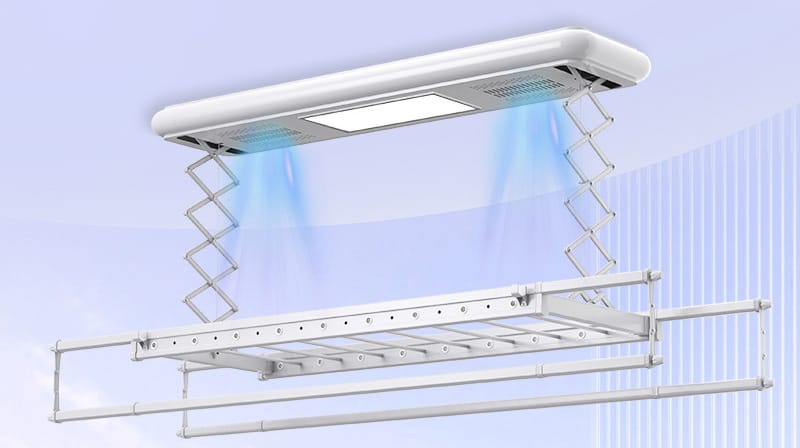
An extra large laundry drying rack sounds easy to define: make the rack wider, add more hanging positions, and increase the amount of clothing it can hold. In real homes, however, useful capacity is more complicated than physical size. A rack can occupy a large section of a balcony and still perform poorly if towels overlap, bedding must be folded several times, or the outer rails become unstable under wet clothing.
Large-capacity drying becomes valuable when it solves the laundry patterns that ordinary racks struggle with. Family washing can combine shirts, trousers, towels, children’s clothing, underwear, and bedding in the same cycle. Weekend laundry may involve several washing-machine loads waiting to dry at once, while seasonal items such as blankets and heavy garments place much greater demands on the structure.
For this reason, an extra large laundry drying rack should be evaluated according to usable drying area, structural support, garment separation, adaptability, and the space it occupies when the household does not need maximum capacity. The objective is not simply to create the biggest possible rack. It is to create enough drying space for unusually demanding laundry days without making the rack unnecessarily inconvenient during ordinary ones.
“Extra Large” Should Describe Usable Capacity, Not Just Dimensions
Overall width and length are the easiest measurements to place on a product specification, but they do not explain how much laundry can actually be arranged effectively.
Imagine two racks with the same external dimensions. The first has many closely spaced rails, while the second uses fewer but longer rods with dedicated hanger positions and greater separation. On paper, the first may appear to provide more capacity. When loaded with towels and large clothing, however, the second may offer more usable drying space because the garments can be spread more effectively.
This distinction becomes especially important with extra large racks because manufacturers can increase dimensions faster than they can improve practical capacity. Adding another outer wing extends the product, but if that wing cannot support realistic wet loads or creates inaccessible hanging positions, its contribution is limited.
Useful capacity therefore needs to be considered in terms of garment types rather than only centimeters of frame.
Family Laundry Rarely Arrives as One Uniform Load
Large households create mixed laundry.
A single drying session may include lightweight shirts, children’s clothes, denim, bath towels, pillowcases, socks, and several longer garments. These textiles do not require the same amount or shape of drying space, which makes a uniform grid of identical rails less efficient than it may initially appear.
Shirts work naturally on hangers and primarily require vertical clearance and sufficient separation. Towels need broader exposed areas and stronger rails. Small garments benefit from numerous organized attachment points, while sheets need long uninterrupted spans.
An extra large laundry drying rack becomes more useful when these different needs can coexist instead of competing for the same rails.
That means capacity should be distributed across different drying zones. The design may include long rods for bedding, hanging positions for shirts, and more compact areas for smaller laundry. Such organization can make the rack feel larger in practice without continually expanding its outside dimensions.
Bedding Is the Real Test of an Extra Large Rack
Small garments can make almost any drying rack appear spacious.
Bedding exposes the real limitations.
A large sheet can occupy several short rails at once. If it must be folded repeatedly, layers of wet fabric sit against each other and much of the apparent drying capacity disappears. Duvet covers create a similar problem, particularly when the available rails are short or closely positioned.
For households that regularly air-dry large fabrics, effective span is therefore one of the most important characteristics of an extra large laundry drying rack.
Expandable structures can address this without forcing the product to remain at maximum width every day. An electric ceiling drying rack with retractable poles can extend its hanging area when larger bedding or family loads require additional span, while the poles can return inward when that extra width is unnecessary.
This approach changes the idea of an extra large rack from a permanently oversized object into a structure that can become larger when the laundry demands it.
Large Capacity Should Be Measured Under Wet Load
Dry clothing provides a poor representation of the forces acting on a drying rack.
Freshly washed textiles retain water, making towels, jeans, sweatshirts, jackets, and bedding considerably heavier than they appear when dry. An extra large rack also encourages users to place more laundry onto the structure, increasing the total load that rails, joints, brackets, and supporting components must carry.
This creates a structural challenge that becomes more significant as the rack grows.
A longer rail experiences greater bending forces when weight is concentrated near its center. Extended wings create leverage against their connecting joints. Ceiling systems transfer the combined load through lifting mechanisms and mounting points, while freestanding racks must keep the entire structure stable through their legs and frame.
For this reason, meaningful capacity testing should use wet textiles distributed in realistic patterns rather than a perfectly balanced collection of lightweight garments.
Bigger Racks Make Uneven Loading More Important
Households rarely distribute laundry symmetrically.
Users normally begin hanging clothes at the most convenient position and continue until that section is full. Several wet towels may end up together, while the opposite side contains only lightweight shirts. Bedding may occupy one extended rod, shifting much of the load toward one side.
As the dimensions of a drying rack increase, the distance between the load and the central support can also increase. This makes weight distribution increasingly relevant to structural behavior.
The basic engineering concept of center of mass helps explain why moving a heavy load farther toward one edge can affect the stability of a structure. A drying rack should therefore be designed for ordinary uneven household loading rather than assuming clothing will always be perfectly balanced.
Users should still distribute very heavy garments sensibly, but routine drying should not require careful load calculations. A well-designed large rack should remain predictable when real households use it imperfectly.
An Extra Large Rack Needs Different Kinds of Space
Large drying capacity is not only about width.
Laundry occupies three dimensions. Shirts require space between neighboring garments, dresses require vertical clearance, towels need exposed surface area, and bedding may require both width and depth.
A rack can therefore be very wide while still failing to accommodate longer clothing effectively.
This is particularly relevant when comparing floor and ceiling systems. A low horizontal floor rack may provide considerable rail length but limited clearance for dresses or trousers suspended from hangers. An overhead system can use vertical space more efficiently for longer garments while keeping the floor below more accessible.
The correct definition of “extra large” depends on what the household actually dries.
For a family that frequently washes bedding, horizontal span may dominate the decision. For households with uniforms, shirts, dresses, and jackets, vertical hanging capacity may be equally important.
Large Laundry Loads Need Zones Rather Than One Crowded Surface
When a rack becomes larger, users gain an opportunity to organize laundry rather than simply add more of it.
Dividing the drying area into zones can improve both access and garment separation. Heavy towels can occupy stronger outer rods, shirts can remain on hangers, children’s clothing can stay together, and bedding can use the longest available sections.
This prevents one type of laundry from interfering unnecessarily with another.
For example, placing a large towel directly in front of several shirts can restrict the open space around those garments. Long trousers positioned above small items may make the lower section difficult to reach. A sheet draped across several rails can suddenly eliminate much of the capacity that was intended for other clothing.
A large rack performs best when its capacity can be organized according to textile behavior instead of being treated as one continuous surface.
How Much Drying Area Does a Large Household Really Need?
The answer changes from day to day.
A family may wash several lightweight clothing loads during the week and then suddenly require substantially more drying space when towels and bedding are included. Designing only for the average load can create shortages during these larger laundry cycles, while designing permanently around the largest possible load can waste residential space.
A more practical evaluation considers several scenarios.
| Laundry Situation | Main Space Requirement | What the Rack Needs to Provide |
|---|---|---|
| Daily family clothing | Multiple separated hanging points | Flexible organization without excessive expansion |
| Several bath towels | Strong rails and open surface area | Wider spacing and stable support |
| Bed sheets | Long uninterrupted span | Extended rods or broad drying sections |
| Duvet covers | Large width and surrounding clearance | Reduced folding and adequate load support |
| Mixed weekend laundry | Several drying zones | Different areas for heavy, light, large, and small items |
| Seasonal clothing | Higher individual garment weight | Strong structure and sufficient hanger clearance |
Thinking in scenarios produces a much more useful definition of capacity than simply asking how many pieces of clothing can fit onto the frame.
Maximum Capacity Should Not Be the Everyday Configuration
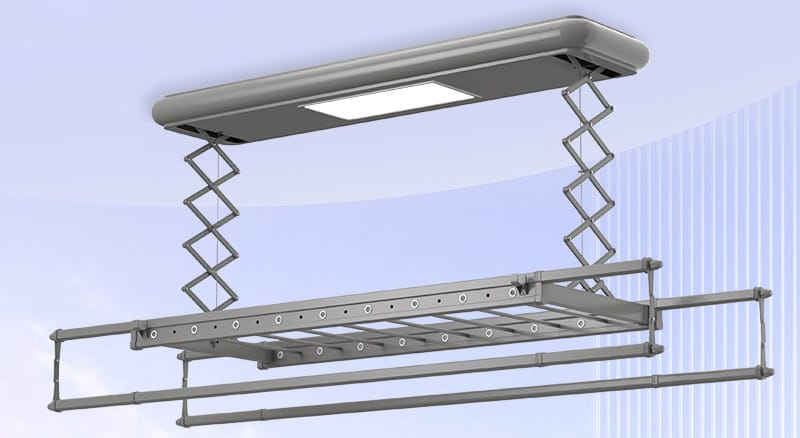
A rack designed for large laundry loads does not need to remain fully extended all week.
In fact, permanent maximum dimensions can become one of the biggest disadvantages of oversized drying equipment. A wide rack may obstruct a balcony door, reduce access to windows, or make a utility room uncomfortable when only five shirts need drying.
Adaptability solves this conflict.
Expandable rods, foldable sections, adjustable wings, or retractable components allow drying capacity to follow laundry volume. The structure can stay relatively compact for ordinary loads and become larger for towels, bedding, or multiple washing cycles.
This creates a more useful relationship between product size and household behavior.
Instead of asking users to permanently surrender enough space for their largest laundry day, the rack changes with the task.
Floor Capacity and Ceiling Capacity Affect the Home Differently
An extra large floor rack and an extra large ceiling rack may offer similar amounts of hanging space, but their impact on the room is very different.
A floor rack creates a physical footprint that remains occupied throughout the drying period. Increasing capacity usually increases that footprint, which can become difficult in small apartments or narrow balconies.
A ceiling-mounted structure places much of the drying equipment above normal walking height. This allows designers to increase usable rod length without necessarily increasing permanent floor occupation.
An automatic ceiling clothes hanger can lower the drying area for loading and then raise the laundry into the upper part of the room, showing how larger household loads can be managed through vertical movement rather than relying entirely on more floor area.
The better approach depends on the available room. Homes with generous utility areas may comfortably use large freestanding racks, while balconies with limited walking space may benefit more from overhead capacity.
Large Racks Need Accessible Capacity, Not Hidden Capacity
A hanging position is not useful if the user cannot comfortably reach it.
This becomes an issue when designers expand racks upward, outward, or into several stacked levels. The product may achieve an impressive total drying area while some sections become inconvenient once other garments are already hanging.
Imagine trying to reach an inner rail after the outer rail has been covered by wet shirts. A second level may look efficient until long garments from the upper level block access to it.
Usable capacity should therefore consider loading sequence.
Can garments be added and removed without rearranging half of the rack? Can shorter users comfortably reach the outer positions? If the rack is ceiling-mounted, can it descend to a convenient working height?
A well-planned extra large laundry drying rack makes its capacity accessible throughout the drying process rather than only while completely empty.
Towels Should Not Determine Where Every Shirt Goes
Large family loads often contain several heavy textiles that dominate the drying area.
Bath towels are one example. Because of their width and thickness, they can occupy large portions of a conventional rack and force smaller garments into increasingly dense arrangements.
A better large-capacity layout gives these textiles dedicated space.
Long outer rods can accommodate towels while interior hanger positions remain available for shirts. Alternatively, different levels can separate broad textiles from smaller garments, provided the upper items do not block airflow or access to those below.
This type of zoning prevents the largest pieces from controlling the entire arrangement.
The result is not simply greater capacity. It is more predictable capacity, because users know where different categories of laundry can go before the rack begins to fill.
Structural Stiffness Becomes More Important as Span Increases
Extending a drying rod creates useful space, but it also increases the mechanical demands on the structure.
A short rail supported near both ends can remain relatively rigid under ordinary laundry loads. Lengthen the same rail without improving its support, and visible deflection can increase.
This is why an extra large rack should not simply be a scaled-up version of a small one.
Rod cross-sections, connection points, frame geometry, supports, and extension mechanisms need to be considered together. The design must provide capacity without allowing the structure to feel excessively flexible once wet garments are added.
The same principle applies to folding wings. Larger wings create more leverage on their hinges, so the joint that works well on a compact rack may require a different approach on a much wider design.
Extra capacity therefore needs structural engineering, not just additional material.
Expandable Width Needs a Useful Stopping Point
More extension is not always better.
If a rack expands so far that users cannot reach the outer rods comfortably, some of that capacity becomes impractical. The enlarged structure may also interfere with walls, windows, cabinets, or neighboring balcony equipment.
The maximum width should therefore reflect realistic residential environments.
For an expandable ceiling system, there is another consideration: the garments themselves extend beyond the rod. A shirt hanger adds width. A towel drapes outward. Bedding may move slightly with surrounding air.
Installation planning should include this clothing envelope rather than measuring only the empty rack.
This is particularly important with extra large laundry drying racks because small clearance errors become more noticeable once the structure reaches its full configuration.
Large Capacity Can Improve Laundry Organization
An extra large rack can reduce more than drying-space pressure.
When there is sufficient room, clothing can be organized while it dries according to where it will go afterward. One section can hold children’s garments, another can hold adult shirts, while household textiles occupy their own area.
This approach reduces sorting after the laundry is dry.
It can also make garments easier to find during the drying process. If a school uniform is needed first, it can be positioned separately instead of disappearing among towels and bedding.
Large capacity is therefore useful not because every rail must always be occupied, but because additional space gives users more control over how clothing is arranged.
This is a subtle difference, but it changes the rack from a simple storage frame into part of the laundry workflow.
Airflow Still Matters on an Extra Large Rack
A large rack can hold more clothing, but surrounding air still needs access to wet fabrics.
If every available rod is filled until garments touch, increasing rack size may simply create a larger dense mass of wet laundry. The physical capacity has increased, while effective separation has not.
This is especially relevant when thick textiles are included.
Jeans, towels, hoodies, and bedding should generally receive more space than lightweight shirts. The rack needs enough flexibility for users to create those differences without wasting entire sections.
Large-capacity products should therefore make spacing easy rather than merely maximizing rail count.
One of the advantages of having extra room is precisely that every garment does not need to compete for the smallest possible gap.
A Large Rack Should Be Evaluated in the Room, Not Alone
Showroom space can make oversized products appear easier to use than they will be at home.
A rack may open beautifully in a large empty area but behave very differently on a narrow balcony containing a washing machine, storage cabinet, window, and door.
The room needs to be measured in its normal condition.
For a floor rack, users should consider the walking route around it when fully loaded. For a ceiling rack, the evaluation should include ceiling fixtures, windows, cabinet doors, garment length, and the lowest loading position.
Expandable products should always be measured at maximum useful extension, not only in their compact configuration.
The best extra large laundry drying rack is the largest rack the room can comfortably support, not simply the largest model available.
Large Loads Change the Importance of Loading Height
Handling one wet shirt above shoulder height may not feel difficult.
Handling an entire family load that way is different.
Large-capacity drying racks increase the number of repeated loading movements, which makes working height more important. If users need to reach upward dozens of times during every laundry session, the inconvenience grows with capacity.
This is one reason height-adjustable overhead systems can work well for larger loads.
The rack can descend while garments are being arranged, allowing users to distribute heavy towels, shirts, and bedding more carefully. Once loading is complete, the drying area can move upward and release the space beneath it.
For large loads, accessibility and capacity should therefore be considered together.
A huge drying area that is uncomfortable to load does not provide a good household experience.
Extra Large Does Not Mean Every Household Needs Maximum Capacity
More capacity can feel reassuring, but unused capacity still occupies physical space and adds structural complexity.
A household of one or two people may rarely generate enough laundry to justify a permanently oversized rack. In such cases, a smaller product with temporary expansion may provide a better balance.
Large families, homes that frequently air-dry bedding, or households that combine several washing cycles are more likely to benefit from higher maximum capacity.
The decision should therefore begin with actual laundry behavior.
A useful exercise is to observe the household’s largest normal laundry day rather than its smallest or most extreme one. Count the types of textiles involved, identify which items compete for space, and determine what the current drying arrangement cannot accommodate well.
The missing capacity becomes easier to define once it is connected to a real problem.
What Should Be Tested Before Calling a Rack “Extra Large”?
The most useful test is not measuring the empty frame.
Load it.
Place bedding across the longest section. Add several wet towels. Hang shirts in the remaining areas. Put heavier trousers toward one side and observe how the structure behaves. Then try accessing a garment from the center after the outer positions have been filled.
The rack should also be tested at partial capacity.
A product designed for twenty or thirty garments should still feel natural when only five need drying. Expandable sections should not make everyday use unnecessarily complicated.
For overhead systems, raising and lowering should be evaluated under realistic distributed loads. For freestanding racks, stability should be checked when one side carries significantly more wet laundry than another.
An extra large rack earns that description when its additional capacity remains useful after real clothing is added.
The Best Large Rack Makes Capacity Disappear When It Is Not Needed
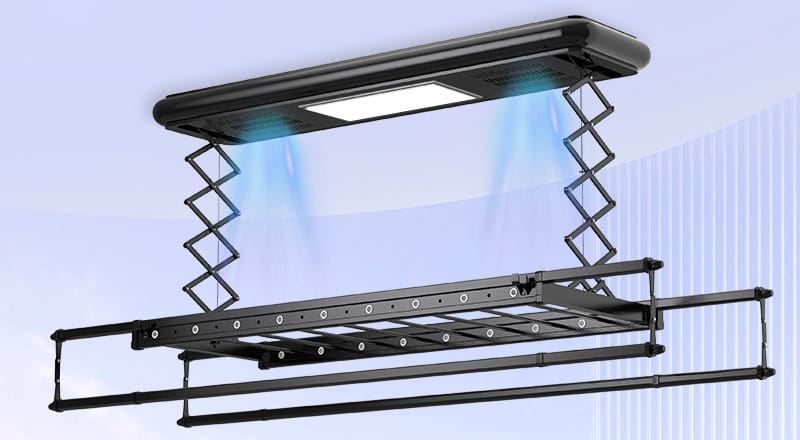
The most successful large-capacity drying solutions solve an apparent contradiction.
Households want more drying space, but they do not necessarily want larger laundry equipment occupying their homes permanently.
Adaptable structures resolve this by separating maximum capacity from everyday size.
A retractable rod can appear only when sheets need it. A folding wing can remain closed for a small load. An overhead rack can move upward once clothing has been arranged. Different approaches achieve the same objective: make drying capacity available without allowing its maximum dimensions to dominate the room every day.
This is a stronger definition of space efficiency than simply making a rack small.
A truly efficient extra large laundry drying rack can be large when the laundry is large and unobtrusive when the laundry is not.
Conclusion
An extra large laundry drying rack should provide more than impressive external dimensions. Its real value comes from turning additional size into usable drying capacity for the types of laundry that ordinary racks struggle to manage.
Bedding needs long spans. Towels require strong support and generous exposed area. Shirts benefit from organized hanger positions, while mixed family loads need several different drying zones. As capacity increases, structural stiffness, uneven loading, accessibility, airflow, and room clearance also become increasingly important.
The most practical designs avoid the assumption that maximum capacity should always mean maximum physical size. Expandable rods, adjustable sections, and vertically moving structures allow the drying area to respond to the laundry rather than forcing the home to adapt permanently to an oversized rack.
For households, the right question is therefore not “How big is the rack?”
It is whether the rack becomes large in the ways that real laundry actually requires.
FAQ
What is an extra large laundry drying rack?
An extra large laundry drying rack is a high-capacity drying structure designed to accommodate larger household loads, bulky garments, towels, bedding, or several categories of laundry at the same time.
Is a wider drying rack always better for large families?
Not necessarily. Width needs to be combined with stable support, useful garment spacing, accessible hanging positions, and a layout suitable for different textile types. Adaptable capacity can be more practical than permanent maximum width.
What features are useful for drying large bedding?
Long uninterrupted rods, expandable drying sections, adequate structural support, and sufficient surrounding clearance are particularly useful because large sheets and duvet covers need more open surface area.
Should wet laundry weight be considered when choosing a large rack?
Yes. Wet towels, jeans, jackets, and bedding can place significantly greater loads on rails and supporting structures than lightweight dry garments, so realistic wet-load performance is important.
Is an extra large ceiling rack suitable for a small balcony?
It can be when the room has suitable ceiling dimensions and clearance. Ceiling-mounted systems can provide substantial drying area while reducing permanent floor occupation, but windows, cabinets, lighting, garment length, and maximum extended dimensions should all be checked.
Need Help Choosing the Right Extra Large Laundry Drying Rack?
If you’re evaluating an extra large laundry drying rack for family laundry, bedding, apartments, balconies, or different residential applications, our team can help you assess usable drying span, load distribution, expandable configurations, overhead space, and everyday laundry requirements. Contact us to explore a drying solution that provides additional capacity when larger loads demand it without allowing the drying equipment to dominate the living space.





