Table of Contents
Introduction
Laundry room drying racks work best when they are planned as part of the room rather than added wherever empty space happens to remain. A laundry room already needs enough clearance for appliances, cabinets, baskets, work surfaces, storage, and normal movement, so a drying rack that occupies the wrong area can make an otherwise practical room feel crowded for hours while wet clothes are hanging.
The right drying setup depends on how the available floor, wall, and ceiling areas are used. A freestanding rack offers flexibility but temporarily occupies the floor, while a wall-mounted design can protect walking space when a suitable vertical surface is available. Ceiling-mounted systems move the drying zone into overhead space, which can be especially useful when lower parts of the room already support appliances and storage.
For this reason, choosing laundry room drying racks should begin with the complete laundry workflow. The rack needs to provide enough usable hanging space for normal loads, remain comfortable to access, support wet garments reliably, and allow appropriate spacing between different fabrics. When these requirements are considered together, the drying zone becomes part of an organized room rather than an obstacle that has to be worked around.
Plan the Drying Zone Before Choosing the Rack
A common approach is to select a drying rack first and then look for somewhere to place it. Reversing that process usually produces a better result. Begin by identifying the parts of the laundry room that must remain available during a normal cycle, including appliance doors, cabinet openings, walking routes, basket positions, and any surfaces used for sorting or folding clothes.
Once these areas are understood, the remaining floor, wall, and ceiling space can be evaluated more realistically. A narrow room may have very little usable floor area but enough overhead clearance for ceiling drying, while another layout may have a clear side wall that makes a folding wall rack more straightforward. The correct solution is determined by which location creates the least conflict with other activities.
This room-first approach is particularly important because laundry does not disappear immediately after it is placed on the rack. Wet garments can remain in the drying zone for a considerable period, meaning even a temporary obstruction can affect the room for much of the day. Effective planning therefore considers how the space functions while the rack is fully loaded, not simply where the empty structure fits.
Floor, Wall, and Ceiling Drying Racks Use Space Differently
Freestanding laundry room drying racks are easy to reposition and normally require no permanent installation. They can work well when sufficient temporary floor area is available and when users value the ability to change the drying location. The disadvantage is that their entire working footprint remains within the lower part of the room during drying, where space is often most valuable.
Wall-mounted racks use vertical surfaces instead, which can preserve more floor area and create a predictable drying zone. Folding or retractable designs can stay relatively compact after use, although the open rack and hanging garments still need enough clearance from cabinets, doors, shelves, and appliances.
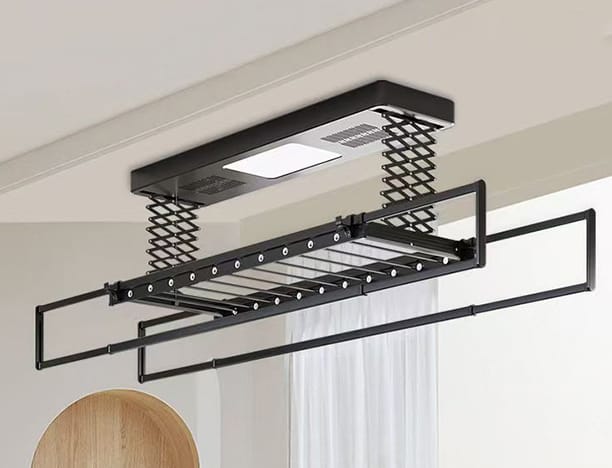
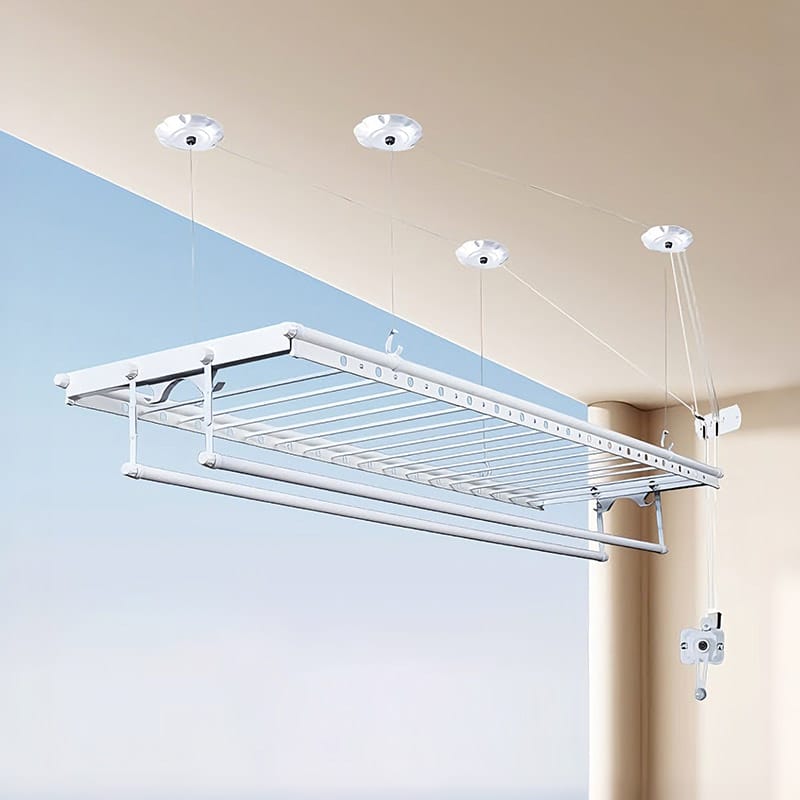
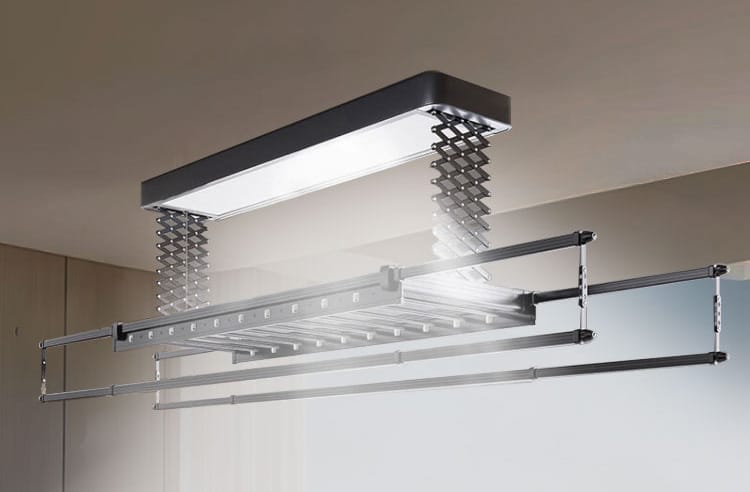
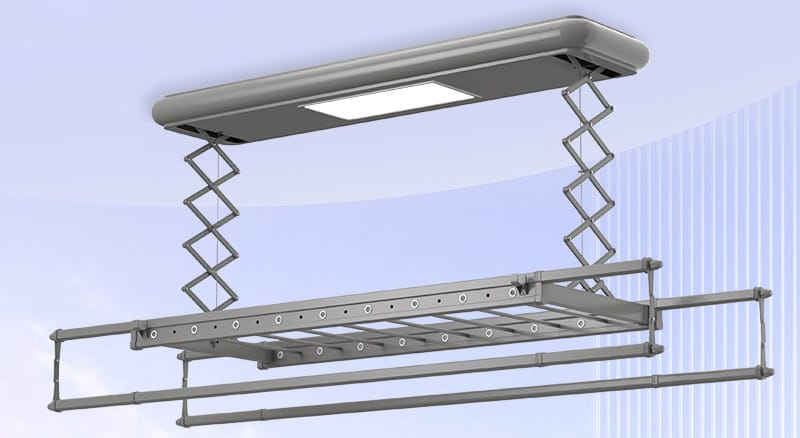
Ceiling-mounted drying racks use the room differently again by placing clothing above the main working area. The concept is related to the traditional overhead clothes airer, but modern systems can add manual or electric lifting and expandable rails. Overhead installation is most useful when the ceiling provides usable space that does not interfere with other important functions.
Comparing Laundry Room Drying Racks
The most appropriate rack is usually the one that uses the least disruptive part of the room while still providing enough accessible drying capacity. Comparing the main configurations according to how they interact with the space makes the differences easier to understand.
| Drying Rack Type | Main Space Used | Floor Impact | Access During Loading | Capacity Flexibility | Best Fit |
|---|---|---|---|---|---|
| Freestanding rack | Floor | High while drying | Easy | Moderate | Flexible temporary use |
| Foldable floor rack | Floor | High while open | Easy | Moderate | Occasional air drying |
| Wall-mounted rack | Wall | Low | Easy | Moderate | Clear vertical wall area |
| Retractable wall rack | Wall | Low | Easy | High | Multipurpose laundry rooms |
| Manual ceiling rack | Ceiling | Very low | Adjustable | Moderate | Regular overhead drying |
| Electric ceiling rack | Ceiling | Very low | Highly adjustable | High | Frequent laundry routines |
| Expandable ceiling rack | Ceiling | Very low | Adjustable | High | Changing laundry loads |
The comparison does not produce one universal winner because room conditions matter more than product type alone. A portable rack can remain the simplest solution where floor space is abundant, while wall and ceiling systems become more valuable as the room needs to support additional functions within the same footprint.
Use the Loaded Footprint Instead of the Empty Rack Size
Product dimensions usually describe the structure, but garments change the actual amount of space a drying rack occupies. Shirts on hangers extend beyond the rails, towels hang below the frame, and bedding can spread across several sections. A rack that appears compact when empty can therefore create a much larger drying zone after wet clothing is added.
This is particularly important with folding racks. Their stored dimensions may be extremely small, but the open structure can still occupy a large section of the laundry room for several hours. Wall-mounted racks create a similar situation because their projection increases after the frame is opened and clothing is placed on the outer rails.
Ceiling systems also need realistic clearance measurements. A frame may fit easily above a work area while long trousers or other garments hang too close to the surface below. When evaluating laundry room drying racks, the most useful measurement is therefore the complete loaded footprint rather than the dimensions of the empty product.
Vertical Space Can Make a Small Laundry Room More Functional
Small laundry rooms do not necessarily require extremely small drying capacity. In many cases, the more important issue is where that capacity is placed. Using wall or ceiling space can keep the lower part of the room available for movement and appliance access while still providing meaningful hanging length.
Ceiling systems are particularly effective when wall storage is already important. Instead of sacrificing cabinets or shelves for a large wall rack, the drying zone can occupy overhead space that might otherwise remain unused. YIHUI’s automated clothes rack range uses this vertical approach by allowing the drying structure to remain overhead and move toward a more accessible position when garments need to be handled.
The objective should not be to fill every available vertical surface. A small room still needs visual and physical clearance, so the rack should occupy the zone that creates the fewest conflicts. Vertical planning works best when it separates drying from other tasks rather than simply increasing the total amount of equipment in the room.
Loading Height Should Be Planned Around Daily Use
A drying rack can be highly space-efficient and still be inconvenient if users struggle to reach it. This problem is most obvious with overhead racks because the ideal drying position may be significantly higher than a comfortable loading position. Handling wet towels, trousers, or larger garments above shoulder height can quickly make repeated laundry routines awkward.
Adjustable ceiling racks solve this problem by allowing loading and drying to happen at different heights. The rack can descend while wet garments are arranged and return upward once the load is complete. This makes overhead drying more practical because accessibility is provided only when interaction is necessary.
YIHUI’s ceiling clothes drying rack uses motorized lifting together with operational protection features, illustrating how height adjustment can be integrated into an overhead drying structure. The practical value of this type of system comes from using vertical space without requiring users to sacrifice comfortable loading.
Laundry Room Drying Racks Need Practical Capacity
Capacity should not be understood only as the amount of weight a rack can support. A useful drying setup also needs enough rail length and garment separation for real laundry to be arranged naturally. This distinction becomes especially important when the load contains towels, trousers, bedding, or other textiles that occupy substantially more space than lightweight shirts.
A rack can be structurally capable of holding a large wet load while still providing limited practical capacity if every garment has to be packed closely together. For everyday use, it is more useful to evaluate how much laundry can be arranged comfortably without excessive overlap. This approach combines structural support with the usable rail space required by different garment types.
Normal laundry patterns should guide the decision. If shirts and lighter garments make up most loads, hanger positions may provide efficient capacity. When towels and larger textiles are common, longer open rails become more valuable. A flexible layout usually performs better across mixed laundry than a structure designed mainly to maximize rail count.
Rail Spacing Affects How the Drying Area Works
Air drying depends on wet fabric being exposed to the surrounding environment, so garment arrangement affects how effectively the rack’s capacity can be used. Thick textiles placed directly against one another can create areas with limited exposure, while lighter clothing may be arranged more closely without the same degree of crowding.
A well-designed rack therefore gives users enough freedom to change spacing according to the load. Towels may need more open rail area, while shirts on hangers can use a longer rail more efficiently. Bedding may occupy several sections and benefit from enough width to avoid excessive folding.
Expandable laundry room drying racks can be particularly useful because additional rail length does not always need to accommodate additional garments. The extra space can also be used to distribute an existing load more effectively, making adjustable capacity valuable even when the total number of items remains unchanged.
Drying Rack Placement Should Support Room Airflow
The drying zone should be planned around the surrounding room as well as the rack itself. When wet garments release moisture, the air around them needs enough room to circulate, which means an extremely enclosed rack position can be less practical than a more open layout.
A wall-mounted rack installed tightly between tall cabinets, for example, may provide excellent space efficiency while leaving little room around larger garments when fully loaded. Ceiling systems can create a more open drying zone, although the same problem can occur if every available rail is filled too densely.
The goal is not to leave unusually large gaps around every garment, but to avoid unnecessary enclosure and overlapping. Laundry room drying racks perform most effectively when rail spacing and room placement allow the load to be arranged according to fabric size rather than forcing every item into the same dense configuration.
Folding and Retractable Racks Work Best in Multipurpose Rooms
When a laundry room also supports storage, sorting, household organization, or other activities, a drying rack that changes configuration can help the room move between different tasks. Folding floor racks provide capacity only while they are open, while wall-mounted retractable systems can reduce their projection after the garments are removed.
These designs are particularly useful when air drying happens regularly but not continuously. The drying zone can temporarily expand during a laundry cycle and return useful space afterward, preventing the room from being permanently organized around maximum hanging capacity.
The mechanical structure still deserves attention because folding and retractable components experience repeated movement. Hinges, support arms, sliding rails, and locking points should remain stable when the rack reaches its working position. Space-saving flexibility is valuable only when the open structure can reliably support normal wet laundry.
Permanent Drying Zones Make More Sense With Frequent Laundry
The frequency of air drying changes how important portability and storage become. When only a few garments are air-dried occasionally, a portable folding rack can provide all the flexibility required. It can be stored after use, leaving no permanent drying equipment in the room.
When air drying happens frequently, the rack may spend so much time open that compact storage provides little practical advantage. A dedicated wall or ceiling system can create a more predictable workflow because users no longer need to retrieve, unfold, position, and store a rack during each laundry cycle.
This is why permanent laundry room drying racks are often better evaluated through routine rather than appearance. If the drying zone is used almost every day, reducing repeated setup may be more valuable than having the ability to completely remove the structure between occasional uses.
Materials and Structure Matter in a Humid Laundry Environment
Laundry drying racks regularly support damp textiles, so materials need to perform under both moisture exposure and changing loads. Aluminum is useful in many movable drying structures because its relatively low weight and corrosion resistance can suit folding, telescopic, or lifting components. Stainless steel and appropriately protected steel can also provide durable structural solutions depending on the design.
The main rails, however, represent only one part of the system. Hinges, brackets, fasteners, telescopic connections, suspension elements, and mounting points all contribute to how loads move through the structure. A rack made with strong rails can still feel unstable if the joints or supporting components are poorly designed.
This becomes especially important with permanent wall or ceiling installations because structural loads ultimately transfer into the mounting surface. The complete system should therefore be considered rather than relying on one material description as an indication of overall durability.
Wet Laundry Requires Thoughtful Load Distribution
Wet garments create more structural demand than dry clothing, and laundry is rarely distributed evenly across every rail. Several heavy towels may occupy one side while lightweight shirts are placed on the other, or bedding may concentrate weight along a limited section of the rack.
Different rack types respond to these patterns in different ways. Freestanding structures need enough frame stability to remain balanced, wall racks transfer loads through brackets and support arms, and ceiling systems rely on suspension and mounting components. Expandable rails also experience additional leverage when heavy garments are positioned farther from the main frame.
A well-designed rack should tolerate normal variation in loading, but users can still improve everyday stability by distributing heavier items across several sections whenever possible. Capacity should therefore be understood through both total weight and placement rather than treated as one isolated number.
Match the Drying Rack to the Garments You Actually Wash
The most useful drying rack configuration is determined partly by garment type. Shirts can often use hanger positions efficiently, while thick towels require broader exposed rail space. Trousers and dresses need vertical clearance, and bedding can occupy several rails at once even when the total number of pieces is small.
This means a rack sized only according to garment count can be misleading. A relatively small number of bulky textiles may require more useful drying area than a much larger number of lightweight items. Users should therefore identify which types of laundry normally consume the greatest amount of hanging space before deciding how large the rack needs to be.
Adjustable and expandable designs provide an advantage for mixed loads because the same structure can support different arrangements from one cycle to the next. This flexibility is usually more valuable than maximizing one fixed type of capacity.
Plan Laundry Room Drying Racks Around the Workflow
A drying zone should connect naturally with the washing area. There needs to be somewhere to place a basket while wet clothes are transferred, and the rack should remain accessible without blocking the appliance. Once loading is complete, users should still be able to reach cabinets, storage, and frequently used working surfaces.
The same logic continues after drying. Garments should be easy to remove and transfer toward folding or storage without requiring the room to be reorganized. Permanent wall and ceiling systems make this planning particularly important because their installation position becomes part of the long-term room layout.
Thinking through the entire process from washing to storage usually provides a better indication of suitability than product dimensions alone. The best rack is one that creates a drying zone exactly where the room can support it with the least repeated inconvenience.
Common Mistakes When Planning Laundry Room Drying Racks
One common mistake is selecting the largest rack that can physically fit the available area. Extra dimensions only provide value when they improve usable drying capacity, and an oversized rack can interfere with cabinets, appliances, or movement while offering more space than normal laundry loads require.
Another mistake is evaluating only the stored configuration. Foldable and retractable racks can appear extremely compact when empty, but the working footprint becomes much larger once the structure is extended and clothing is added. The loaded condition should therefore be the primary reference during room planning.
Users may also concentrate on rail quantity while ignoring garment type and airflow. Practical drying capacity depends on how different fabrics can be arranged, so flexible spacing often matters more than a dense arrangement of bars. Structural connections should receive similar attention because brackets, hinges, mounting points, and extension mechanisms directly influence long-term stability.
How to Choose the Right Laundry Room Drying Racks
The selection process should begin by identifying which part of the room can support drying with the least interference. When floor space is abundant and portability matters, a freestanding rack can remain entirely practical. A clear wall favors folding or retractable systems, while ceiling space becomes increasingly useful when floors and walls already support appliances, storage, and movement.
After identifying the location, normal laundry volume and garment types should determine the required rail arrangement. The rack should comfortably support frequent loads without being sized mainly around an exceptional maximum. Adjustable capacity can be valuable when larger bedding or towels appear only occasionally.
Finally, accessibility and construction should confirm the choice. The rack needs to remain stable under wet loads and comfortable to reach during normal operation. When location, capacity, garment spacing, structure, and routine all work together, the drying rack becomes a functional part of the laundry room rather than temporary equipment competing for space.
Conclusion
Laundry room drying racks should be selected as part of the complete room layout rather than treated as standalone equipment. Floor racks provide flexibility, wall-mounted designs protect floor area, and ceiling systems use overhead volume that may otherwise contribute little to the laundry workflow.
The most effective setup also balances practical capacity with room usability. Garment size, rail spacing, airflow, wet-laundry load, accessibility, and structural stability all influence how useful the rack becomes once clothing is actually hanging from it.
Frequency is equally important. Portable systems can work extremely well for occasional air drying, while permanent wall and ceiling racks can make regular laundry routines more predictable. Folding, retractable, and adjustable designs add further flexibility when the room needs to serve several functions.
A successful drying zone ultimately gives wet laundry enough space without asking the rest of the room to stop functioning. When floor, wall, and ceiling areas are planned together, laundry room drying racks can provide substantial capacity while keeping appliances, storage, and movement easier to manage.
FAQ
What are the best laundry room drying racks for small spaces?
Wall-mounted, retractable, and ceiling-mounted racks are often practical when floor space is limited because they use vertical or overhead areas. A foldable floor rack can also work when temporary floor space is available. The best choice depends on wall clearance, ceiling height, garment length, appliance access, and drying frequency.
Are ceiling drying racks good for laundry rooms?
Yes, particularly when floor and wall areas are already needed for appliances, cabinets, or storage. Ceiling systems create an overhead drying zone and adjustable models can lower for easier loading. Ceiling structure, garment clearance, surrounding fixtures, rail length, and the rack’s full movement range should be evaluated before installation.
How large should laundry room drying racks be?
The rack should be sized around normal laundry volume and the textiles that require the most space rather than the largest possible load. Shirts can use hanger rails efficiently, while towels and bedding require more open rail area. The loaded rack should still allow access to appliances, cabinets, doors, and walking routes.
Is a wall-mounted or freestanding laundry drying rack better?
A wall-mounted rack is useful when preserving floor space is important and a suitable vertical surface is available. A freestanding rack provides greater location flexibility and requires no permanent installation. The better option depends on laundry frequency, available storage, room layout, garment volume, and whether temporary floor occupation is acceptable.
What should I consider before installing laundry room drying racks?
A wall-mounted rack is useful when preserving floor space is important and a suitable vertical surface is available. A freestanding rack provides greater location flexibility and requires no permanent installation. The better option depends on laundry frequency, available storage, room layout, garment volume, and whether temporary floor occupation is acceptable.