
Table of Contents
Introduction

A wet shirt hanging on a balcony seems simple enough. Give it air, enough time, and somewhere to hang, and eventually it dries. The difficulty begins when the balcony is small, the weather is humid, several loads of laundry arrive at once, or the drying area also needs to function as part of the living space.
That is where the idea of a smart drying rack becomes more meaningful.
“Smart” should not simply mean adding a remote control to a conventional rack. A genuinely useful smart drying rack should solve the changing conditions around laundry: where the clothes are positioned, how easily the rack can be reached, whether airflow is sufficient, how much space is available, and which functions are actually useful at that moment.
Seen from this perspective, the development of smart drying racks is less about turning a clothes rail into a gadget and more about redesigning the relationship between laundry, people, and residential space.
The Real Laundry Problem Is Not Always Drying Speed
When people discuss advanced drying equipment, faster drying often receives most of the attention. In actual homes, however, the difficulty is usually broader.
A balcony may be only a few square meters and still need to accommodate plants, storage cabinets, windows, and everyday movement. A family may need space for shirts on one day and large bedding on another. Someone may be able to reach a fixed rail comfortably, while another person finds the same height inconvenient.
Weather adds another variable. Indoor and semi-enclosed balconies behave differently on a dry afternoon and during a humid rainy period. Relative humidity describes the amount of water vapor in the air relative to what the air can contain under the same conditions, so changing humidity can influence how readily moisture leaves wet textiles. Humidity and relative humidity explained
A useful smart drying rack therefore starts with a different question:
How can one drying area adapt when the laundry, weather, user, and room keep changing?
That question leads to much more interesting product design than simply automating one mechanical movement.
A Drying Rack Becomes Smart When Its Functions Work Together
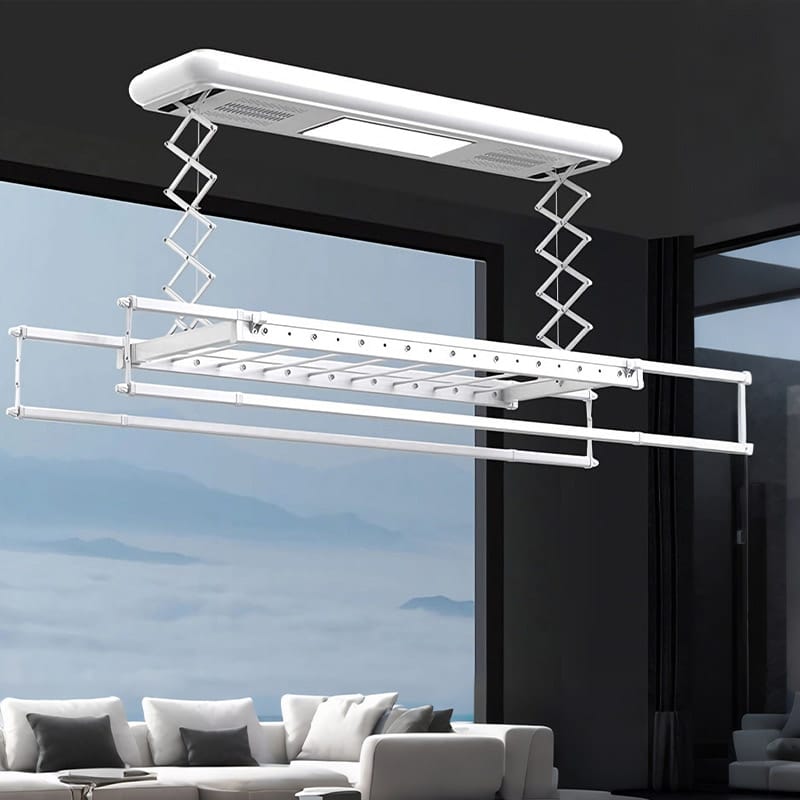
Consider a ceiling rack with electric lifting. The motor lowers the rods, the user hangs the clothes, and the rods rise again. This is convenient, but motorization alone does not necessarily create an intelligent drying experience.
The product becomes more useful when individual functions begin supporting one another.
Height adjustment improves accessibility while clearing the area below after loading. Air circulation can help when natural ventilation is weak. Lighting makes the same ceiling position useful for another household function. Remote or app-based control changes where the user needs to stand when operating the rack. Adjustable rods allow the physical drying area to respond to different garment volumes.
For example, YIHUI’s Automatic Clothes Hanger 829 supports both app operation and remote control rather than relying on only one control method. Automatic Clothes Hanger 829 This illustrates an important smart-product principle: intelligence is useful when it gives the household practical choices rather than simply adding another electronic feature.
The strongest smart drying rack designs therefore behave like coordinated systems. Their features should solve connected problems rather than appearing as a collection of unrelated specifications.
The Balcony Is Often the Best Test of Whether a Design Is Actually Smart
A product brochure can make almost any drying rack appear convenient. A small apartment balcony is a much harder test.
Imagine a balcony that measures only enough for a narrow walking route beside the windows. A conventional floor rack may work during laundry time but make the space difficult to use afterward. A permanently extended ceiling rack solves the floor problem but may still dominate the room visually.
A well-designed smart drying rack changes with the activity.
During loading, the rack can move into an accessible position. While drying, it can occupy the most practical height for airflow and clearance. Once laundry is removed, the structure can return upward or retract to reduce its presence.
Some designs also change horizontally. YIHUI’s Electric Ceiling Drying Rack 8828, for example, uses retractable rods that can extend for larger laundry loads and reduce again for compact balcony conditions. Electric Ceiling Drying Rack 8828 That kind of physical adaptability matters because households rarely dry the same amount or type of laundry every day.
Smartness, in other words, can come from mechanical flexibility just as much as from software.
Useful Intelligence Starts with Understanding Moisture and Air
Clothes dry when moisture moves away from the textile and into the surrounding environment. This makes airflow and ambient conditions fundamental to any drying strategy.
Imagine two identical shirts. One hangs in an open, ventilated area. The other hangs tightly between several damp garments in still air. Even without changing the fabric or washing process, the drying experience can be noticeably different because the immediate environment around the garment has changed.
A smart drying rack can be designed around this reality.
Drying rods need sufficient spacing so garments do not form a dense barrier. Air-assisted functions should support circulation across the hanging area rather than simply blowing toward one small section. If environmental sensing is incorporated, it should provide information or control that meaningfully changes the drying process.
This is also why a feature list should never replace good physical design. Sensors cannot compensate for poor garment spacing, an undersized hanging area, or a structure that blocks airflow.
The best smart drying systems combine mechanical layout and intelligent functions rather than treating electronics as a substitute for basic engineering.
Not Every Household Needs Every Smart Feature
One of the biggest mistakes in intelligent home-product design is assuming that more functions automatically create a better product.
A family using a naturally ventilated balcony in a dry climate may care most about automatic lifting, adjustable hanging capacity, and quiet operation. Another household in a humid environment may place greater value on active airflow or assisted drying. A compact apartment may prioritize a slim ceiling profile, while a larger family may care more about rods that accommodate bedding and higher laundry volume.
This is why smart drying rack selection should begin with the household scenario rather than the specification sheet.
| Household Situation | Most Relevant Functions | Why They Matter |
|---|---|---|
| Small apartment balcony | Ceiling mounting, retractable structure, lifting control | Keeps valuable floor area available |
| Family with frequent laundry | Larger hanging capacity, adjustable rods, assisted airflow | Handles changing loads more easily |
| Humid or rainy environment | Air circulation, drying assistance, environmental awareness | Supports drying when natural conditions are less favorable |
| Elderly household members | Easy controls, smooth lowering, obstruction protection | Improves accessibility and everyday operation |
| Minimalist interior | Compact upper position, integrated appearance | Reduces visual interruption when laundry is absent |
| Smart-home-focused residence | App or remote control, coordinated functions | Fits a more connected household routine |
This distinction is important for manufacturers as well. A product designed for every possible feature can become unnecessarily complicated. A product designed around a clear use case is easier to understand and more likely to deliver a coherent experience.
What Happens When Smart Features Become Annoying?
Smart household products often fail in small ways rather than dramatic ones.
A control interface that requires too many steps becomes frustrating. A motor that is technically effective but noticeably loud may feel unsuitable in a quiet apartment. A mobile function that duplicates a nearby button without adding any practical convenience can become irrelevant after the novelty disappears.
Drying racks are used repeatedly, so these small details matter.
The best interface is often the one that disappears into the routine. Lowering the rack should feel obvious. Returning it upward should not require navigating complicated controls. A remote should respond consistently. Safety behavior should occur automatically rather than forcing users to think about it.
This is where the idea of “smart” becomes less visible but more valuable.
Good intelligence removes friction. Poor intelligence adds another thing the household needs to manage.
Safety Is Part of Smart Design, Not a Separate Feature
A ceiling-mounted drying system moves above people and household objects. That makes safe movement an essential part of the design rather than an optional extra.
The rack should know when movement needs to stop. The structure should remain stable under expected laundry loads. Controls should prevent unintended operation, and moving components should behave predictably.
YIHUI’s Ceiling Clothes Drying Rack 811, for instance, incorporates automatic stopping when an obstruction is detected along with overload protection. These functions demonstrate why intelligence in a drying rack should not be judged solely by convenience features. Some of its most useful “smart” behavior may be the behavior that users barely notice during normal operation.
In household equipment, prevention can be more valuable than another visible function on the control panel.
Why Quiet Operation Matters More Than It Seems
Drying racks are often installed close to living areas rather than hidden in separate utility rooms.
In an apartment, the balcony may connect directly to the living room or bedroom. A motor that operates several times each day therefore becomes part of the household sound environment.
Quiet movement affects perceived product quality, but it also affects where the system can realistically be used. Smooth acceleration, stable transmission, and reduced vibration can make an electric rack feel far more integrated into the home.
This is an example of a feature that rarely dominates marketing language yet strongly influences the everyday experience.
Smart product development should pay attention to these quiet details because users live with the product for much longer than they spend comparing its specifications.
A Smart Drying Rack Should Disappear When the Laundry Does
Laundry equipment has an unusual relationship with interior design: homeowners need it frequently but usually do not want it to dominate the room.
This creates a design challenge.
When covered with wet clothing, the drying rack is naturally visible. Once those clothes are removed, however, the system should ideally return the room to its normal function.
Ceiling placement helps because it moves the structure away from the primary living zone. Slim housings, retractable components, balanced proportions, and finishes that suit contemporary interiors can further reduce visual disruption.
This matters particularly in apartments where the balcony is no longer treated as a purely utilitarian area. It may also function as a reading space, plant area, extension of the living room, or simply a source of daylight.
A successful smart drying rack therefore participates in the room only when needed.
That is a more sophisticated form of space saving than simply making the product smaller.
The Next Generation May Be Less About Adding Features
It is tempting to imagine the future of the smart drying rack as an endless sequence of new functions. More sensors. More modes. More buttons. More connections.
A better direction may be the opposite.
Future products are likely to become smarter by deciding which functions should operate automatically and which controls users genuinely need. Environmental information could help select appropriate drying assistance. Motors could become quieter and more responsive. Structures could adapt to larger or smaller laundry loads without adding visual complexity.
The physical design may also become more integrated. Instead of looking like a traditional rack with electronics attached, future systems could be developed as part of the ceiling and residential space from the beginning.
The key question will not be “How many smart features does this product have?”
It will be:
“How much easier does the laundry routine become because those features are there?”
Conclusion
A smart drying rack should solve more than the problem of where to hang wet clothes. Its real value comes from responding intelligently to the realities of household laundry: limited space, changing loads, different users, varying humidity, and the need to keep residential areas comfortable when laundry is finished.
Automatic lifting can improve accessibility. Retractable structures can adapt capacity. Air circulation can support difficult drying conditions. Smart controls can simplify interaction. Safety systems can operate quietly in the background.
None of these features makes a product intelligent on its own.
A smart drying rack becomes genuinely useful when those elements work together to make the laundry area easier to use, easier to share with the rest of the home, and less demanding on the people who use it every day.
FAQ
What makes a drying rack “smart”?
A smart drying rack combines conventional hanging functions with automated or intelligent features such as powered lifting, remote or app control, assisted airflow, environmental sensing, safety protection, or adaptable drying capacity. The exact combination depends on the product.
Is a smart drying rack useful in a small apartment?
Yes. Small apartments are one of the situations where ceiling-mounted and adjustable drying systems can be especially useful because they move the drying area away from valuable floor space.
Does a smart drying rack always need an app?
No. An app is only one possible control method. For many households, a well-designed remote or simple one-touch control may be equally important. A
Can a smart drying rack help when the weather is humid?
Models with active airflow or drying assistance can provide additional support when natural drying conditions are less favorable. However, actual drying performance also depends on garment spacing, airflow, room conditions, and product configuration.
What should distributors consider when evaluating smart drying racks?
Beyond visible functions, important considerations include motor behavior, control simplicity, safety protection, structural flexibility, installation requirements, drying capacity, and whether the feature set matches the intended residential market.
Need Help Choosing the Right Smart Drying Rack?
If you’re deciding which smart drying rack functions are suitable for your market, residential project, or application, our team can help you evaluate the practical differences between control systems, drying functions, structural designs, and installation options. Contact us today to discuss your requirements and develop a drying solution that combines useful intelligence with reliable everyday performance.




