Table of Contents
Introduction

A drying rack becomes much more useful when it works with the room instead of competing with it. In many laundry spaces, the floor is already occupied by appliances, baskets, storage, and normal movement, while walls may be needed for cabinets or work surfaces. A hanging drying rack laundry setup shifts part of the drying function into vertical or overhead space, allowing wet garments to remain organized without requiring a large freestanding frame in the middle of the room.
The term hanging drying rack can describe several designs. Some racks suspend directly from the ceiling, some attach to a wall and provide hanging rails, while adjustable systems can lower toward the user before returning to a higher drying position. The most appropriate configuration depends on the room layout, laundry volume, garment length, loading height, structural support, and how frequently air drying is part of the normal routine.
A good hanging system should therefore be evaluated as more than a collection of rails. Its position needs to make clothes easy to load, its structure needs to remain stable under wet garments, and its rail arrangement should provide enough separation for different fabrics. When these factors are considered together, hanging drying can provide useful capacity while keeping important working areas more accessible.
Why Hanging Drying Racks Work Differently From Floor Racks
A freestanding rack occupies floor space throughout the drying period, even if it folds into a compact shape afterward. A hanging rack uses a different part of the room, which can be particularly useful when the drying cycle lasts several hours and the surrounding space still needs to remain functional.
This principle has been used for generations in the form of an overhead clothes airer, where laundry is suspended from rails positioned above the normal working area. Modern hanging drying racks develop the same basic idea with lighter structures, adjustable rails, manual or electric lifting, and different mounting configurations.
The main advantage comes from separating drying space from movement space. A well-positioned rack allows garments to remain suspended while users continue reaching appliances, opening storage, or moving baskets underneath or around the drying zone. The result is not simply a smaller rack but a different way of allocating room volume.
Ceiling Hanging Racks for Vertical Space Utilization
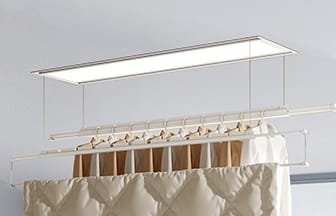
Ceiling-mounted hanging racks are particularly useful where floor and wall areas already serve important functions. Instead of reserving another part of the room for drying equipment, the rack creates a permanent overhead zone that can remain available whenever wet garments need to be arranged.
The effectiveness of this design depends heavily on height. A fixed ceiling rack positioned too high can become difficult to load, while one installed too low may interfere with people or objects underneath. Adjustable systems solve this conflict by allowing the rack to occupy a lower working position during loading and a higher position during drying.
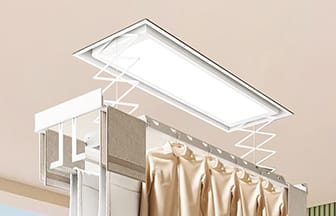
This separation between loading height and drying height is one of the strongest reasons to choose a movable hanging system. Rather than forcing one installation height to satisfy every task, the rack changes position according to what the user is doing. That can make overhead drying considerably more practical when it is used frequently.
Wall-Mounted Hanging Racks for Accessible Drying
Wall-mounted hanging racks provide another way to keep the main floor clearer. These systems use a vertical surface to support rails, arms, or hanging positions and can work especially well when there is an unused wall near the washing area.
Their main advantage is straightforward accessibility because the rack can usually be installed around a comfortable working height. Folding or retractable versions can reduce their projection after use, allowing the same wall area to remain less intrusive between laundry cycles.
The challenge is working clearance. A rack that appears compact when empty may extend much farther into the room after shirts, towels, or trousers are added. Cabinet doors, shelves, switches, appliances, and normal walking routes should therefore be evaluated with the rack fully open and loaded rather than only in its stored configuration.
Hanging Drying Rack Laundry Types Compared
Different hanging systems use space in different ways, so choosing between them should begin with the part of the room that can most easily support a drying zone. Ceiling systems preserve both floor and working-height walls, while wall-mounted designs provide easier direct access. Adjustable electric and manual racks add another dimension by allowing the drying position itself to change.
| Hanging Rack Type | Main Space Used | Loading Access | Floor Impact | Capacity Flexibility | Best Application |
|---|---|---|---|---|---|
| Fixed ceiling rack | Ceiling | Depends on height | Very low | Moderate | Permanent overhead drying |
| Manual lifting rack | Ceiling | Adjustable | Very low | Moderate | Regular vertical drying |
| Electric hanging rack | Ceiling | Highly adjustable | Very low | High | Frequent laundry routines |
| Wall-mounted hanging rack | Wall | Easy | Low | Moderate | Open wall areas |
| Retractable wall rack | Wall | Easy | Low | High | Multipurpose spaces |
| Expandable ceiling rack | Ceiling | Adjustable | Very low | High | Variable laundry loads |
The comparison shows why there is no single hanging rack that suits every layout. A permanent fixed structure may be entirely sufficient where rails can be installed within comfortable reach, while an adjustable system becomes more useful when the best drying position is higher than the best loading position. The room should determine the mechanism rather than the other way around.
How Loading Height Changes Everyday Convenience
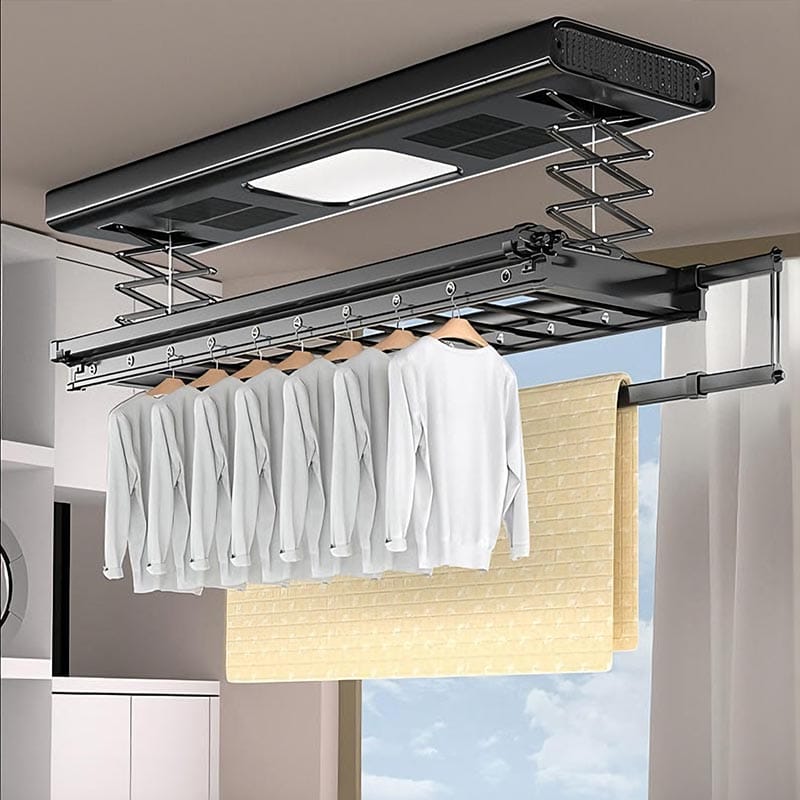
Loading wet clothing repeatedly above shoulder level can become inconvenient even when the rack itself is structurally suitable. Wet towels, trousers, bedding, and other larger garments require users to control both weight and fabric position while arranging them, so comfortable loading height plays an important role in everyday usability.
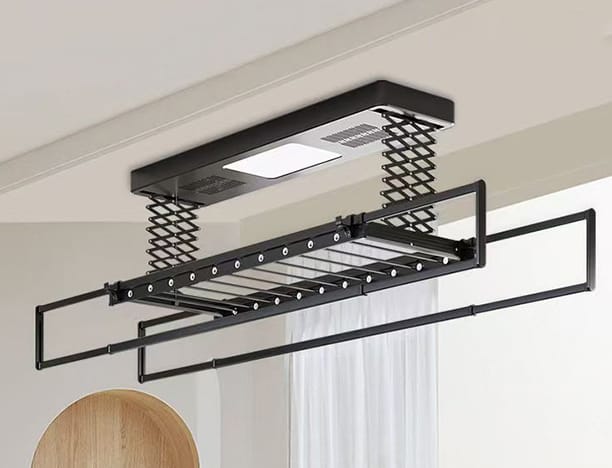
Adjustable hanging racks solve this by bringing the rail system toward the user. An automatic hanging rack can integrate powered vertical movement into a permanent overhead structure, allowing the drying zone to remain above the main working area while still being accessible when garments need to be handled.
The practical value of this design is easier to understand when the entire laundry cycle is considered. The rack does not need to remain within direct reach for several hours while clothing dries. It only needs to be accessible during loading and unloading. Height adjustment allows the structure to use two different positions for those two different stages.
Hanging Capacity Should Be Based on Real Garments
A drying rack can offer substantial rail length without necessarily providing the right type of capacity for every laundry load. Lightweight shirts, thick towels, trousers, and bedding each use hanging space differently, so practical capacity depends on the relationship between rail layout and the garments normally placed on it.
Shirts can often be arranged efficiently on hangers, which allows several items to use a long rail without being folded across individual bars. Towels require more exposed fabric area and may need wider spacing, while trousers and dresses depend on sufficient vertical clearance below the rail. Bedding creates an even larger drying surface and may occupy several parts of the rack simultaneously.
For this reason, hanging drying rack laundry capacity should be evaluated according to normal clothing patterns rather than simply counting bars or hanger holes. A flexible rack that allows users to alter spacing from one load to another can provide greater everyday value than a denser structure designed to maximize theoretical capacity.
Why Garment Spacing Matters During Hanging Drying
Air drying relies on moisture leaving fabric and moving into the surrounding environment, so the way garments are positioned influences how effectively the available rack area is used. If several thick wet items remain pressed together, some fabric surfaces receive less exposure to surrounding air even though the rack may still have enough structural strength to support the load.
Good hanging arrangements leave enough flexibility to separate thicker textiles while allowing lighter garments to use space more efficiently. This does not require every item to have the same gap because different fabrics behave differently. A shirt hanging freely may need less rail space than a thick folded towel, while bedding may require several rails to avoid excessive layering.
The most useful rack therefore gives users enough hanging length to organize clothing according to the load instead of encouraging every available position to be filled. Practical drying capacity is created by the combination of structural support and usable spacing, not by either one alone.
Expandable Hanging Racks for Changing Laundry Loads
Laundry volume can change significantly from one cycle to another, which makes fixed maximum dimensions unnecessary for many users. A smaller everyday load may need only the central drying rails, while bedding or a larger group of garments may require additional hanging length.
An electric ceiling drying rack with retractable drying poles allows the usable hanging area to expand when additional capacity is required and return to a more compact configuration afterward. This can be particularly helpful when a room needs greater capacity occasionally but does not need a permanently oversized drying structure.
Expandable designs also provide another benefit: additional length can be used to improve garment spacing rather than simply accommodate more clothing. A larger textile load can be distributed across a wider area, while normal cycles can use a more compact configuration. This gives the hanging structure greater flexibility without permanently increasing its visual or physical footprint.
Structural Stability in a Hanging Drying System
A hanging rack transfers laundry weight through more components than a simple floor-supported frame. Wet garments place force on the rails, which then transfer the load through joints, suspension components, brackets, and finally into the ceiling or wall structure. Every connection along this path contributes to the overall stability of the system.
This makes construction quality especially important. A strong main rail cannot compensate for an unstable connection, and a well-designed drying frame still depends on appropriate mounting. Moving systems create additional requirements because cables, lifting components, telescopic sections, and joints experience repeated mechanical operation as the rack changes position.
Materials should therefore be evaluated together with the structure rather than as isolated selling points. Aluminum can be useful where lower component weight and corrosion resistance are desirable, while other metals may be appropriate for supporting brackets or structural connections. Long-term reliability comes from how these components work together under normal wet-laundry conditions.
Load Distribution Matters in Overhead Drying
Wet laundry rarely creates a perfectly balanced load. Several towels may be placed on one side of the rack while lighter shirts occupy another, or bedding may concentrate much of its weight along a particular rail. Even when the total load remains within the rack’s intended capacity, uneven distribution can change how the structure responds.
This is particularly relevant for expandable hanging systems because garments positioned farther from the central supporting structure can create greater leverage on extension components. Users should therefore distribute heavier wet items across the available drying area instead of concentrating them entirely at one end whenever practical.
A good hanging drying rack laundry system should tolerate normal variation in garment placement without becoming difficult to operate, but thoughtful load distribution can still improve everyday stability. Capacity should therefore be understood as a relationship between total weight, garment position, and structural design rather than as one isolated number.
Planning Airflow Around a Hanging Drying Rack
Rack placement affects more than room organization because air drying also depends on the environment surrounding the garments. Wet fabric releases moisture into the surrounding air, so a drying zone should avoid unnecessary enclosure between cabinets, walls, or other large surfaces.
Ceiling mounting can provide relatively open space around garments, but good results still depend on how the rack is loaded. Filling every available rail with tightly packed textiles can reduce the advantage of an open position. Adjustable or expandable rails can help by allowing the same load to be distributed across more space when thicker garments need additional separation.
Room ventilation should also be considered as part of the drying setup. The rack itself supports clothing, while the surrounding room provides the conditions in which moisture can move away from wet fabric. A useful installation therefore combines space efficiency with a location that does not unnecessarily restrict air movement around the load.
Fixed Hanging Racks vs Adjustable Hanging Racks
A fixed hanging rack has the advantage of mechanical simplicity because the drying position remains constant. This can work well in rooms where the ceiling or wall allows the rails to remain accessible without interfering with other functions. Fewer moving components can also make the system straightforward to understand and use.
Adjustable racks become more valuable when one fixed height cannot satisfy both loading and drying requirements. A rack may need to stay relatively high to preserve space underneath while also needing to move lower so wet garments can be arranged comfortably. Manual or electric lifting allows both requirements to be met without permanently compromising one for the other.
The decision should therefore depend on the physical relationship between users, garments, and the installation area. If comfortable access and good clearance already exist at one height, fixed rails may be sufficient. If the room benefits from a higher drying position, adjustability can become a meaningful part of the system rather than an unnecessary feature.
How Hanging Drying Racks Fit Small Laundry Spaces
Small laundry spaces need drying equipment to work around other essential functions. Appliances need access, cabinets need clearance, baskets need temporary space, and people need a route through the room. A large portable rack can make these tasks difficult even if it can eventually be folded and stored.
Hanging drying shifts some of this activity upward or onto the wall, which allows the lower part of the room to remain more functional. The greatest benefit appears when the rack occupies a zone that does not already have another important purpose.
Ceiling height and garment length still matter. An overhead rack installed above a cabinet may work perfectly for shirts while long trousers touch the surface below. A useful small-space layout therefore considers the lowest point of hanging garments rather than only the height of the empty rack.
Hanging Drying Rack Laundry for Shirts, Towels, and Bedding
A versatile hanging rack should accommodate garments with different shapes rather than forcing every load into one arrangement. Shirts and dresses can use hanger positions efficiently because they remain suspended vertically and require relatively little rail contact. This makes long hanging rails particularly useful when a large portion of the laundry consists of everyday clothing.
Towels create different requirements because their thicker fabric benefits from broader exposure and should not be excessively layered. Bedding can require even greater rail length and may need to be distributed across several sections of the rack. Expandable systems can help accommodate these occasional larger loads without requiring the drying structure to remain permanently extended.
When selecting the rack, it is therefore useful to think about the textiles that occupy the greatest amount of space rather than simply the largest number of garments. A relatively small number of towels or bedding pieces may require more usable rail area than many lightweight shirts.
Installation Planning Before Choosing a Hanging Rack
Installation planning should begin with the rack in its largest realistic operating condition. Ceiling systems need enough clearance from lights, cabinets, ventilation fixtures, and other overhead elements, while wall-mounted structures need sufficient projection space when fully extended and loaded.
Loading position should also be considered. If an adjustable rack descends, the lowered frame needs a clear zone where users can stand comfortably with a laundry basket. The highest position needs enough space for garments to remain clear of frequently used surfaces below.
The most successful installation is usually one that feels natural during every stage of the laundry process. Wet clothes should move from the washing area to the rack without unnecessary obstacles, the rack should remain unobtrusive during drying, and dry garments should be easy to remove afterward.
Common Hanging Drying Rack Selection Mistakes
One common mistake is choosing a rack mainly by total rail length without considering garment type. More rail length is useful only when it can be organized effectively, and tightly packed fabrics may reduce the practical benefit of additional capacity. A flexible arrangement is generally more useful than simply maximizing hanging positions.
Another mistake is measuring only the empty frame. Clothing can extend well beyond the rack itself, particularly with long garments and bedding, so the loaded drying zone should be included when evaluating surrounding clearance.
Users may also focus too heavily on the main metal rails while overlooking mounting, joints, suspension components, and extension mechanisms. Hanging racks depend on the complete structural path from garments to the ceiling or wall, making connection quality particularly important for long-term use.
Choosing a Hanging Drying Rack According to Laundry Frequency
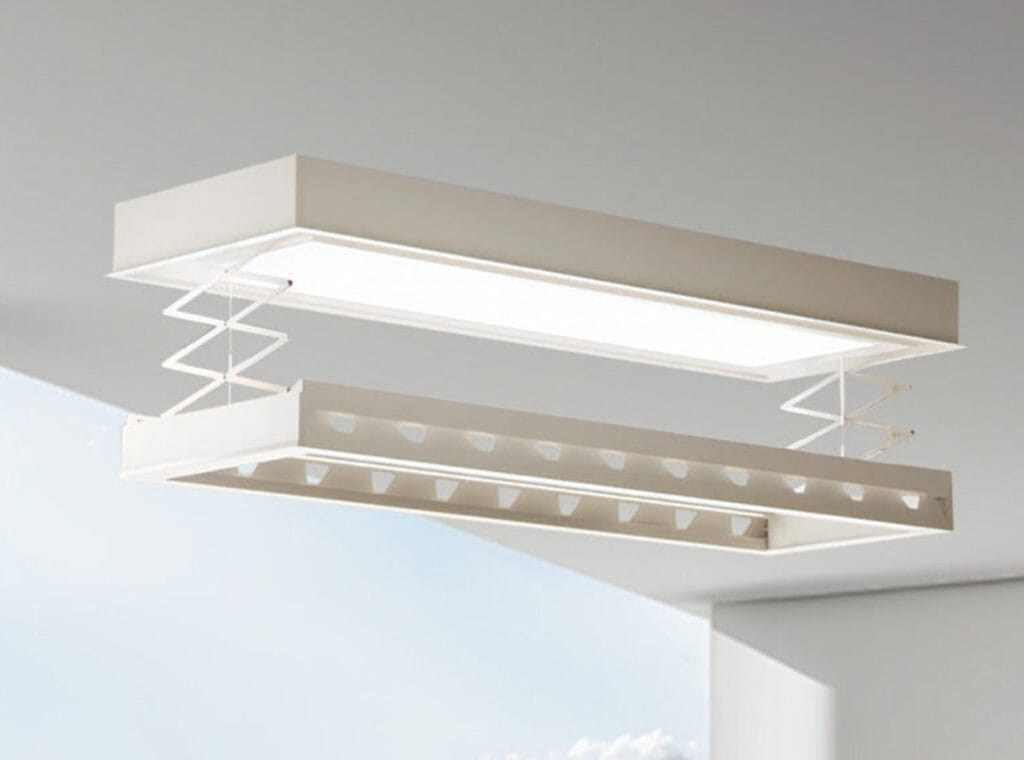
The frequency of air drying can help determine whether a permanent hanging rack is worthwhile. If only a few garments need occasional air drying, a portable or temporary solution may provide sufficient capacity without requiring fixed installation.
Regular laundry drying changes that calculation. A permanent wall or ceiling rack eliminates the need to repeatedly find floor space, unfold equipment, and store the structure afterward. Adjustable overhead racks can make this permanent drying zone even more practical by moving out of the way during the longest part of the drying cycle.
The rack should therefore solve the pattern that occurs most often. Occasional use favors flexibility of location, while frequent use makes predictable installation and convenient accessibility increasingly valuable.
Conclusion
A hanging drying rack laundry setup can improve the way laundry space is used by shifting wet garments away from areas needed for movement, appliances, and storage. Ceiling-mounted racks use overhead volume, wall-mounted systems preserve the floor, and adjustable structures allow the drying zone to change position according to the stage of the laundry process.
The most effective design depends on more than installation type. Loading height, garment length, practical rail spacing, structural stability, load distribution, airflow, and normal laundry volume all influence how well the rack performs. Expandable rails can add useful flexibility when larger loads appear, while lifting systems can make high drying positions easier to access.
Rather than choosing according to the greatest number of rails or the most compact appearance, evaluate how the complete loaded rack interacts with the room. A successful hanging drying system should remain accessible when clothes need to be handled and become less intrusive while they dry.
When the rack is matched to the actual room and laundry routine, hanging drying becomes more than a way to keep wet clothing off the floor. It becomes a practical method of creating dedicated drying capacity without allowing that capacity to dominate the rest of the space.
FAQ
What is a hanging drying rack laundry system?
A hanging drying rack laundry system suspends garments from wall- or ceiling-supported rails rather than relying only on a freestanding floor frame. Designs may be fixed, retractable, manually adjustable, or electrically operated. The main purpose is to create useful hanging capacity while preserving more floor space for other laundry activities.
Are hanging drying racks suitable for small laundry spaces?
Yes. Hanging racks can work especially well in small spaces because they use wall or ceiling areas instead of permanently occupying the floor. The rack should still be planned around ceiling height, garment length, cabinet clearance, appliance access, airflow, and the complete loaded footprint rather than only the dimensions of the empty frame.
How much weight can a hanging drying rack hold?
Capacity depends on the rack design, rails, mounting system, suspension components, and manufacturer specifications. Wet towels, denim, and bedding create greater loads than lightweight garments, so both total weight and distribution matter. Heavier items should be spread across the available structure rather than concentrated on one outer section.
Is a ceiling hanging drying rack better than a wall-mounted rack?
A ceiling rack is useful when floor and wall space are already valuable, while a wall-mounted rack offers convenient access when an open vertical surface is available. Neither design is universally better. Ceiling height, wall clearance, drying frequency, garment types, installation conditions, and desired height adjustment should guide the choice.
How can I improve airflow when using a hanging drying rack?
Avoid placing thick wet garments directly against each other and use the available rail length to create suitable separation. Towels and bedding generally need more space than lightweight shirts. Position the rack where surrounding air can move reasonably well and consider the room’s ventilation so moisture released from the garments can disperse effectively.