
Table of Contents
Introduction
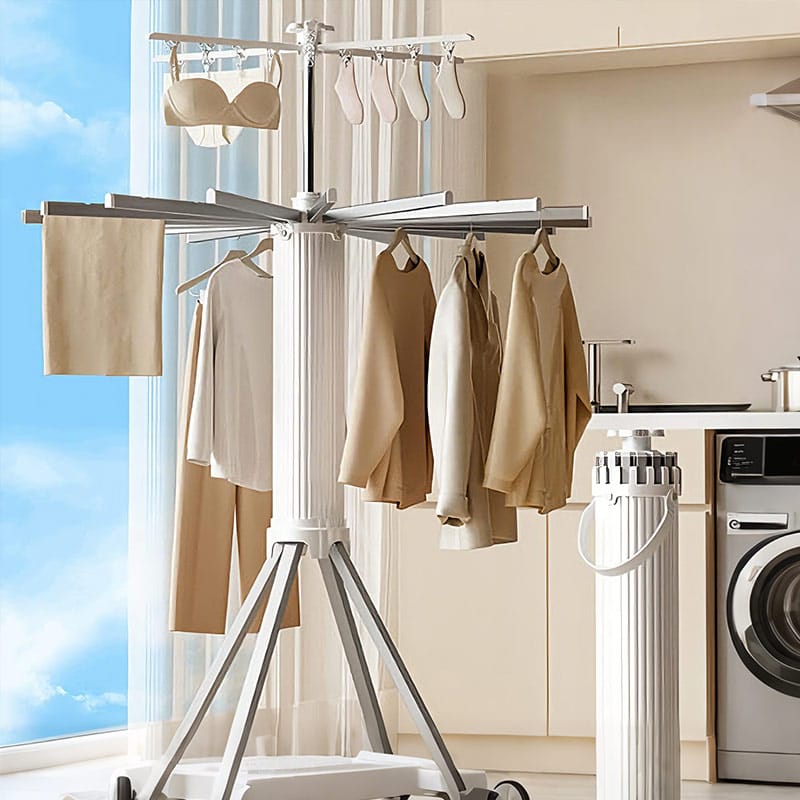
A drying rack does not always need a wide rectangular frame to create useful hanging space. In compact homes, balconies, dormitories, utility rooms, and temporary laundry areas, a smaller structure that expands around a central point can sometimes work more naturally. This is where the tripod clothes hanger becomes interesting.
Its three-point support changes the way the rack uses the floor. Instead of stretching across a long horizontal area, the structure concentrates around a central zone while distributing support through three legs. Garments can then be arranged around the upper section, allowing the rack to create useful hanging capacity without behaving like a conventional wing-style drying rack.
The design looks simple, but simplicity does not mean there is little to evaluate. Leg angle affects stability. Hanging positions affect balance. The diameter of the open structure determines whether it truly works in a small room. Garment length changes the useful vertical space, while the folded form determines whether portability is actually convenient.
A good tripod clothes hanger succeeds because all of these relationships work together.
Why Three Legs Can Create a Surprisingly Stable Structure
Three-legged supports have been used for centuries because three contact points naturally establish a plane. On reasonably solid flooring, this means a tripod can remain stable without requiring all four feet of a rectangular stand to contact the floor with exactly the same pressure.
The general engineering principle behind a tripod is simple: three spread legs create a broad supporting base around a central load. Increasing the distance between the feet can improve resistance to tipping, although the final stability still depends on height, weight distribution, materials, and the object being supported.
For a clothes hanger, this geometry creates several useful possibilities.
The central column can carry the upper hanging structure while the legs spread outward only near the floor. This leaves much of the space around the middle relatively open. Garments can hang in different directions instead of forming one long wall of laundry.
At the same time, tripod geometry does not automatically guarantee stability. A tall structure with narrow leg spacing can still tip easily. If most wet garments are placed on one side, the center of mass moves toward that direction.
The effectiveness of the design therefore comes from proportion rather than simply from having three legs.
A Tripod Rack Uses Space Radially Instead of Horizontally
Traditional folding racks usually expand sideways. This works well when the room provides a long, open section of floor.
A tripod clothes hanger uses space differently.
Its hanging capacity develops around a central point. This means the user needs a roughly circular working zone rather than a long rectangular footprint.
That difference can be useful in awkward spaces.
A small bedroom corner may not accommodate a 150-centimeter-wide rack, but it may have enough open area for a compact tripod structure. A utility room may contain narrow gaps between appliances and cabinets where a long drying stand is impractical. A balcony may have enough central space even though its walls are interrupted by doors, windows, or storage units.
This does not mean a tripod always occupies less area. The legs still need sufficient spread for stability, and long garments extend beyond the central column.
The advantage is flexibility in the shape of the footprint.
When choosing a rack for a real room, footprint shape can matter just as much as total square area.
The Center Column Does More Work Than It Appears
On many tripod designs, most of the structure depends on one central vertical member.
That column transfers the weight of clothing from the upper hanging section toward the legs below. If the column bends, twists, or connects poorly to the base, the entire rack can feel unstable even when the legs are correctly positioned.
The connection between the column and upper hanger structure is equally important.
Garments rarely load the rack symmetrically. One user may place a heavy coat on the first available arm and lightweight shirts on the opposite side. Another may hang several damp towels together. The upper joint therefore experiences both vertical weight and uneven rotational forces.
A well-designed tripod rack needs enough stiffness to manage these ordinary household situations without feeling delicate.
For buyers and distributors, gently applying an uneven test load can reveal more about structural quality than simply examining the rack while empty.
Wet Clothes Turn Balance Into a Real Design Question
Dry shirts are light. Wet laundry is not.
Water retained after washing increases garment weight, and the effect becomes particularly noticeable with jeans, hoodies, jackets, towels, and children’s winter clothing.
On a tripod clothes hanger, uneven loading changes the balance around the central column.
Imagine placing four lightweight shirts evenly around the rack. The load remains close to the center. Now replace three of those shirts with one heavy wet jacket positioned at the edge of an extended arm. The force acting toward that side increases significantly.
Users should not need to perform calculations every time they hang laundry, so the structure should provide reasonable stability under imperfect loading.
Good design can support this through sufficient leg spread, appropriate rack height, controlled arm length, and a strong center connection.
The practical lesson is simple: test tripod drying racks with realistic wet garments rather than only lightweight display clothing.
Tripod Clothes Hangers Are Particularly Useful for Hanging Garments
A tripod format is naturally suited to clothing that already uses hangers.
Shirts, blouses, dresses, school uniforms, jackets, and lightweight coats can hang around the central structure while remaining relatively easy to access from different sides.
This creates a different laundry workflow from a horizontal drying rack.
Instead of folding a shirt across a rail, the garment can remain on a hanger during drying. For suitable fabrics, this helps preserve a more natural hanging orientation and can make later transfer to the wardrobe easier.
The radial arrangement also allows users to approach the rack from several directions. This can be convenient when adding or removing garments because there is no single front side.
However, hanger spacing still matters. Filling every available point can cause sleeves and garment sides to overlap, reducing the practical benefit of the radial arrangement.
Maximum capacity should therefore not be confused with ideal drying capacity.
Small Clothes Can Be Organized Without Taking Over the Main Rails
One practical challenge in household laundry is the large number of small garments.
Children’s clothing, socks, underwear, baby items, scarves, and lightweight accessories may occupy surprisingly large sections of a conventional rack when each piece is given an individual rail position.
A multi-zone tripod design can make this easier by separating types of garments around different sections.
YIHUI’s current Tripod Clothes Drying Rack is positioned around a zoned drying concept, using separate areas to organize different categories of clothing. This type of arrangement demonstrates how a tripod structure can focus not only on total capacity but also on making laundry easier to sort while it dries.
For families, this can reduce the time spent searching through mixed garments afterward.
Instead of treating the rack as one undivided hanging area, users can assign different parts to adults, children, frequently used clothing, or smaller pieces.
The value lies in organization rather than simply increasing the number of hanging points.
A Drying Rack Can Become a Sorting System
Laundry usually needs sorting at several points.
Clothes are separated before washing according to fabric, color, or washing requirements. After drying, they are sorted again according to owner, wardrobe, or room.
A tripod clothes hanger can support some of this organization during the drying stage.
One side might hold children’s shirts. Another can carry adult garments. A third section could be used for clothing that needs to return to a particular wardrobe.
This creates a simple visual system.
When garments dry, the user does not need to search through a large mixed rack. Clothing can already be grouped according to where it will go next.
The broader octopus drying rack category illustrates how multi-directional and zoned layouts can provide an alternative to traditional straight drying structures.
For household products, organization is often an underrated form of efficiency. Saving several minutes of sorting after each load can matter just as much as reducing setup time.
Does a Tripod Rack Really Save Floor Space?
The answer depends on what it is compared with.
A large wing-style drying rack may require a long rectangle of floor area. A tripod may fit within a shorter but wider circular zone. In some rooms this is a major advantage; in others it is not.
The correct comparison should therefore examine usable room space rather than only product dimensions.
| Situation | Tripod Clothes Hanger | Wide Folding Rack |
|---|---|---|
| Narrow room with short open wall sections | Often easier to position | Can be difficult to open fully |
| Need to hang shirts on hangers | Very suitable | Depends on available hanger points |
| Drying large sheets | Limited on many designs | Often more suitable |
| Sorting garments into groups | Radial zones can work well | Usually one continuous drying area |
| Need to walk around the rack | Requires surrounding clearance | Mainly requires front and side clearance |
| Compact storage after use | Depends on folding design | Often folds flat |
| Heavy towels and bedding | Capacity must be checked carefully | Larger rail area may be preferable |
A tripod is therefore not automatically the smallest option.
Its strength is that it uses a different geometry, which may fit rooms that are difficult for conventional drying racks.
The Best Location Is Often a Corner with Breathing Room
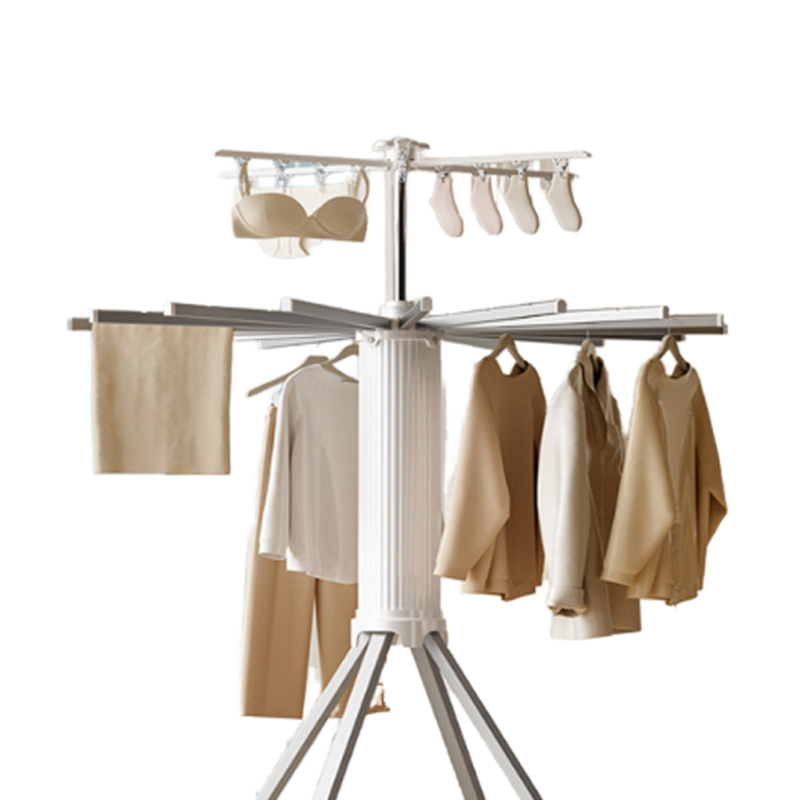
Because tripod racks spread outward, placing one directly against a wall can reduce access to part of the hanging structure.
A better position often leaves some clearance around at least two sides.
In a bedroom, this might mean placing the rack near a window but not directly against furniture. In a utility room, it may sit between laundry cycles in an open corner. On a balcony, positioning should consider door movement, wind exposure, and the routes people normally use.
The rack should also remain reasonably level.
Although three-point support can work well on slightly uneven surfaces, highly sloped or unstable flooring changes the load direction and may affect balance.
A compact footprint is useful only if the location still allows users to load and unload clothing comfortably.
Portability Is More Than Low Weight
A tripod clothes hanger is often chosen because it can move easily between spaces.
Weight matters, but portability involves several other factors.
Can the legs close without complicated steps? Does the folded structure remain together when carried? Is there a convenient place to grip the column? Do upper arms catch on door frames? Can one person move the rack without individual parts swinging open?
These details determine whether users actually move the product regularly.
A lightweight rack with awkward folding behavior may be less portable than a slightly heavier structure that collapses cleanly into one controlled shape.
Storage matters too.
A tripod that reduces to a narrow vertical form may fit beside a wardrobe, inside a utility cupboard, or between a washing machine and wall. If the legs remain widely separated after folding, the theoretical portability advantage becomes much smaller.
Dormitories and Temporary Living Spaces Create a Strong Use Case
Not every household can install permanent drying equipment.
Students, renters, seasonal residents, and people living in temporary accommodation may need laundry equipment that arrives and leaves with them.
A tripod clothes hanger fits this situation well because the basic concept does not depend on a fixed wall or ceiling installation.
It can create a temporary drying zone where needed and move away afterward.
For dormitories, room size remains important. The rack should not obstruct doors or shared walking routes. A vertical design can be particularly useful where the available open floor area is fragmented rather than wide.
Rental apartments present similar requirements.
A product that provides useful clothing capacity without modifying the building can offer greater flexibility when living arrangements change.
Tripod Designs Work Best When the Garment Mix Matches the Structure
A tripod rack can be highly effective for one household and poorly suited to another.
Someone who mainly dries shirts, uniforms, dresses, and children’s clothing may benefit significantly from multiple hanger positions.
A household that regularly air-dries king-size sheets and large bath towels may need long horizontal rails instead.
The decision therefore begins with the laundry mix.
Consider the last five washing cycles rather than an imaginary ideal load.
How many shirts were there?
How many towels?
Were large sheets included?
How often did children’s clothing need separate sorting?
How many garments would normally go directly onto hangers?
These questions provide a much more realistic basis for selecting a drying structure.
Height Determines Which Garments Can Hang Freely
Tripod racks often emphasize vertical design, but usable hanging height still needs careful attention.
If the upper arms are too low, long dresses may touch the floor. Trousers hung from the waist may overlap lower sections. Jackets can interfere with clothing positioned beneath them.
Increasing the rack height creates more garment clearance but also raises the center of mass.
That creates an engineering trade-off.
A taller structure provides better hanging space for long garments but may require a wider or stronger base to maintain stability.
For designers, height should therefore be linked directly to base geometry and intended garment types.
For users, overall product height alone is not enough. The relevant measurement is the distance from the actual hanging position to the floor.
The Three Legs Need Their Own Space
One common mistake is measuring only the upper part of the rack.
The legs may create the largest diameter near floor level.
In a furnished room, this can cause unexpected conflicts. A leg may extend underneath a curtain, prevent a cupboard from opening, or become a trip point beside a narrow walkway.
Before positioning a tripod clothes hanger, households should consider where all three feet will land.
The same applies to product photography and product information. Showing only the upper hanging structure can make the rack appear smaller than it behaves in a real room.
A useful specification should make both the maximum hanging width and the base footprint clear.
How Tripod and Octopus Designs Differ from Conventional Racks
Tripod and octopus-style drying products share an emphasis on multi-directional organization, but the names can describe different aspects of the structure.
“Tripod” refers primarily to the supporting base: three main legs.
“Octopus” usually refers to the upper arrangement, where multiple arms or hanging sections extend outward.
A product can combine both concepts.
The three-leg base supports the structure while the upper multi-arm layout creates separated drying zones.
This combination helps explain why these products behave differently from rectangular racks.
A conventional rack organizes clothing along lines. A multi-arm tripod organizes it around a center.
Neither arrangement is universally better. They serve different laundry habits and spaces.
Stability Testing Should Include One-Sided Loading
For distributors and product-development teams, tripod racks deserve a specific kind of practical test.
Do not load every arm evenly.
Place several heavier wet garments on one side. Leave the other side almost empty. Observe whether the feet remain stable and whether the upper structure twists noticeably.
Then move one heavy item farther from the center.
This simulates the way people actually use household equipment.
Other useful checks include opening and closing the legs repeatedly, carrying the folded rack between rooms, testing upper connections after repeated use, and placing the rack on common residential flooring such as tile or laminate.
These tests help reveal whether a visually attractive structure is also forgiving in everyday conditions.
The Best Tripod Rack Does Not Need to Be the Biggest

Large capacity can be attractive, but increasing the number and length of arms changes the entire structure.
Longer arms create greater leverage against the central column. More hanging positions encourage heavier loads. A wider leg spread improves stability but increases floor area.
At some point, making the tripod larger can eliminate the compactness that made the design useful.
The better objective is appropriate capacity.
For a small apartment, a moderate number of well-spaced hanger positions may be more useful than maximum expansion. For a family, additional zones may justify a larger footprint.
Product development should therefore start with a clear user group rather than attempting to maximize every dimension simultaneously.
Conclusion
A tripod clothes hanger offers an alternative way to organize drying space by building outward from a central point rather than stretching across a long rectangular frame.
Its three-leg support can create a stable foundation when the proportions are designed correctly, while a radial upper layout can make shirts, dresses, children’s clothing, and other hanging garments easier to organize into separate zones.
The design is particularly useful in homes where available floor space is irregular, permanent installation is undesirable, or garments need to be sorted while drying.
But the tripod shape alone does not guarantee a good product.
Leg spread, central-column stiffness, hanging height, uneven-load stability, folded dimensions, garment spacing, and ease of movement all determine whether the structure works naturally in daily life.
A successful tripod clothes hanger is therefore not simply a rack with three legs. It is a carefully balanced relationship between stability, portability, organization, and the type of laundry people actually dry.
FAQ
What is a tripod clothes hanger?
A tripod clothes hanger is a freestanding clothing rack that uses three supporting legs and typically places hanging positions around or near a central vertical structure.
Why does a tripod use three legs?
Three legs create three contact points around the center and can provide a stable supporting plane. Actual rack stability still depends on leg spread, height, structural stiffness, and load distribution.
Is a tripod clothes hanger suitable for small apartments?
It can be useful where a long rectangular drying rack is difficult to position. Users should still measure the full base footprint and allow enough space around hanging garments.
Can a tripod clothes hanger hold wet jackets?
That depends on the rack’s structural design and intended load. Heavy wet garments should be distributed sensibly, and the manufacturer’s load guidance should be followed.
Is a tripod rack suitable for bedding?
Many tripod designs are better suited to hanging garments and smaller textiles than large sheets. Households that frequently dry bedding may benefit from products with longer horizontal rods.
Need Help Choosing the Right Tripod Clothes Hanger?
If you’re evaluating a tripod clothes hanger for apartments, family laundry, compact rooms, or different market applications, our team can help you compare base stability, hanging zones, usable height, storage dimensions, and garment capacity. Contact us today to discuss a drying solution that balances easy organization, flexible placement, and dependable everyday use.





