Table of Contents
Introduction
Choosing drying racks for laundry room spaces is less about finding one universally “best” rack and more about understanding how the rack will work inside the room you actually have. A design that performs well in a spacious dedicated laundry area may become inconvenient in a narrow room where appliances, cabinets, doors, and storage already compete for space.
That is why the most useful starting point is not style, but layout. Look at your available floor area, wall width, ceiling height, ventilation, typical laundry volume, garment types, and how frequently the rack will be used. These factors determine whether a ceiling-mounted, wall-mounted, freestanding, foldable, manual, or automatic system will fit naturally into your routine.
The best drying racks for laundry room use should do more than hold wet garments. They should provide enough hanging capacity without making the room harder to move through, allow air to circulate between clothes, remain convenient to load and unload, and fit the way other laundry equipment is arranged.
For many modern laundry spaces, this makes vertical space particularly valuable. Instead of treating the ceiling as unused space, an overhead drying system can move laundry away from working surfaces and circulation areas. The concept is not new: an overhead clothes airer is fundamentally a ceiling-mounted mechanism designed to raise laundry above the normal working area.
Modern drying racks build on that same space-saving principle with more adaptable structures, lifting mechanisms, adjustable rails, and automated functions.
What Makes a Drying Rack Suitable for a Laundry Room?
A good laundry room drying rack needs to balance capacity, accessibility, airflow, and space efficiency. Focusing on only one of these factors often leads to a rack that looks suitable on paper but becomes awkward in everyday use.
Space efficiency is the first consideration. A laundry room already contains equipment such as washing machines, cabinets, work surfaces, baskets, storage units, and doors. A rack should use the remaining space intelligently rather than competing with these elements.
Accessibility matters just as much. A rack mounted too high may free floor space but make hanging heavy wet garments uncomfortable. A large floor rack may be easy to reach but could block movement whenever it is open. The best solution places garments at a comfortable working height during loading while minimizing obstruction after loading is complete.
Air circulation is another important factor. Drying occurs as moisture evaporates from fabric into the surrounding air. Garments packed tightly together may technically fit on the rack, but their effective drying performance can be poor because damp surfaces receive less moving air.
This leads to an important distinction: maximum hanging capacity is not always the same as useful drying capacity. A better drying rack creates enough separation between garments to support evaporation while still using the room efficiently.
Structural stability should also be evaluated. Wet towels, bedding, trousers, and layered clothing can place considerably more stress on a rack than lightweight dry garments. The rail structure, mounting method, lifting components, joints, and suspension system therefore matter as much as the overall dimensions.
Main Types of Drying Racks for Laundry Room Spaces
Different rooms create different constraints, so understanding the main drying rack designs makes selection much easier.
Ceiling-Mounted Drying Racks
Ceiling-mounted racks use the vertical area above the normal working zone. They are particularly effective when floor space is limited or when walls are already occupied by cabinets, shelves, appliances, or doors.
A ceiling rack can be raised after garments are hung, leaving the lower part of the room relatively unobstructed. This creates a useful separation between the “drying zone” and the “working zone.”
This layout can work especially well in compact laundry spaces because the same floor area can serve several purposes. You can load laundry at one moment and recover the usable area underneath once the rack is raised.
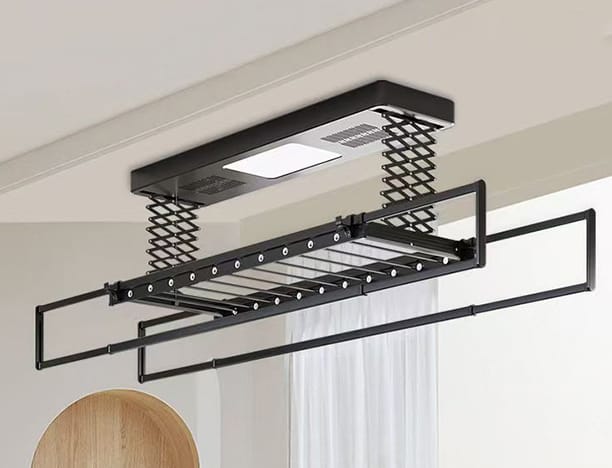
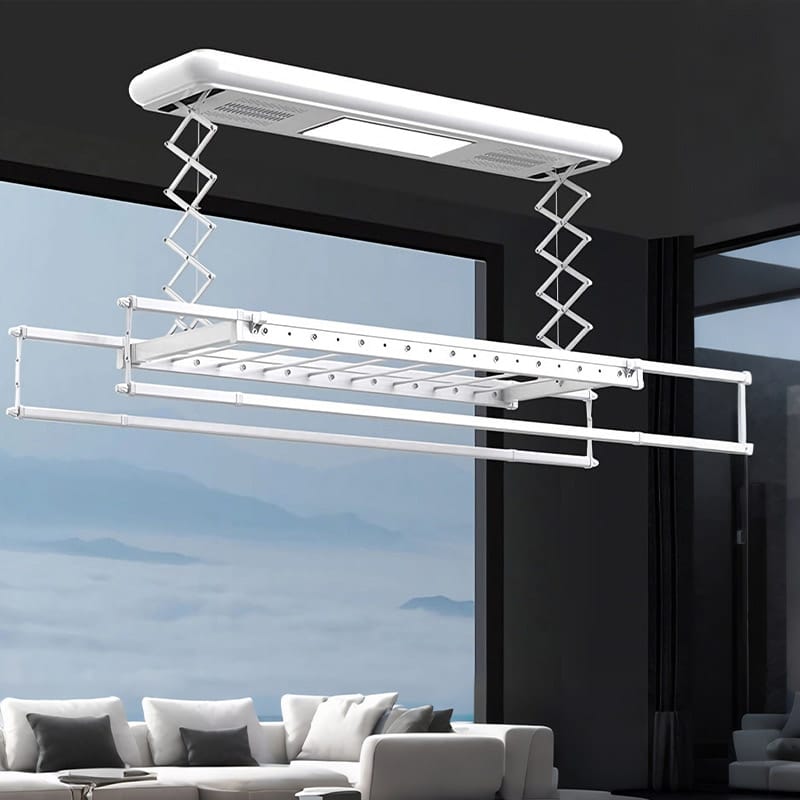
Modern products such as a ceiling clothes drying rack can combine motorized lifting with operational and safety functions, allowing the drying position to change without permanently occupying the most accessible part of the room.
The key limitation is installation. Ceiling structure, available height, electrical requirements for motorized models, operating clearance, and the position of lights or cabinets all need to be considered before installation.
Wall-Mounted and Foldable Drying Racks
Wall-mounted drying racks are useful when a laundry room has an open wall but limited floor space. Many designs fold against the wall or retract when they are not being used.
Their main advantage is simplicity. They create a defined drying area without introducing another piece of movable equipment into the room.
However, usable wall width is often more limited than expected. Cabinets, doors, windows, shelving, electrical outlets, and appliances can reduce the available mounting area. A rack also needs enough clearance when extended, so measuring only its folded dimensions can be misleading.
Wall-mounted systems are therefore best suited to layouts where one wall can be intentionally reserved for laundry drying.
Freestanding Drying Racks
Freestanding racks remain useful because they require no permanent mounting and can usually be repositioned when laundry habits change.
They work well when flexibility is more important than permanent space optimization. A user can move the rack toward better airflow, fold it away after use, or use it in different rooms.
Their disadvantage is predictable: they consume floor space at exactly the time the laundry room is most active. A fully loaded freestanding rack can restrict access to appliances, cabinets, baskets, or doors.
For occasional use, this may be acceptable. For frequent drying in a compact room, it can become a recurring inconvenience.
Automatic Drying Racks
Automatic drying racks combine the space advantages of overhead installation with powered movement. Rather than manually reaching upward or operating a pulley, the rack can descend toward a convenient loading position and rise again for drying.
This changes the practical value of ceiling space. High positioning no longer necessarily means difficult access.
Depending on the design, automatic systems may also include lighting, remote operation, airflow functions, expandable rails, obstruction detection, or other control features. An automatic clothes hanger illustrates how lifting and control functions can be integrated into one overhead laundry system.
For users who dry laundry frequently, this type of system can make the routine more organized because the rack is moved to the user rather than requiring the user to repeatedly reach the rack.
Comparing Different Drying Rack Designs
The following comparison provides a practical way to evaluate common drying racks for laundry room environments.
| Drying Rack Type | Space Use | Installation | Daily Accessibility | Main Strength | Main Consideration |
|---|---|---|---|---|---|
| Ceiling-mounted | Uses overhead space | Permanent | Good when height is adjustable | Keeps floor clear | Requires suitable ceiling conditions |
| Automatic ceiling rack | Uses overhead space | Permanent, may require electrical preparation | Very convenient | Combines vertical storage with adjustable loading height | More components require proper installation |
| Wall-mounted | Uses wall area | Permanent | Generally easy | Compact when folded | Requires clear wall and extension space |
| Foldable wall rack | Uses temporary wall projection | Permanent | Easy | Can disappear after use | Capacity depends on wall width |
| Freestanding | Uses floor area | None | Very easy | Flexible placement | Can obstruct movement |
| Retractable system | Uses wall or ceiling area | Usually permanent | Depends on design | Reduces visual and physical clutter when stored | Needs sufficient extension clearance |
| Manual lifting rack | Uses overhead space | Permanent | Moderate | Simple height adjustment | Requires manual operation |
The table also highlights why there is no single design that wins every category. A freestanding rack offers excellent flexibility but weak floor-space efficiency. A fixed wall rack may be compact but requires an uninterrupted wall. A ceiling system saves valuable working space but needs proper structural planning.
The right decision comes from identifying which limitation matters most in your laundry room.
How Laundry Room Size Changes the Best Choice
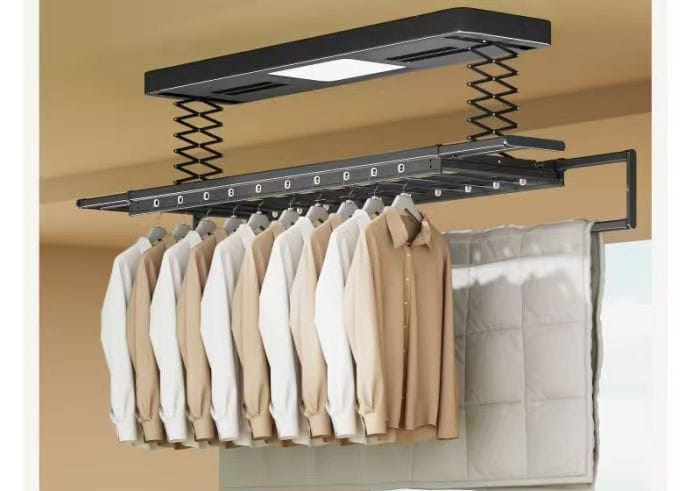
When comparing drying racks for laundry room spaces, total room size can be misleading. What matters is usable space after appliances, doors, cabinetry, storage, and circulation routes are taken into account.
A small room may have almost no free floor area but a large unused ceiling. In that situation, an overhead system can make much more sense than a supposedly “compact” floor rack.
Similarly, a wider room with a clear side wall may be better suited to a folding wall rack. There is little benefit in adding an overhead mechanism if a wall-mounted solution already provides adequate capacity without interfering with other functions.
For medium-sized multipurpose rooms, flexibility becomes important. Laundry spaces often double as storage rooms, utility spaces, or garment-care areas. A rack that can retract, fold, or lift away after use allows the same area to support more than one activity.
Larger laundry rooms offer more freedom, but that does not mean larger racks are automatically better. Oversized systems can still interfere with ventilation, make garment sorting less convenient, or encourage clothes to be packed too closely together.
A more useful question is therefore not “How large a rack can fit?” but “How much accessible drying space do I regularly need?”
Ceiling-Mounted vs Wall-Mounted Drying Racks
Ceiling-mounted and wall-mounted systems solve the same fundamental problem in different ways: they move laundry away from the floor.
The choice depends on where your room has unused space.
A ceiling-mounted rack is usually more attractive when wall space is occupied. Cabinets, vertical storage, worktops, doors, and appliances can consume most available wall area, while the ceiling remains largely unused.
A wall-mounted rack makes sense when the opposite is true. If you have a wide, unobstructed wall, installing the rack there can create a simple and accessible drying station.
Operating clearance should also influence the choice. Wall-mounted racks extend horizontally into the room. Even when the unit itself looks compact, hanging garments can increase its effective projection considerably.
Ceiling racks occupy vertical space instead. The critical dimensions are ceiling height, lowered loading position, raised drying position, and clearance from doors, lighting fixtures, cabinets, and people moving underneath.
This is why installation measurements should include the rack in both its working and stored positions.
Automatic vs Manual Drying Racks for Laundry Room Use
Manual and automatic racks differ most clearly in how the drying area is accessed.
A manual ceiling rack may use a lifting mechanism, pulley, or hand-operated adjustment. Its structural concept can be relatively straightforward, and it works well when users are comfortable operating the system manually.
An automatic rack uses a motorized mechanism to change height. This is particularly useful when the rack normally remains above comfortable arm level.
The practical advantage is not simply automation for its own sake. Adjustable height can improve the sequence of the laundry task. The rack comes down for loading, moves upward for drying, and returns when clothes need to be removed.
That workflow can become especially valuable when wet items are heavy or when the rack is used frequently.
Automatic systems should nevertheless be assessed as mechanical products, not simply as decorative household accessories. Motor behavior, suspension stability, load protection, control reliability, obstruction response, component quality, and maintenance access all deserve consideration.
Manual racks contain fewer powered components but still depend on reliable mounting, balanced loading, durable cables or lifting parts, and appropriate structural support.
The better choice therefore depends on how much convenience you expect from the system and how frequently the lifting function will be used.
Why Airflow and Garment Spacing Matter
A drying rack does not actively remove water unless it includes an assisted airflow or heating function. In ordinary air drying, moisture leaves the fabric through evaporation and enters the surrounding air.
That makes garment arrangement an important part of drying performance.
If shirts, towels, or bedding overlap heavily, moisture becomes trapped between fabric surfaces. Air cannot move freely through the load, so the center of the arrangement may remain damp much longer than the exposed edges.
Adding more rods is therefore useful only when the layout still allows reasonable spacing.
A practical rack should also allow longer garments to hang without bunching against surfaces below them. Bedding may require wider support, while shirts and dresses benefit from enough vertical clearance to hang naturally.
Indoor humidity also matters. Because evaporated water enters the room air, adequate ventilation supports more consistent drying. Opening available ventilation routes or using appropriate room airflow can help prevent the drying zone from becoming excessively humid.
This is another reason to avoid treating capacity as a simple number. A rack that holds slightly fewer garments with good spacing may perform better in daily use than one overloaded with tightly packed laundry.
Materials, Structure, and Safety Features to Consider
The durability of drying racks for laundry room applications depends on more than the material named in a product description.
Aluminum is widely suited to drying rack structures because it offers a useful combination of manageable weight and corrosion resistance. Other metals may also perform well when appropriate surface treatments and construction methods are used.
However, the weakest part of a drying system is not always the main rail. Connection points, suspension cables, joints, brackets, fasteners, telescopic sections, and moving assemblies also determine long-term stability.
This becomes particularly important with ceiling-mounted systems because the load is suspended above the floor.
Load distribution should therefore be evaluated across the complete structure. Hanging all heavy items on one side can create uneven stress even when the total laundry weight remains within the rack’s intended capacity.
Automatic systems add another layer of consideration. Smooth motor operation is important, but safety functions can be equally relevant. Features designed to respond to obstruction, abnormal resistance, or excessive loading can help protect both the mechanism and its surroundings.
Users should also consider maintenance accessibility. Components that cannot be inspected or serviced easily may turn a small issue into a larger inconvenience later.
How to Choose the Right Drying Rack for Your Laundry Routine
A useful selection process starts with your room and your habits, not a product catalog.
Step 1: Measure the Usable Installation Area
Measure more than wall width or ceiling length. Record door swing, cabinet opening space, appliance access, ceiling fixtures, shelving depth, and the path people normally use through the room.
For ceiling systems, consider both the raised and lowered positions.
For wall-mounted systems, measure the complete projection when the rack and garments are extended.
Step 2: Estimate Typical Laundry Volume
Design around normal laundry, not the largest load you can imagine.
If the rack will usually hold everyday clothing, a highly oversized system may create unnecessary bulk. If towels, bedding, or larger garments are common, additional hanging length and structural stability become more important.
Think in terms of usable rail space rather than only the number of rods.
Step 3: Consider Garment Types
Different garments occupy drying space differently.
Shirts can often be arranged efficiently on hangers. Towels need broader exposure. Long garments require vertical clearance. Bedding can demand both length and width.
A versatile laundry room rack should accommodate the items you wash most frequently without requiring awkward folding or excessive overlap.
Step 4: Evaluate Daily Accessibility
Imagine the complete laundry sequence.
Where will the basket sit? Can you reach the rack comfortably? Does the rack block the appliance while loading? Where do dry clothes go afterward?
A rack can have excellent technical specifications and still produce a poor experience if every laundry cycle requires moving furniture, reaching overhead repeatedly, or squeezing around hanging clothes.
This is where adjustable and lifting designs provide a meaningful advantage: the drying surface can change position as the task changes.
Step 5: Check Installation Conditions
Finally, confirm that the wall or ceiling is appropriate for the selected mounting method.
A rack is only as reliable as its installation. Suspended loads, powered mechanisms, and frequently moving systems require suitable fixing points and correct installation procedures.
Installation planning should therefore be treated as part of product selection rather than something considered after the rack has already been chosen.
Common Drying Rack Selection Mistakes
One of the most common mistakes is choosing a drying rack from its folded dimensions. What matters during use is the complete footprint created by the structure and the clothes hanging from it.
Another mistake is maximizing capacity without considering airflow. More hanging positions do not necessarily create more effective drying space if the clothes are pressed together.
Users also sometimes overlook access to nearby storage. A drying rack placed in front of frequently used cabinets may create a small inconvenience that repeats every laundry day.
Ceiling installations have a similar risk. A rack may physically fit the available ceiling area but interfere with cabinet doors, lighting, ventilation, or normal head clearance when lowered.
Selecting by appearance alone can also produce poor results. A minimalist design is useful only if its rail arrangement, height, capacity, movement, and mounting method suit the room.
Finally, avoid evaluating a laundry rack as an isolated object. The rack is part of a workflow that begins at the washing machine and ends when dry garments are removed, folded, stored, or ironed. Good room planning should make that entire sequence easier.
A Practical Decision Framework
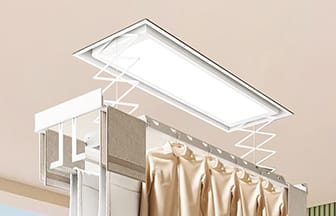
If several drying racks for laundry room layouts appear suitable, use a constraint-first approach.
Start by identifying the biggest problem in the room.
If the problem is limited floor area, move the drying function upward or onto a wall.
If walls are already occupied, prioritize ceiling space.
If high mounting positions are difficult to reach, consider a lifting or automatic system.
If the drying rack is only needed occasionally, a foldable or portable design may provide greater flexibility.
If large amounts of laundry are dried frequently, prioritize accessible hanging length, structural stability, garment spacing, and convenient loading.
If the room has several competing functions, choose a system that can retract, fold, or lift away when drying is finished.
This approach is more reliable than beginning with a particular rack style and trying to make the room adapt to it.
You can also evaluate each option against five practical questions:
- Does it preserve the space I use most often?
- Can I comfortably load wet laundry onto it?
- Can garments hang with enough separation for airflow?
- Does it interfere with appliances, cabinets, doors, or movement?
- Can the installation support the rack safely throughout regular use?
A design that answers all five questions well is usually a stronger choice than one selected primarily for maximum capacity or visual appearance.
Conclusion
The best drying racks for laundry room spaces are the ones that solve a room’s real constraints rather than simply occupying the available area.
Ceiling-mounted systems make strong use of overhead space. Wall-mounted and foldable racks can turn an unused wall into a dedicated drying zone. Freestanding designs provide flexibility without permanent installation, while automatic ceiling systems make vertical space more accessible through adjustable lifting.
The final decision should consider usable room dimensions, laundry volume, garment types, ventilation, structural conditions, and the way you move through your laundry routine.
Most importantly, look beyond maximum rack size. A well-planned system should allow garments to hang naturally, maintain useful airflow, remain easy to load, and stay out of the way when the room is being used for other tasks.
When those factors are balanced correctly, a drying rack becomes more than a place to hang clothes. It becomes part of a more organized and efficient laundry space.
FAQ
What are the best drying racks for laundry room spaces?
The best drying racks for laundry room spaces depend on available floor, wall, and ceiling area. Ceiling-mounted and automatic systems suit rooms where floor space is limited, while wall-mounted racks work well with open walls. Freestanding racks offer greater flexibility when permanent installation is unnecessary.
Are ceiling drying racks suitable for small laundry rooms?
Yes. Ceiling drying racks use overhead space that would otherwise remain unused, helping keep floors clear for appliances, baskets, storage, and movement. A lifting design can also lower the rack for easier loading before raising wet laundry away from the main working area during drying.
Are automatic drying racks better than manual drying racks?
Automatic racks are useful when convenient height adjustment and frequent use are priorities. Manual systems can provide effective drying with simpler operation. The better option depends on how often the rack is used, installation conditions, accessibility requirements, desired functions, and maintenance expectations.
How much space should be left between clothes on a drying rack?
There is no single spacing measurement suitable for every garment. Clothes should have enough separation to allow air to move around damp surfaces without excessive overlapping. Thick towels and layered garments usually require more space than lightweight shirts, so useful drying capacity matters more than maximum hanging density.
What should I check before installing a laundry room drying rack?
Check usable wall or ceiling dimensions, structural mounting conditions, door and cabinet clearance, appliance access, ventilation, loading height, garment length, and expected laundry volume. For lifting or automatic systems, also consider movement clearance, control accessibility, safety features, and maintenance access.